

Your brand has been mentioned 847 times across the web over the past three years. Maybe it's 2,400 times. Or 312. The exact number doesn't actually matter as much as this: roughly 30% of those mentions are now pointing to dead pages, redirecting to competitors, or sitting there as plain text with zero link value.
I stumbled into this problem while helping a mid-sized outdoor gear brand figure out why their referral traffic had dropped 40% over six months despite no major changes to their marketing. We discovered they'd lost active backlinks from 126 different sources — everything from old product reviews pointing to discontinued SKUs to brand mentions in industry roundups that linked to a domain variation they'd stopped using two years earlier.
The kicker? Their biggest competitor had somehow claimed 14 of those broken links by reaching out to publishers with "helpful corrections" about outdated URLs. That's $4,800 per month in estimated traffic value, just handed over without a fight.
Why backlink decay happens faster than anyone tracks
Most brands treat link building like new customer acquisition — always hunting for the next mention, the next placement, the next feature. Meanwhile, their existing link equity rots away in the background through completely preventable decay patterns.
Product pages get discontinued. Blog posts move during redesigns. Subdomains get consolidated. Marketing teams change URL structures without telling anyone. Publishers fat-finger your domain name. Writers link to the wrong page because they grabbed the first Google result without checking.
The outdoor gear brand I mentioned? They'd changed their URL structure twice in three years. First from /products/category/item to /shop/item, then to /gear/item when they rebranded. Each migration properly redirected pages... for about 18 months. Then someone "cleaned up" old redirects during a server migration, instantly breaking hundreds of historical links.
A beauty brand we worked with discovered something even worse. They'd been mentioned in Allure, Cosmopolitan, and about forty smaller beauty blogs over five years. But half those mentions linked to http:// instead of https://, and their redirect wasn't configured properly. They were essentially invisible to anyone clicking through from those massive media placements.
The real damage compounds over time. Each broken link doesn't just lose you that single click — it trains Google that mentions of your brand lead to poor user experiences. Publishers who linked to you once see the 404s in their own analytics and become less likely to link again. Your domain authority slowly bleeds out through a thousand tiny cuts.
The discovery operation that captures lost value
Traditional backlink audits focus on competitive analysis and new opportunities. A reclamation workflow flips this — you're mining your existing brand equity for quick wins that should've never been lost.
Stop losing visibility in search results.
GoSeofy helps you monitor, analyze, and improve your SEO performance with ease.
- Comprehensive keyword tracking
- Backlink quality monitoring
- Real-time SEO performance reports
No credit card required
Start with a multi-source discovery approach:
-
Brand mention monitoring without links Set up tracking for every variation of your brand name, including common misspellings. We use a priority scoring system based on domain authority and estimated traffic. A mention from a DR70+ site without a link gets immediate attention. A mention from someone's personal blog might wait for a batch outreach round.
-
404 detection across referring domains Pull your complete backlink profile from multiple tools (they all miss different links). Then systematically check every single destination URL. Not just whether it redirects — check where it redirects to. Brands accidentally redirect to category pages instead of specific products all the time, losing all conversion intent.
-
Lost link forensics Compare your backlink profile month over month. When links disappear, investigate why. Did the page get deleted? Did they update the article? Did they switch to linking to a competitor? Each pattern needs a different recovery approach.
-
Competitive hijacking alerts Monitor when competitors get linked from domains that previously linked to you. This usually happens in resource pages and "best of" lists that get updated annually. The moment you spot the switch, you have a narrow window to reach out before it becomes established.
-
Everything feeds into a single priority queue with clear action triggers.
Everything feeds into a single priority queue with clear action triggers.
| Discovery Type | Priority Score | Action Trigger | Outreach Template | Success Rate |
|---|---|---|---|---|
| Unlinked brand mention (DR70+) | 95 | Immediate | Friendly correction | 67% |
| 404 from media site | 90 | Within 24 hours | Technical assistance | 58% |
| Redirecting to wrong page | 85 | Within 48 hours | Helpful update | 71% |
| Lost to competitor | 88 | Within 48 hours | Value proposition | 34% |
| Unlinked mention (DR40-69) | 60 | Weekly batch | Brand introduction | 43% |
| Old product mention | 55 | Monthly batch | Product update | 28% |
The scoring system seems basic but it transforms random discovery into systematic reclamation. Without it, teams chase whatever they noticed most recently instead of what actually drives traffic.
Pro-tip: Pull your complete backlink profile from multiple tools — they all miss different links.
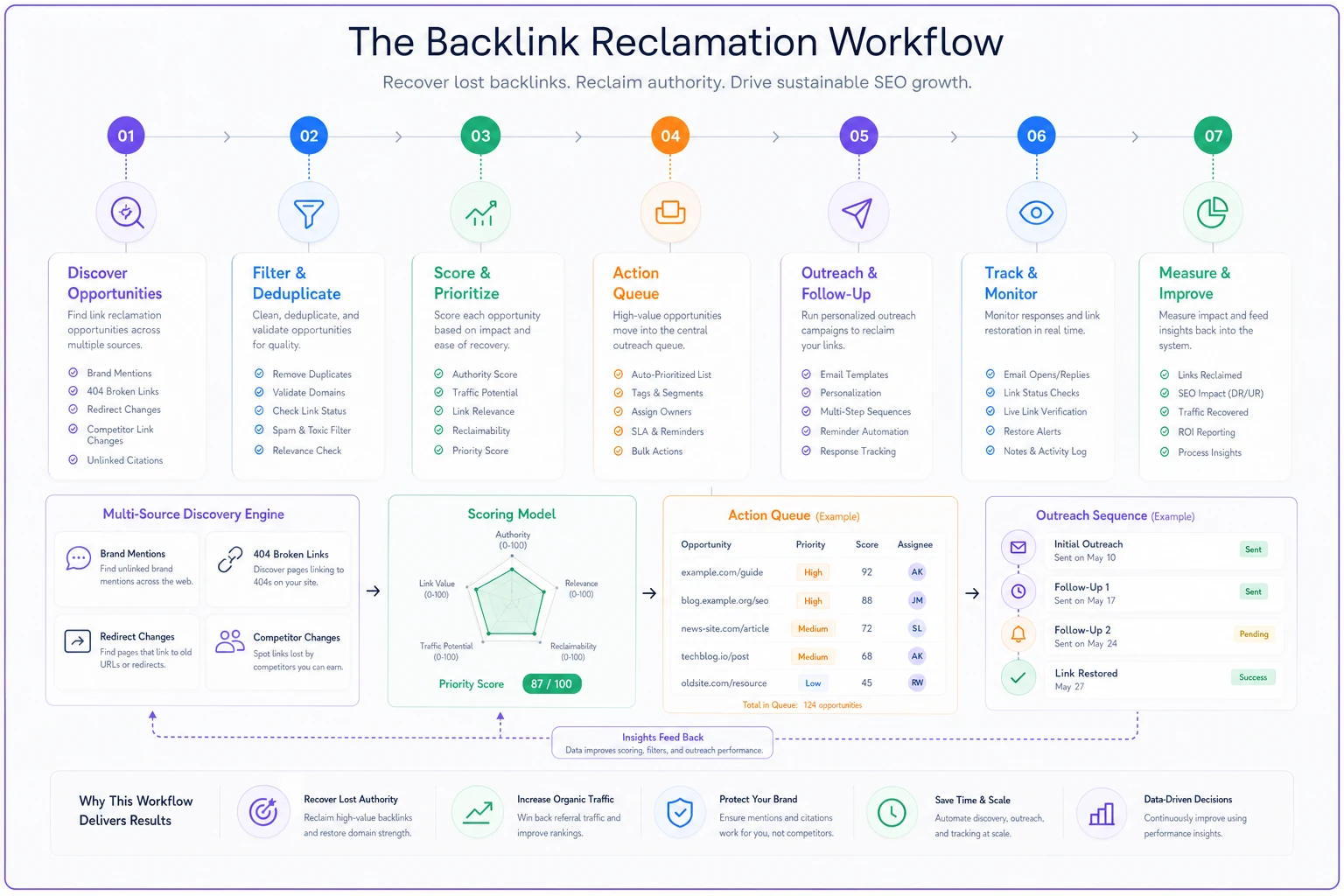
This image shows the flow from discovery through prioritization to outreach and measurement, all feeding back into the queue.
Outreach that doesn't feel like begging
Publishers don't owe you anything. Your job is to make their content better while happening to reclaim your link.
Skip the sob story about needing links. For unlinked brand mentions:
"Noticed you mentioned our [product] in your guide about [topic]. Readers commenting seem confused about where to find it — here's the direct link if you want to add it: [URL]. Also attached our latest product images if you want to update those 2019 photos."
For 404 errors, become their technical support:
"Your article about [topic] has been sending us great traffic, but heads up — the link is hitting a 404 since we redesigned. The new URL is [URL]. I checked your other links to us and they're all working fine. Let me know if you need anything else updated while you're in there."
For competitive hijacking situations, you need a different angle entirely. Don't mention the competitor. Instead, provide new value:
"Saw your annual [topic] guide just updated — looking great. We just released [specific thing] that your readers keep asking about in the comments. Here's early access before we announce it publicly next week: [URL]. Happy to do an exclusive quote if you're updating the article anyway."
Notice what's missing? Begging. Explanation of what backlinks are. SEO jargon. Mention of rankings or domain authority. Multiple follow-ups. Fake urgency.
The response rates tell the story. Generic "please link to us" templates convert around 8-12%. The value-first templates above run 34-71% depending on the scenario. The difference is treating publishers like partners, not link dispensers.
Measurement beyond just "links reclaimed"
Most reclamation campaigns track the wrong metrics. They count total links recovered, maybe domain authority, then call it a success. But a DR85 link from a dead industry directory drives less actual value than a DR45 link from an active niche blog whose readers actually buy.
Week 1-4: Immediate traffic recovery Track referral traffic from each reclaimed link. Compare it to historical traffic from that source when the link was working. We typically see 40-60% immediate recovery, with full recovery taking 2-3 months as crawlers re-establish the connection.
Month 2-3: Search visibility impact Monitor rankings for branded searches and the specific topics mentioned in reclaimed content. High-authority reclamations usually show ranking improvements within 60 days, especially for longer-tail branded queries.
Month 3-6: Revenue attribution Track assisted conversions through reclaimed links. The outdoor gear brand discovered their reclaimed links drove $67,000 in revenue over six months — not from direct clicks, but from improved domain authority lifting their entire search presence.
Ongoing: Decay prevention value Calculate what you're NOT losing anymore. If you were hemorrhaging 10 links per month and now you're catching them before they break, that's compound value that traditional ROI calculations miss.
Brands that implement systematic reclamation see their overall link velocity improve even without additional link building. Publishers who get helpful fixes become more likely to link again. Your domain becomes "safer" to link to because publishers trust you'll maintain your URLs properly.
The PR handoff that most teams fumble
Backlink reclamation workflows usually die at the transition from discovery to outreach to relationship building. SEO finds the opportunities, sends some emails, then... nothing systematic happens with the relationships formed.
The beauty brand successfully reclaimed 44 high-value beauty blog links. Six months later, they'd lost 31 of them again because no one maintained those publisher relationships. The bloggers updated their resource pages, switched to newer brands, or simply removed old content.
Build a proper handoff system:
-
For media mentions These go straight to PR with full context. Include the original mention, the fix that was made, and the publisher's response. PR can then add them to their media list for future announcements.
-
For industry resources Marketing owns these relationships long-term. They need quarterly check-ins to ensure resource pages stay updated and to provide new assets when relevant.
-
For customer-created content Customer success should know when customers mention you (even incorrectly). They can reach out with support, turning a broken link into a success story.
-
For partnership mentions Business development needs visibility into which partners actively promote you versus just having a logo on their site. Broken partner links often signal deeper relationship issues.
Without these handoffs, you're just playing whack-a-mole with broken links instead of building sustainable link equity.
When automation makes sense (and when it destroys relationships)
The discovery part of backlink reclamation screams for automation. Checking thousands of URLs, monitoring brand mentions, tracking competitor movements — that's exactly where AI-powered operational software excels. You want machines handling the detection so humans can focus on relationships.
But brands consistently screw up by trying to automate the outreach too.
A SaaS company implemented fully automated link reclamation emails. Their recovery rate dropped from 51% to 7% in two months. Publishers started marking their domain as spam. One major tech blog publicly called them out for sending eight identical emails about the same broken link. The damage to their brand reputation far exceeded any SEO value they might've gained.
The sweet spot is semi-automated workflows. AI handles discovery and prioritization. It drafts initial outreach templates based on context. It tracks responses and triggers follow-ups. But humans review and personalize every single publisher interaction.
Think of it like customer service. You want automation handling ticket routing and initial responses, but complex issues need human judgment. Same principle applies to publisher relationships — they're too valuable to risk with pure automation.
The compound effect everyone misses
Most brands think about backlink reclamation as a one-time cleanup project. Audit your links, fix what's broken, move on. That mindset leaves enormous value uncaptured.
The outdoor gear brand now runs reclamation workflows monthly. In year two, they're finding 70% fewer broken links because publishers learned they actively maintain their web presence. Their domain authority increased 12 points, not from new link building but from preserving existing equity. Referral traffic grew 340% as old mentions became active pathways again.
The real compound effect happens in brand perception. Publishers remember brands that help them fix problems. Customers notice when every mention of your brand actually leads somewhere useful. Google's algorithms definitely notice when your link graph stays healthy instead of decaying.
A subscription box company started reclamation workflows to fix immediate traffic losses. A year later, their brand mention volume had increased 4x without additional PR spend. Publishers who'd experienced their helpful outreach started mentioning them proactively, knowing the brand would ensure links stayed current.
The operational reality check
Setting up a backlink reclamation workflow isn't technically complex. The tools exist. The templates are proven. The value is measurable. So why do most brands still ignore their decaying link equity?
Because it requires operational discipline that most marketing teams lack. It's not sexy like a new campaign. It doesn't have the immediate dopamine hit of viral content. It's maintenance work that prevents problems rather than creating visible wins.
Brands that succeed treat reclamation like they treat email list hygiene or customer database management — an essential operational function that runs continuously in the background. They assign clear ownership, set measurable KPIs, and build systematic workflows that don't rely on someone remembering to check.
Start small if you need to. Pick your top 100 referring domains and check them monthly. Set up alerts for your top 5 brand variations. Dedicate just two hours per week to outreach. Even this minimal effort typically recovers thousands in monthly traffic value.
The brands losing the most from link decay are often the ones with the longest history and strongest brand equity. Every year they've been in business is another year of mentions that might've broken. Every product launch, every PR campaign, every piece of content marketing — they all create links that eventually need reclamation.
Your backlink reclamation workflow doesn't need to be perfect on day one. It just needs to exist. Because right now, while you're reading this, somewhere on the internet a link to your brand just broke. A publisher just updated their resource page and removed you. A competitor just claimed a mention that should've been yours.
The question isn't whether you need backlink reclamation. It's whether you'll build the operational discipline to do it systematically, or keep letting your link equity slowly bleed away while you chase new mentions that will eventually break too.
Ready to elevate your search rankings?
Join 5,000+ businesses using GoSeofy to increase organic traffic, optimize content, and outperform competitors online.