



Most content audits end the same way. Someone exports all the pages, marks hundreds for deletion in a spreadsheet, then either chickens out completely or nukes everything at once and watches organic traffic crater for months.
The real problem isn't identifying what to prune—it's executing without tanking your rankings.
After running content pruning programs for dozens of sites, the difference between success and disaster comes down to one thing: treating it like a controlled experiment instead of spring cleaning. You need scoring rules that actually predict impact, pilot designs that limit blast radius, and monitoring that catches problems before they compound.
Why content pruning turns into traffic disasters
Content accumulates like inventory in a warehouse. Old product pages, outdated blog posts, duplicate location pages, thin category pages—they pile up year after year. Eventually someone realizes half the site gets zero traffic and decides to clean house.
The execution usually goes sideways in predictable ways.
First, people rely on basic traffic metrics. They look at pages with zero sessions in the last 90 days and assume they're safe to delete. What they miss: those pages might have valuable backlinks passing authority to other pages. They might rank for long-tail keywords that convert but don't show up in standard reports. They might be seasonal content that explodes during specific periods.
Second, the consolidation logic breaks down. Someone decides to merge five similar blog posts into one "ultimate guide." Sounds smart until you realize each post ranked for different keyword variations. Now instead of ranking position 3-7 for five terms, you rank position 15 for one term. Total traffic drops 80%.
Third, nobody plans for rollback. They delete 500 pages on Friday afternoon and come back Monday to find organic traffic down 30%. Now what? The pages are gone from the index. The redirects are live. The internal links are broken. Reversing course takes weeks and traffic never fully recovers.
Building scoring rules that actually predict impact
The standard approach—looking at traffic and calling it a day—misses critical signals. You need a multi-factor scoring system that weighs real risk indicators.
Stop losing visibility in search results.
GoSeofy helps you monitor, analyze, and improve your SEO performance with ease.
- Comprehensive keyword tracking
- Backlink quality monitoring
- Real-time SEO performance reports
No credit card required
Start with traffic, but segment it properly. Don't just look at total sessions. Break it down:
-
Organic sessions (last 12 months)
-
Organic sessions (last 30 days)
-
Seasonal patterns (compare month-over-month for 2 years)
-
Traffic quality (bounce rate, time on page, conversion events)
A page with 10 sessions per month that converts at 5% is worth more than a page with 500 sessions and 95% bounce rate.
Layer in backlink signals. Pull your backlink data and map it to URLs. Look for:
-
Total referring domains
-
Domain authority of linking sites
-
Anchor text relevance
-
Link velocity (new links in last 90 days)
Pages with zero traffic but strong backlinks should be consolidated, not deleted. Those links can boost other pages if you redirect properly.
Check indexation status and crawl patterns. Use your log files to see:
-
Last Googlebot crawl date
-
Crawl frequency
-
Indexation status in Search Console
-
Pages in sitemap vs indexed
If Google actively crawls and indexes a page, deleting it sends negative quality signals. Better to improve it or consolidate it.
Score based on content overlap and cannibalization. Run a content similarity analysis across your pages. When you find clusters of similar content:
-
Map which keywords each page ranks for
-
Identify the strongest performer in each cluster
-
Check if they compete for the same terms
Your scoring matrix should look something like this:
| Factor | High Risk (Keep/Improve) | Medium Risk (Consolidate) | Low Risk (Delete) |
|---|---|---|---|
| Organic Traffic | >100 sessions/month | 10-100 sessions/month | <10 sessions/month |
| Backlinks | >5 referring domains | 1-5 referring domains | 0 referring domains |
| Conversions | Any conversion events | Engagement but no conversions | No engagement |
| Crawl Frequency | Crawled weekly | Crawled monthly | Not crawled in 90+ days |
| Content Quality | >1000 words, unique | 500-1000 words, some overlap | <500 words, high overlap |
| Internal Links | >10 internal links | 3-10 internal links | <3 internal links |
Weight these factors based on your business model. Ecommerce sites might weight conversion signals higher. Publishers might prioritize traffic volume. B2B sites might focus on keyword intent matching.
Designing pilots that limit blast radius
Never prune everything at once. Start with a controlled pilot that lets you measure impact before scaling.
Pick a test segment that represents your broader content but won't tank the business if something goes wrong. Good pilot candidates: old blog posts from 3+ years ago, location pages for closed locations, product pages for discontinued items, event pages from past years, tag and author archive pages.
Size your pilot at roughly 5-10% of total pruning candidates. If you identified 1,000 pages to prune, start with 50-100. This gives you enough data to measure impact without risking significant traffic.
Wave 1 (Weeks 1-2): Delete the absolute garbage
-
Pages with zero traffic, zero backlinks, zero internal links
-
Test pages, staging content that got indexed
-
Duplicate content with no redirection value
Wave 2 (Weeks 3-4): Simple consolidations
-
Merge similar location pages
-
Combine thin product variations
-
Consolidate date-based archives
Wave 3 (Weeks 5-6): Complex consolidations
-
Merge competing blog posts
-
Combine overlapping category pages
-
Consolidate related FAQ content
Monitor daily during the pilot. You need to catch problems fast. Set up automated alerts for organic traffic drops >10% day-over-day, 404 errors spiking in Search Console, crawl errors increasing, core page rankings dropping.
Document every action with timestamps. Keep a detailed log: URL pruned, action taken (delete, redirect, noindex), date/time of change, traffic before action, backlinks before action.
This documentation becomes your safety net if you need to rollback.
Consolidation patterns by page type
Different page types need different consolidation strategies. What works for blog content destroys product pages.
Blog post consolidations
The classic mistake: merging everything into mega-guides. These 5,000-word monsters rarely outperform focused content.
Instead, look for topic clusters that complement each other: beginner guide + advanced guide = comprehensive guide with clear sections, how-to post + tools post + examples post = complete implementation guide, multiple posts on same topic from different years = updated definitive version.
When consolidating blogs, keep the URL of the strongest performer, 301 redirect others to it, preserve unique sections from each post, update publish date to most recent, add editor's note explaining the consolidation.
Product page consolidations
Never merge active products, even if similar. Instead, focus on color variations with individual pages, size variations without inventory, discontinued models of same product line, bundle pages that duplicate individual products.
Create a single canonical page and redirect variations to it. Keep variation info in dropdowns or tabs, not separate URLs.
Location page consolidations
Local pages need special handling. Don't just redirect closed locations to your homepage—Google sees this as soft 404s.
Better approach: redirect closed locations to a "service area" page, redirect duplicate city pages to state/region pages, consolidate neighborhood pages into city pages, merge low-value zip code pages into city pages.
Preserve the local content value by including a section like "Previously served areas" with the old location info.
Category and tag consolidations
These multiply like rabbits on most sites. You end up with categories like "SEO," "Search Engine Optimization," "SEO Tips," and "SEO Strategy"—all competing.
Map your taxonomy overlap:
-
Export all categories/tags with post counts
-
Identify semantic duplicates
-
Check which ones actually get traffic
-
Merge weak performers into strong ones
-
Update all posts to use consolidated taxonomy
Update all posts to use consolidated taxonomy
Rollback triggers and recovery procedures
Even careful pilots sometimes go sideways. You need clear triggers for when to abort and how to recover.
Set automatic rollback triggers: organic traffic drops >20% week-over-week, core landing pages lose >10 ranking positions, 404 errors exceed 5% of pruned pages, Search Console shows manual actions, conversion rate drops >15%.
When you hit a trigger, don't panic-reverse everything. First, identify the specific problem.
Run a quick analysis. Which pruned pages had the most traffic loss? Are 301s resolving correctly? Did any high-value pages get accidentally pruned? Are redirects creating chains or loops?
For targeted rollback, restore the specific problem pages from backup, remove redirects for those URLs, re-submit to Google through Search Console, update internal links back to original URLs, monitor recovery over next 48 hours.
If targeted rollback doesn't work within 48 hours, execute full rollback: restore all pruned content from backup, remove all redirects from pilot, revert sitemap to pre-pilot version, force crawl through Search Console, document what went wrong for next attempt.
Most rollbacks recover 80-90% of traffic within two weeks if executed quickly. The longer you wait, the harder recovery becomes.
Monitoring templates that catch problems early
You can't monitor everything manually. Set up automated tracking that flags issues before they cascade.
Create a dashboard with these key metrics:
Daily monitoring: total organic sessions, organic sessions to pruned URLs (should be zero or redirected), 404 error count, 301 redirect count, average position for top 100 keywords.
Weekly monitoring: pages indexed vs submitted in sitemap, crawl budget usage, new vs returning organic users, organic conversion rate, page speed scores (redirects add latency).
Monthly monitoring: backlink profile changes, domain authority trends, keyword ranking distribution, share of voice vs competitors.
Build a simple tracking spreadsheet:
| Week | Organic Traffic | vs Previous Week | 404 Errors | Crawl Budget | Conversions | Notes |
|---|---|---|---|---|---|---|
| Baseline | 25,000 | - | 45 | 10,000/day | 750 | Pre-pilot |
| Week 1 | 24,500 | -2% | 125 | 9,500/day | 735 | Deleted 50 pages |
| Week 2 | 24,200 | -1.2% | 89 | 9,800/day | 740 | Redirects stabilizing |
| Week 3 | 24,800 | +2.5% | 52 | 10,200/day | 765 | Positive movement |
Set up email alerts for anomalies: traffic drops >10% day-over-day, 404 spikes >50 per day, core page rankings drop >5 positions, crawl errors exceed 100, index coverage issues in Search Console.
You need to catch problems in the first 48 hours. After that, Google's systems start treating changes as permanent and recovery gets harder.
When content pruning actually makes sense (and when it doesn't)
Not every site needs aggressive pruning. Sometimes the risk outweighs the reward.
Good candidates for pruning: sites with 1000+ pages but <100 getting traffic, publishers with years of outdated content, ecommerce sites with discontinued product pages, multi-location businesses with closed locations, sites recovering from content farm penalties.
Bad candidates for pruning: new sites under 18 months old, sites with steady traffic growth, highly seasonal businesses outside their season, sites preparing for migration or redesign, domains with pending algorithm updates.
The timing matters as much as the selection. Don't prune during holiday shopping seasons, major algorithm updates, site migrations or redesigns, peak business periods, right before funding rounds or acquisitions.
Scale gradually based on pilot results
Once your pilot succeeds, resist the urge to prune everything immediately. Scale in controlled increments.
If your pilot removed 100 pages successfully: next wave 200 pages, following wave 400 pages, final wave remaining pages.
Keep the same monitoring rigor at each stage. What works for 100 pages might break at 1,000.
Adjust your approach based on pilot learnings. If redirects caused issues, try noindex tags instead. If consolidations failed, stick to deletions. If certain page types caused problems, exclude them. If timing was wrong, wait for better window.
Document your pruning program results: total pages pruned, traffic impact (positive or negative), crawl budget improvement, page speed improvements, ranking improvements for remaining pages.
These metrics help justify the program and guide future iterations.
Making pruning sustainable with operational systems
Manual pruning programs happen once then get abandoned. To maintain content quality long-term, you need operational systems that prevent accumulation.
Modern AI-powered operational software changes how businesses approach content management. Instead of massive quarterly pruning projects, you can build workflows that continuously evaluate and flag content for review.
An automated workflow might run daily checks on all pages for traffic/engagement metrics, weekly flags for pages below thresholds, monthly consolidation recommendations, quarterly full content audit reports.
An automated workflow might look like this.
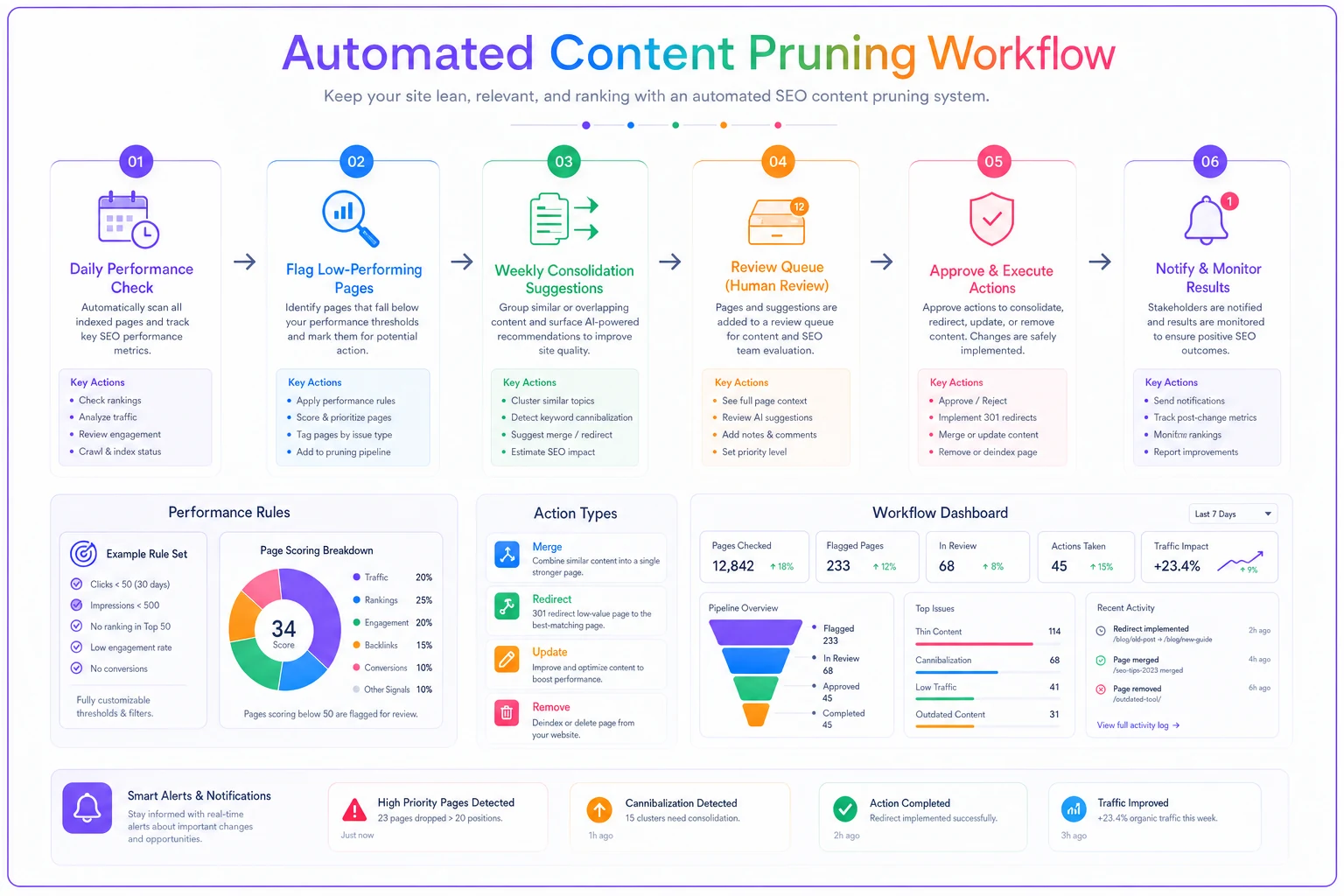
This shifts content pruning from reactive cleanup to proactive maintenance. Instead of discovering 1,000 dead pages after three years, you catch and address them within months.
The operational discipline also improves content creation. When teams know content gets reviewed regularly, they create more thoughtfully. Quality improves because everyone knows weak content won't hide forever in the site architecture.
The difference between pruning and growth
Most people miss this about content pruning: it's not about having less content. It's about having better content that actually serves a purpose.
Every page on your site either helps or hurts. There's no neutral. Dead pages dilute your authority, waste crawl budget, and confuse users who land on thin content.
But pruning without a plan is just destruction. You need scoring systems to identify what matters. You need pilots to test your assumptions. You need monitoring to catch problems. And you need rollback plans when things go wrong.
Sites that maintain quality over time don't run massive pruning projects every few years. They build operational systems that continuously evaluate and improve content. They catch problems early, consolidate strategically, and maintain focus on what actually drives value.
Start small with your pilot. Measure everything. Keep your rollback ready. The goal isn't perfection on the first try—it's learning what works for your specific situation and building systems to maintain quality as you scale.
Ready to elevate your search rankings?
Join 5,000+ businesses using GoSeofy to increase organic traffic, optimize content, and outperform competitors online.