



Most SEO teams change title tags based on gut feeling. They update a page, watch rankings bounce around for three weeks, then panic-revert everything when organic traffic dips 15%. No control group, no significance testing, just anxiety and guesswork.
Running controlled metadata experiments isn't complicated. You need sample size calculations, measurement queries that actually capture what changed, and engineering guardrails so you don't accidentally deindex half your site during a test. The teams that get this right see 20-30% CTR improvements without the ranking volatility that makes everyone nervous.
Why metadata tests fail before they even start
The core mistake happens in test design. Someone decides to test "emoji in title tags" across 500 pages simultaneously. No holdback group. No pre-test baseline. No way to separate seasonal changes from test impact. When rankings shift—and they always shift—you can't tell if your test caused it or if Google just updated something.
Even worse, teams test on their highest-traffic pages first. One ecommerce site tested new title formats on their top 100 category pages, saw a 12% traffic drop in week two, and immediately rolled back. They never knew if that drop was temporary ranking flux or actual negative impact because they had no control group running the original titles.
The measurement side breaks down too. Most teams check rankings and traffic, maybe CTR if they remember. But they miss the critical stuff: impression share changes, query distribution shifts, cannibalization patterns. You need queries that capture the full impact, not just the obvious metrics.
Building a low-risk testing framework
Start with segmentation. Never test on all your pages at once. Break your site into statistically similar groups—pages with comparable traffic, similar ranking positions, matching search intent. An online course platform might segment by course category, ensuring each test group has pages ranking between positions 5-15 with 1,000-5,000 monthly impressions.
Stop losing visibility in search results.
GoSeofy helps you monitor, analyze, and improve your SEO performance with ease.
- Comprehensive keyword tracking
- Backlink quality monitoring
- Real-time SEO performance reports
No credit card required
Your test/control split matters more than most people realize. A 50/50 split seems logical but often leaves you underpowered for detection. For pages with lower impression volumes, consider 70/30 or even 80/20 test/control splits. You need enough data in your test group to detect meaningful changes.
Calculate required sample sizes before launching anything. Here's the basic framework:
For CTR tests:
-
Baseline CTR
4%
-
Minimum detectable effect
0.5% absolute change
-
Statistical power
80%
-
Significance level
95%
-
Required impressions per variant
~31,000
For ranking tests:
-
Baseline position
8.0
-
Minimum detectable effect
1.0 position change
-
Statistical power
80%
-
Significance level
95%
-
Required days of data
~14-21 depending on query volume
Most teams underestimate how long tests need to run. A local business directory tested new title formats on city landing pages. With only 200-300 impressions per day per page, they needed six weeks to reach statistical significance. They initially planned for two weeks.
A simple workflow for the testing process:
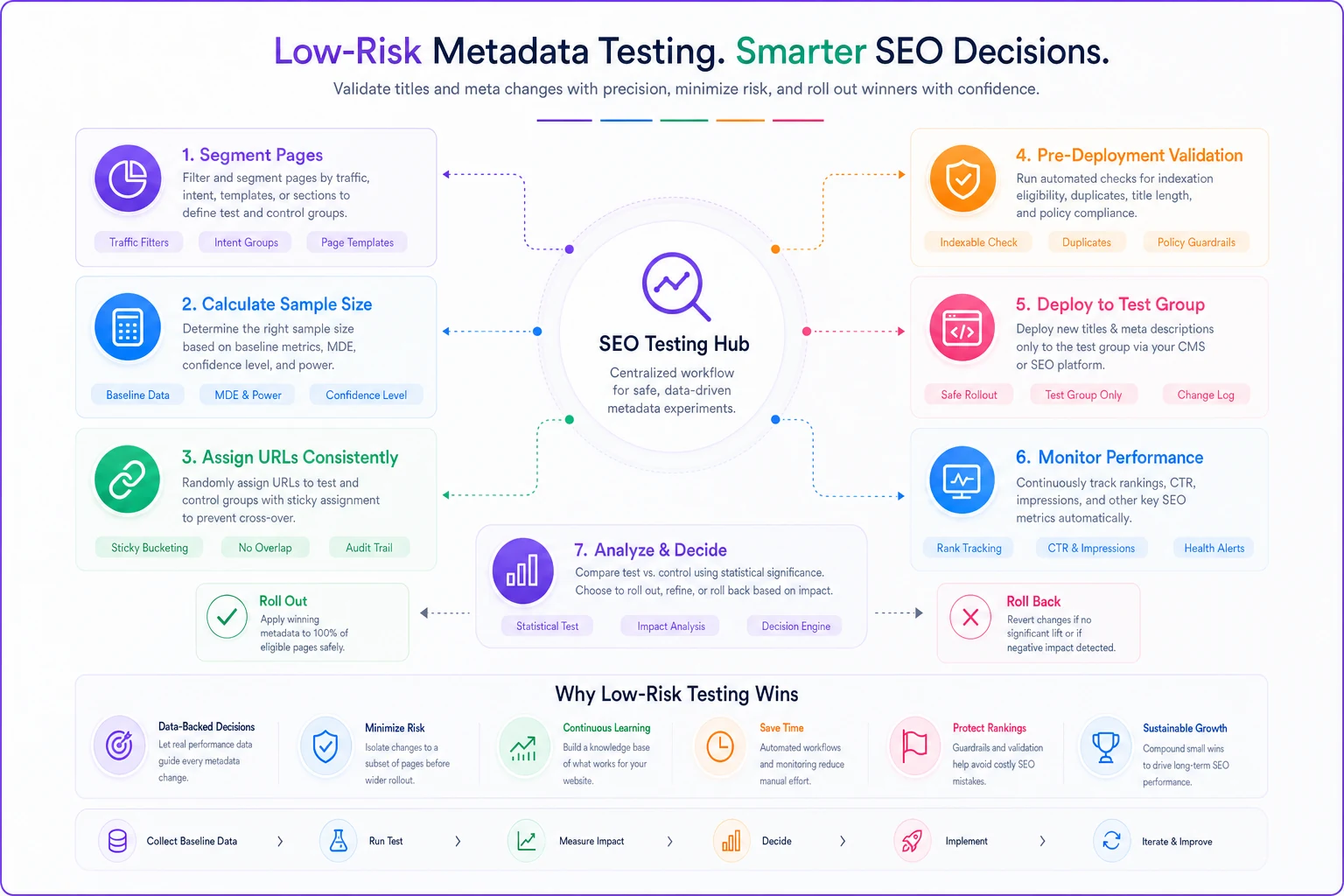
| Sample Size Guidelines |
|---|
| For CTR tests: - Baseline CTR: 4% |
| Minimum detectable effect: 0.5% absolute change |
| Statistical power: 80% |
| Significance level: 95% |
| Required impressions per variant: ~31,000 |
| For ranking tests: - Baseline position: 8.0 |
| Minimum detectable effect: 1.0 position change |
| Statistical power: 80% |
| Significance level: 95% |
| Required days of data: ~14-21 depending on query volume |
This approach ensures consistent assignment—a URL always stays in the same group even if you rerun the script. Critical for avoiding contamination.
Sample test scripts that actually work
Here's a title variation test that balances risk and learning potential:
Test Setup: Ecommerce Category Pages
Original format:
[Category] - [Count] Products | [Brand]
Example: "Running Shoes - 847 Products | SportStore"
Test variant:
[Category]: Shop [Count]+ Styles with Free Shipping | [Brand]
Example: "Running Shoes: Shop 850+ Styles with Free Shipping | SportStore"
``python
import hashlib
import pandas as pd
def assigntestgroup(url, testpercentage=30):
# Consistent assignment based on URL hash
urlhash = hashlib.md5(url.encode()).hexdigest()
hashint = int(urlhash[:8], 16)
if (hashint % 100) < testpercentage:
return 'test'
return 'control'
def generatetesttitle(pagedata):
if pagedata['testgroup'] == 'control':
return f"{pagedata['category']} - {pagedata['productcount']} Products | {pagedata['brand']}"
# Round up product count for test variant
roundedcount = round(pagedata['productcount'], -1)
return f"{pagedata['category']}: Shop {roundedcount}+ Styles with Free Shipping | {pagedata['brand']}"
# Track assignments for analysis
testassignments = pd.DataFrame()
testassignments['url'] = pageurls
testassignments['group'] = [assigntestgroup(url) for url in pageurls]
testassignments['implementationdate'] = datetime.now()
``
This approach ensures consistent assignment—a URL always stays in the same group even if you rerun the script. Critical for avoiding contamination.
Measurement queries that capture real impact
Basic GSC exports won't cut it. You need queries that segment properly and capture indirect effects.
Primary measurement query (BigQuery):
``sql
WITH testdata AS (
SELECT
date,
url,
query,
device,
impressions,
clicks,
position,
CASE
WHEN url IN (SELECT url FROM testgroupurls WHERE group = 'test') THEN 'test'
ELSE 'control'
END as testgroup
FROM
searchconsole.searchdata
WHERE
date >= DATESUB(CURRENTDATE(), INTERVAL 60 DAY)
AND datatype = 'WEB'
)
SELECT
testgroup,
DATETRUNC(date, WEEK) as week,
COUNT(DISTINCT url) as pages,
SUM(impressions) as totalimpressions,
SUM(clicks) as totalclicks,
SAFEDIVIDE(SUM(clicks), SUM(impressions)) as ctr,
AVG(position) as avgposition,
APPROXQUANTILES(position, 100)[OFFSET(50)] as medianposition,
COUNT(DISTINCT query) as uniquequeries
FROM
test_data
GROUP BY
1, 2
ORDER BY
2 DESC, 1
``
Cannibalization check query:
``sql
WITH rankedurls AS (
SELECT
query,
url,
SUM(impressions) as queryimpressions,
ROWNUMBER() OVER (PARTITION BY query ORDER BY SUM(impressions) DESC) as rank
FROM
searchconsole.searchdata
WHERE
date >= DATESUB(CURRENTDATE(), INTERVAL 30 DAY)
GROUP BY
1, 2
)
SELECT
query,
COUNT(DISTINCT CASE WHEN queryimpressions > 100 THEN url END) as urlsover100impressions,
MAX(queryimpressions) as topurlimpressions,
SUM(CASE WHEN rank > 1 THEN queryimpressions ELSE 0 END) as cannibalizedimpressions
FROM
rankedurls
WHERE
query IN (SELECT DISTINCT query FROM testqueries)
GROUP BY
1
HAVING
COUNT(DISTINCT url) > 1
``
Track everything in a spreadsheet, but automate the data collection. Manual tracking introduces errors and nobody maintains it past week two.
Engineering guardrails to prevent disasters
The worst metadata test disasters happen from implementation errors, not bad test ideas. A travel site accidentally set all their test group pages to noindex when deploying new titles through their CMS. Took three days to notice, two weeks to recover rankings.
Build these checks into your deployment process:
Pre-deployment validation:
-
Title length stays under 60 characters
-
No duplicate titles within test group
-
Critical keywords remain in title
-
No special characters that break HTML
-
Brand name consistently formatted
Add a quick canonical and robots check to pre-deployment validation to catch accidental noindex or canonical changes.
Post-deployment monitoring:
``python
def validatedeployment(testurls, validationwindowhours=6):
alerts = []
# Check robots.txt isn't blocking test URLs
for url in testurls:
if isblockedbyrobots(url):
alerts.append(f"CRITICAL: {url} blocked by robots.txt")
# Verify pages return 200 status
for url in testurls:
status = checkhttpstatus(url)
if status != 200:
alerts.append(f"WARNING: {url} returns {status}")
# Confirm title actually changed
for url in testurls:
currenttitle = fetchpagetitle(url)
expectedtitle = testassignments[testassignments.url == url]['newtitle']
if currenttitle != expectedtitle:
alerts.append(f"Title mismatch on {url}")
# Check for rendering issues
for url in testurls[:10]: # Sample check
rendered = checkjavascriptrendering(url)
if not rendered:
alerts.append(f"Rendering issue on {url}")
return alerts
``
Set up automated monitoring that checks every four hours for the first week. A recruitment platform caught a caching issue where their CDN was serving old titles to Googlebot but new titles to users. Without monitoring, they would've run the entire test on bad data.
When to kill a test (and when to let it run)
Early test results mislead everyone. Rankings fluctuate naturally—sometimes dramatically—in the first 5-7 days after any change. A SaaS company killed a promising title test after four days when rankings dropped from position 6 to position 9. Three weeks later, their control group pages dropped to the same positions. Not the test, just normal volatility.
Set kill criteria before launching:
-
Traffic drops >30% sustained for 7+ days
-
Rankings drop >5 positions across >50% of test pages
-
CTR decreases >25% with statistical significance
-
Technical errors affect >10% of test group
Don't kill tests for:
-
Ranking fluctuations in first week
-
Small CTR changes without significance
-
Isolated page performance issues
-
Seasonal traffic patterns
Document everything in a test log. Include why you killed tests, not just that you did. A marketplace site discovered their "failed" tests all had one thing in common—they removed price indicators from titles. That pattern insight was worth more than any single test success.
Scaling beyond basic title tests
Once your framework runs smoothly, expand testing scope. Meta descriptions impact CTR but not rankings—perfect for aggressive testing. One education site tested adding "Updated [Month Year]" to descriptions for their guide content. CTR jumped 18% on pages where the content actually was recently updated, dropped 8% on older content. Clear segmentation opportunity they never would've found without testing.
Structure your testing calendar:
-
Weeks 1-2
Baseline measurement, segment identification
-
Weeks 3-6
First test deployment, daily monitoring
-
Weeks 7-8
Results analysis, winner selection
-
Week 9
Full rollout or rollback
-
Week 10
Post-implementation monitoring
Run overlapping tests once you have confidence. Just maintain clean segmentation—never test multiple variables on the same URLs simultaneously. An online marketplace runs 3-4 metadata tests continuously across different page types. Their testing velocity means they evaluate 40+ variations per year versus the 2-3 most teams manage.
Making test insights operational
Test results mean nothing if they don't change your operations. Build new title guidelines from winning tests. Update your CMS templates. Train content creators on what works.
A business software company discovered adding the publication year to their guide titles improved CTR by 22% for content less than 12 months old. They built this logic directly into their CMS:
``python
def generatedynamictitle(pagedata):
basetitle = pagedata['title']
# Add recency indicator for fresh content
if pagedata['lastupdated'] > datetime.now() - timedelta(days=365):
year = datetime.now().year
basetitle = f"{basetitle} ({year} Guide)"
# Add rating if available and high
if pagedata.get('avgrating', 0) >= 4.5:
rating = round(pagedata['avgrating'], 1)
basetitle = f"{basetitle} - {rating}★ Rated"
return basetitle[:57] + "..." if len(basetitle) > 60 else basetitle
``
This automation ensures every new page benefits from test learnings immediately. No manual implementation, no inconsistency, no forgotten pages.
Track test impact over time. CTR improvements sometimes decay as users get used to new formats. A job board saw their emoji title test maintain strong performance for four months, then slowly decline back to baseline by month six. They now rotate title formats quarterly based on test results.
Teams that succeed with metadata testing treat it as an operational capability, not a one-time project. They have documented processes, automated measurements, and clear decision frameworks. Most importantly, they test continuously—because search behavior evolves and what worked last year might not work today.
Testing metadata changes doesn't require complex infrastructure or huge traffic volumes. You need a systematic approach, proper measurement, and patience to let tests run to completion. The 20-30% CTR improvements from successful tests compound over time. Three or four wins per year can transform your organic performance without touching a single backlink or content piece.
Start with your category pages or guide content—pages with decent traffic but not your absolute money makers. Run one clean test with proper controls. Document everything. Once you see the impact of systematic testing versus random changes, you won't go back to updating titles based on hunches.
Ready to elevate your search rankings?
Join 5,000+ businesses using GoSeofy to increase organic traffic, optimize content, and outperform competitors online.