



SEO operations break at scale for the same reason warehouse operations do—everyone thinks they know how to do it until the volume doubles. You start with one person managing keywords and content, then suddenly you've got product teams shipping features that tank page speed, engineers redirecting URLs without documentation, and content teams publishing articles that cannibalize each other's rankings. The problem isn't the people. It's that SEO touches every part of the digital operation, but nobody treats it like the cross-functional system it actually is.
Why SEO becomes operational chaos at scale
Most companies handle SEO the way restaurants handle inventory before they implement proper systems—everyone does their own thing and hopes it works out. The content team publishes whatever feels right. Engineering makes technical changes without considering search impact. Product launches new features that create duplicate content issues.
This works fine when you're publishing 10 pages a month. But scale to 100 pages monthly, add multiple product lines, or have three different teams all trying to rank for similar keywords, and the whole thing falls apart.
Take a B2B software company I worked with recently. They were pulling in decent traffic—about 38K monthly visitors. When they decided to scale content production, disaster struck. Three separate teams started creating content without talking to each other. Their blog team created an email automation guide. Product marketing made a similar one. Customer success published help docs targeting identical keywords.
They were basically competing against themselves. Meanwhile, their engineering team rolled out a site redesign and changed URL structures without setting up redirects. Two months of content disappeared from search results overnight. All because nobody created a simple ticket system for changes that could affect SEO.
What actually breaks when SEO scales
The breakdown happens in predictable spots. Technical debt piles up faster than you can track it. Every new feature, site update, or structural change creates potential SEO problems. Without systems to track and prioritize these issues, you end up with hundreds of small problems that turn into major ranking disasters.
Stop losing visibility in search results.
GoSeofy helps you monitor, analyze, and improve your SEO performance with ease.
- Comprehensive keyword tracking
- Backlink quality monitoring
- Real-time SEO performance reports
No credit card required
Content coordination becomes a nightmare. Different teams target the same keywords. Old content never gets updated. New content ignores established patterns. You might have 50 articles about "customer service tips" scattered across your blog, help center, and resource library, all fighting for the same search terms.
Nobody owns the outcomes. Marketing blames engineering for site speed issues. Engineering blames content for duplicate problems. Content blames product for not providing keyword research. Everyone's responsible, which means nobody's accountable.
Then there's the measurement problem. One team celebrates traffic increases while another team's conversions tank. Product teams launch features that improve user experience but hurt search visibility. Without shared metrics and clear ownership, every team optimizes for their own goals while sabotaging overall SEO performance.
Building the operational foundation
The solution isn't hiring an SEO manager and hoping they figure it out. You need operational infrastructure—the same way you'd build systems for customer service or inventory management.
SEO Operations Governance Structure
Technical SEO ownership sits with engineering, but with clear escalation paths. Any code deployment that touches URL structures, page templates, or site architecture needs SEO review. This isn't about slowing down releases—it's about having a two-minute checklist before pushing changes live.
Content SEO ownership stays with marketing, but with coordination requirements. Before any team publishes content targeting commercial keywords, they check a simple shared spreadsheet. Takes 30 seconds, prevents months of cannibalization problems.
Strategic SEO ownership needs a dedicated point person—doesn't have to be full-time initially, but someone who can see across all teams. They don't do all the SEO work; they make sure the work gets coordinated.
The ticket system that actually gets used
Most SEO ticket systems fail because they're either too complex or too vague. Engineers ignore tickets that say "improve SEO" and marketers can't fill out 20-field technical forms. You need templates that match how people actually work.
Technical SEO Ticket Template
Issue Type: [Page Speed / Indexation / Structure / Other] Affected URLs: [Specific pages or patterns] Current Impact: [Traffic numbers or specific metric] Proposed Fix: [One sentence description] Success Metric: [What improves when fixed] Priority Score: [1-5 based on scoring matrix below]
Content SEO Request Template
Target Keyword: [Primary focus] Search Intent: [What user wants] Existing Content: [URLs targeting similar terms] Business Goal: [Lead gen / Education / Support] Launch Date: [When going live] Review Needed By: [Date for SEO check]
The magic happens in the priority scoring. Without it, everything becomes urgent and nothing gets done.
| Factor | Points |
|---|---|
| Affects over 1,000 monthly sessions | 3 |
| Impacts conversion pages | 2 |
| Quick fix (under 2 hours) | 2 |
| Blocking other improvements | 1 |
| Regulatory/compliance related | 3 |
Score 7+ = This sprint Score 4-6 = Next sprint Score under 4 = Backlog
Keep ticket templates short and field-focused so non-technical contributors can complete them quickly.
This seems simple, but it solves the biggest operational problem: deciding what to fix first. A slow-loading product page affecting 5,000 monthly visitors gets fixed before some perfect technical issue on a rarely-visited support article.
Service level agreements that prevent surprises
SLAs for SEO sound corporate, but they're really just promises about response times. They prevent marketing from waiting three weeks for a redirect that engineering could implement in five minutes.
Internal SEO SLAs
Technical implementations:
-
Critical fixes (broken pages, lost traffic)
24 hours
-
Standard improvements
5 business days
-
Major structural changes
Planned in quarterly roadmap
Content reviews:
-
Keyword conflict checks
Same day
-
Content optimization review
48 hours
-
Competitive analysis
5 business days
Reporting and insights:
-
Traffic alerts
Real-time via automated monitoring
-
Performance reports
Weekly automated, monthly detailed
-
Strategic reviews
Quarterly with all stakeholders
These aren't random timelines. They match actual business impact. A broken high-traffic page needs immediate attention. A content optimization request can wait two days. Everyone knows what to expect.
The onboarding program that scales knowledge
Every new hire who touches the website needs SEO context, but you can't run individual training sessions forever. Build curriculum that scales.
Week 1: SEO Fundamentals (All Teams)
-
30-minute video
How search impacts our business
-
Hands-on
Find our site in search results
-
Assignment
Identify one SEO improvement opportunity
Week 2: Team-Specific Training
For Engineers:
-
Technical SEO checklist walkthrough
-
How to test SEO impact before deployment
-
Common pitfalls in our tech stack
For Content Teams:
-
Keyword research using our tools
-
Content optimization process
-
How to check for cannibalization
For Product Teams:
-
SEO implications of feature launches
-
User experience vs search visibility tradeoffs
-
How to include SEO in product requirements
Week 3: Cross-Team Collaboration
-
Shadow an SEO review meeting
-
Complete one SEO ticket (with guidance)
-
Present learning to team
You're not trying to make everyone an SEO expert. You want everyone to understand how their work affects search visibility. The engineer who knows that changing URL structures breaks backlinks will create redirects without being asked. The content creator who understands keyword cannibalization will check existing content before publishing.
Automation and AI in SEO operations
Modern SEO operations get interesting when you add automation. AI-powered operational platforms handle the repetitive analysis that used to eat up hours of human time. Instead of manually checking hundreds of pages for technical issues, these systems continuously scan and prioritize problems. Instead of spreadsheet gymnastics to find keyword opportunities, automated workflows identify gaps and opportunities across your entire content library.
Automation works best when it enhances human decision-making rather than replacing it. An AI-assisted operational platform can alert you when page speed drops below thresholds, identify when new content might cannibalize existing rankings, or flag technical issues before they impact traffic. Humans still make strategic decisions—the AI just makes sure nothing falls through the cracks.
This illustrates the workflow from automated detection to prioritized ticketing and team assignment.
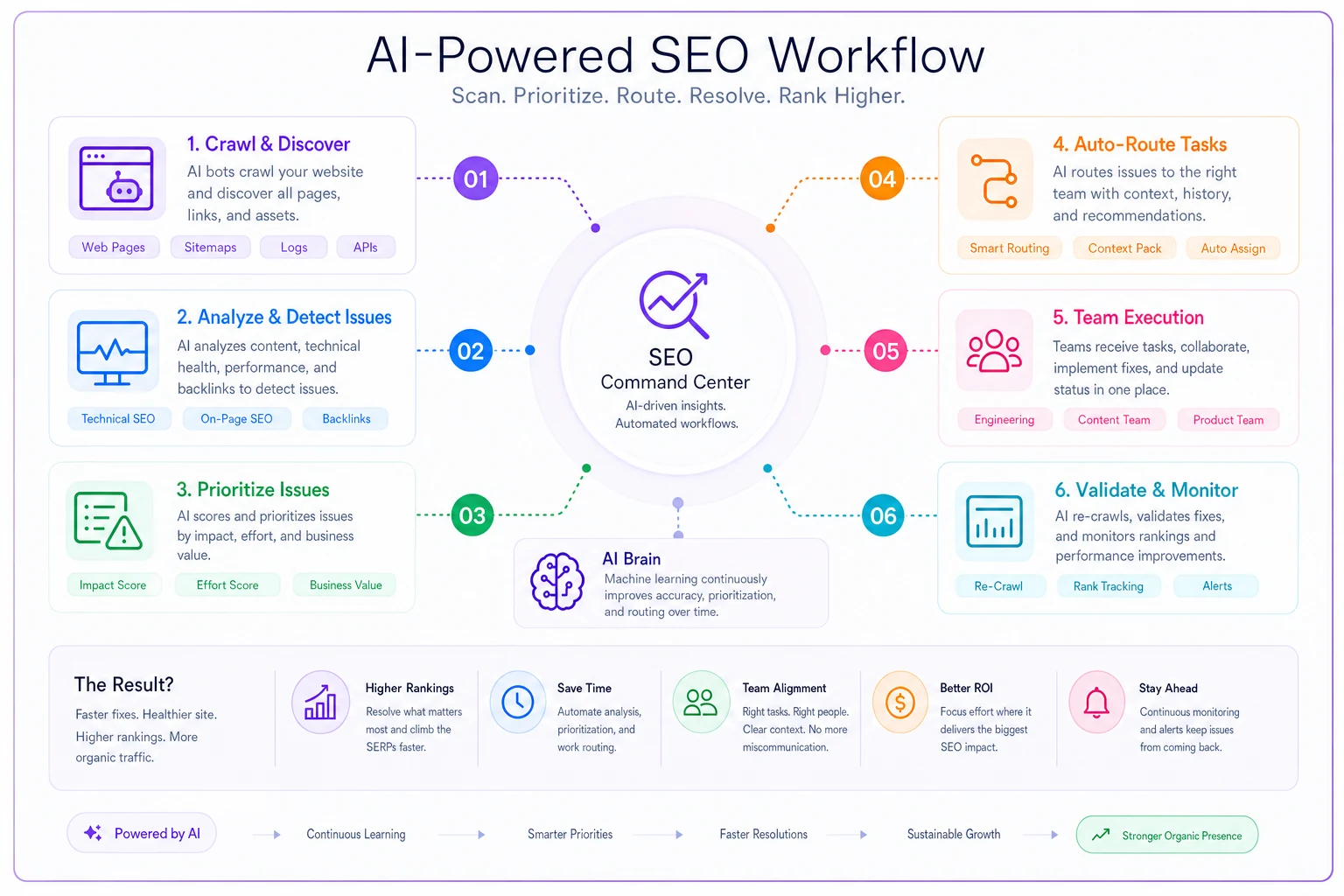
Think of it like inventory management software for SEO. The system tracks everything, alerts you to problems, and suggests optimizations. Your team focuses on strategy and creation rather than manual monitoring and reporting.
Making it work across different business models
The exact implementation varies by business type, but the operational principles stay consistent.
Ecommerce sites focus more on product page optimization and category structure. Your ticket templates include fields for product SKUs and seasonal priorities. Your SLAs account for sale periods and inventory changes.
B2B SaaS companies emphasize feature pages and comparison content. The governance model includes product marketing more heavily. The onboarding curriculum covers how feature releases affect search visibility.
Local service businesses need operational focus on location pages and review management. The priority scoring weights local search factors higher. The automation monitors local pack rankings and competitor movements.
The framework adapts, but the core remains: clear ownership, systematic coordination, and scalable processes.
The compound effect of operational discipline
Good SEO operations create compound improvements. Each fixed technical issue makes the next content piece perform better. Each optimized article makes the site stronger. Each trained team member prevents future problems.
A marketing agency I know implemented this operational approach after years of scattered SEO efforts. They started with about 14,800 monthly organic visitors, spread across hundreds of unfocused pages. Six months after implementing proper operations—ticket systems, SLAs, clear ownership—they hit 43,200 monthly visitors. Not from publishing more content, but from making existing content work properly.
The technical debt got addressed systematically. Old high-potential articles got updated. New content targeted gaps instead of overlapping existing pages. Teams stopped accidentally sabotaging each other's work.
Most importantly, the improvements stuck. When new people joined, they inherited working systems instead of mysterious tribal knowledge. When traffic dipped, they had processes to diagnose and fix issues. When opportunities emerged, they could move fast without breaking things.
Building your SEO operations playbook
You don't need to implement everything at once. Start with the biggest pain point—usually either technical issues piling up or content coordination falling apart.
Begin with simple templates and basic SLAs. Get teams used to the new workflow. Add sophistication as you scale. The goal isn't perfection on day one. It's creating systems that improve continuously.
Most businesses avoid operational discipline around SEO because it seems complex. But the complexity comes from not having systems, not from implementing them. When everyone knows their role, when processes are clear, when accountability exists—SEO becomes just another smooth-running part of the business operation.
The companies winning at organic search aren't necessarily the ones with the best content or the most links. They're the ones who treat SEO as an operational discipline, build systems that scale, and execute consistently over time. That's not magic. It's operations.
Ready to elevate your search rankings?
Join 5,000+ businesses using GoSeofy to increase organic traffic, optimize content, and outperform competitors online.