


The hardest part of local SEO at scale isn't ranking factors. It's that you're managing the same 12 data points across 40, 80, or 300 locations, and every one of those data points is being touched by someone who doesn't report to you.
A regional manager updates store hours on Facebook but forgets Google Business Profile. A franchisee "improves" their landing page and accidentally deletes the schema. Someone in accounts payable cancels a Yext subscription and 90 citations quietly drift out of sync over six weeks. None of these are SEO problems in the technical sense. They're governance problems that show up as ranking problems. So this is really about the boring stuff — templates you can deploy without a developer, a citation audit that catches drift before it costs you, and a clear line on what corporate controls versus what the location controls.
Why multi-location SEO fails as an operations problem, not a ranking problem
When a single location loses local visibility, you usually find one of these underneath:
-
The NAP (name, address, phone) doesn't match across directories, so Google's confidence in the entity drops.
-
Two locations are competing for the same city term because nobody drew a service-area boundary.
-
The landing page is a corporate template that got "customized" locally until it lost its structured data.
-
Reviews are being requested inconsistently — one location asks every customer, another asks nobody.
None of these require an algorithm update to hurt you. They're the natural result of distributed ownership without a system. What tends to happen across chain and franchise setups is that visibility doesn't collapse — it erodes. A location drops from the map pack in one city, then another, and by the time someone notices the revenue dip, you're untangling six months of uncoordinated edits.
The mental shift that helps: treat each location like a record in a database, not a webpage. Records have owners, allowed fields, and validation rules. Once you think that way, the rest of this becomes pretty straightforward.
Copy-and-deploy landing page templates that survive local editing
The most common failure with multi-location pages is over-templating that produces doorway-like sameness, or under-templating that lets every location reinvent the page and break the parts that matter.
Stop losing visibility in search results.
GoSeofy helps you monitor, analyze, and improve your SEO performance with ease.
- Comprehensive keyword tracking
- Backlink quality monitoring
- Real-time SEO performance reports
No credit card required
The goal is a template where locked elements can't be touched and local elements have to be filled in. Here's a practical split:
| Element | Ownership | Locked or editable | Why |
|---|---|---|---|
| Page title / H1 pattern | Central | Locked structure, local variables | Keeps {Service} in {City} consistent |
| LocalBusiness schema | Central | Auto-generated from data source | Humans always break JSON-LD |
| NAP block | Central (fed by data) | Locked display, editable source record | Single source of truth |
| Local intro paragraph | Local | Editable, min/max length | Needs genuine local relevance |
| Photos | Local | Editable, required minimum | Real storefront > stock |
| Reviews / testimonials | Local | Auto-pulled | Freshness and trust |
| Staff / team section | Local | Optional | Adds uniqueness |
| Embedded map | Central | Auto from lat/long | Prevents wrong-pin errors |
Schema should be generated, not hand-edited. The moment a non-technical person opens the page editor, they will eventually delete a closing bracket. Feed schema from the same structured record that populates the NAP block. If the address changes in one place, it changes everywhere, including the JSON-LD.
Generate schema from the canonical record so no one has to edit JSON-LD by hand.
A deployable template is only "deployable" if a marketing coordinator with no coding background can spin up a new location page in under 20 minutes. If it requires a developer, you don't have a scaling system — you have a bottleneck that gets worse every time you open a new store.
The uniqueness problem people underestimate
Location pages that differ only by city name are the fastest way to get a whole folder of thin pages ignored. The fix isn't spinning content — it's requiring genuinely local inputs: parking details, neighborhoods served, actual staff, real photos, location-specific FAQs. Make those fields required in the template. If the location can't provide them, that tells you something about whether the page is ready to go live.
The citation audit process (and how drift actually happens)
Citations don't break loudly. They drift. A typical pattern: a location moves 400 meters into a bigger unit. Corporate updates Google and the website. Nobody touches the 40+ aggregators, the old Yelp listing, the chamber of commerce page, or the two industry directories a former employee submitted three years ago. Now you have two addresses floating in the ecosystem for one business, and Google has to guess which is real.
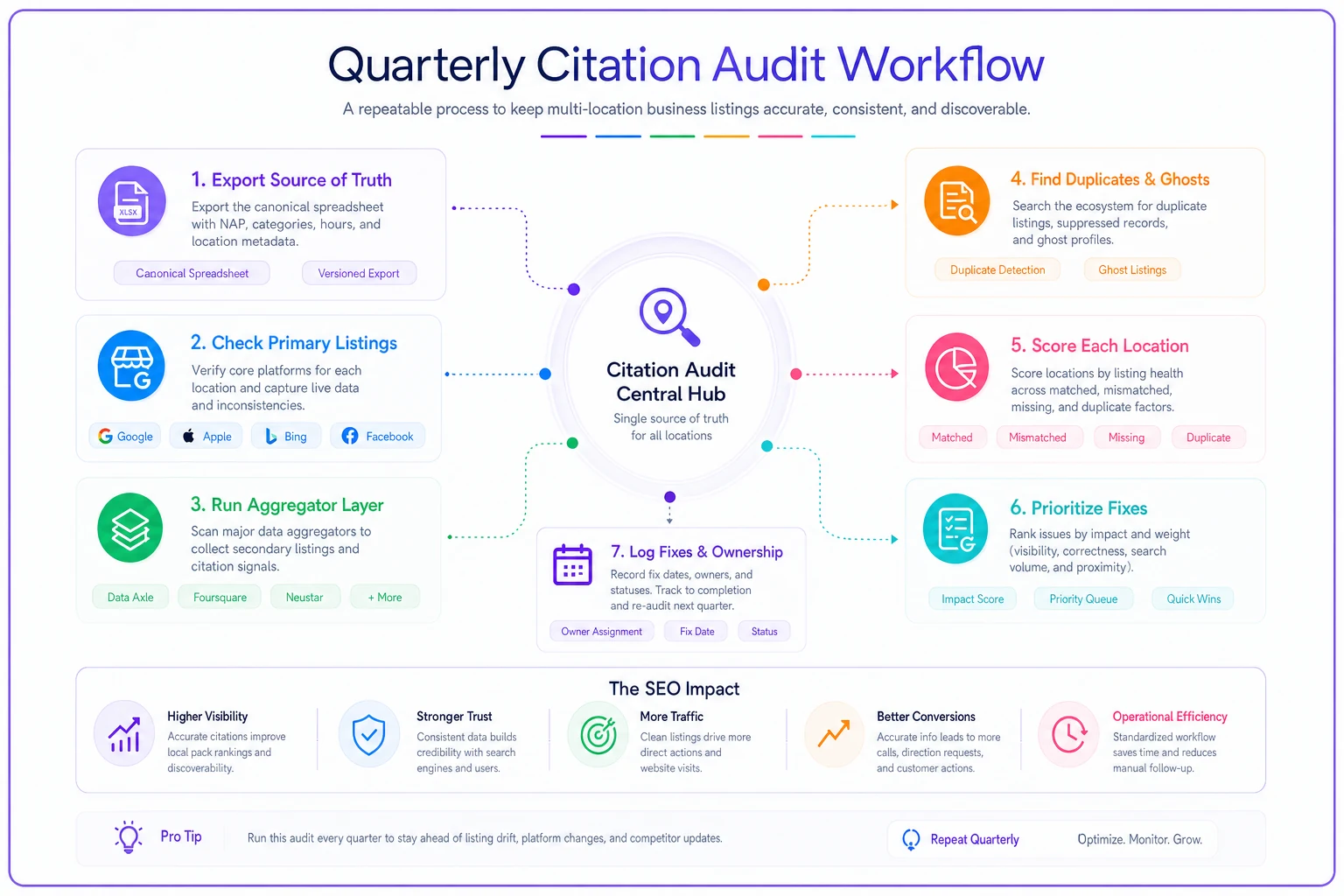
Here's a citation audit you can actually run quarterly:
-
Export your source of truth. One spreadsheet, one row per location, canonical NAP plus hours and categories. This is what everything gets checked against.
-
Pull the primary listings first. Google Business Profile, Apple Business Connect, Bing Places, Facebook. These carry the most weight and get the most informal local edits.
-
Run the aggregator layer. Data amplifiers feed hundreds of smaller directories. Check the four or five that matter for your region and let them propagate.
-
Search for duplicates and ghost listings. Query the brand plus old addresses and old phone numbers. Old listings from closed locations are silent killers.
-
Score each location. Simple
matched / mismatched / missing / duplicate. Total the mismatches per location.
-
Fix by weight, not by count. One wrong Google listing outweighs ten wrong obscure directories. Prioritize accordingly.
-
Log the fix date and who owns follow-up. Drift returns. You want to see which locations keep drifting so you can find whoever's causing it.
Below is a visual workflow of the citation audit process.
Most citation problems trace back to one or two locations generating the bulk of the errors — usually because of a recent move, a rebrand, or a manager who edits things on their own. Find those and you've cleared 70% of the noise.
A checklist for what to verify per location
-
NAP matches source of truth exactly (including suite numbers and abbreviations)
-
Primary category consistent across Google, Apple, and Bing
-
Hours match, including holiday hours
-
Phone number is the consistent tracked one (different call-tracking numbers per directory fragments NAP)
-
Website URL points to the specific location page, not the homepage
-
No duplicate or lingering closed-location listings
-
Business description doesn't contradict itself across platforms
Most citation problems trace back to one or two locations generating the bulk of the errors — usually because of a recent move, a rebrand, or a manager who edits things on their own. Find those and you've cleared 70% of the noise.
Central vs. local governance: drawing the line before it draws itself
The reason franchise and chain SEO turns political is that nobody wrote down who controls what. When it's undefined, control gets grabbed by whoever's most motivated in the moment — usually a frustrated franchisee, and usually in a way that breaks consistency.
Here's a governance split that holds up reasonably well:
Central owns:
-
The page template and all locked structural and schema elements
-
The canonical NAP data source
-
Primary Google Business Profile management (or at minimum, admin access)
-
Review response policy and escalation rules
-
The citation audit and aggregator subscriptions
-
Category taxonomy and city/service-area boundaries
Local owns:
-
Local photos and storefront imagery
-
Responding to reviews within the central policy
-
Local intro copy, staff bios, location-specific FAQs
-
Posting local updates and offers to GBP
-
Flagging address or hours changes to central (they request, central executes)
The critical rule: locations request data changes, central executes them. The moment locations can directly edit NAP, hours, or schema, you lose your source of truth. They flag it, central updates the canonical record, and the change propagates. That one boundary prevents most of the drift described above.
When tight central control is the wrong call
If your franchisees genuinely operate as strong local marketers — and some do — locking everything down kills engagement and you end up with half-empty location pages nobody maintains. In those cases, give locations more editorial freedom on the local layer but keep an absolute lock on NAP and schema. Governance isn't about control for its own sake. It's about controlling the things that break silently when they're inconsistent.
A real scenario: a 46-location home services brand
A regional HVAC and plumbing group with 46 locations across three states had steadily declining map pack visibility despite decent ad spend. The audit surfaced the usual pattern:
-
11 locations had NAP mismatches, mostly from three that had relocated in the past year
-
7 old listings from two closed branches were still live and misrouting calls
-
Landing page schema was missing entirely on roughly a third of pages because a contractor had rebuilt them and dropped the JSON-LD
-
Review requests were happening at maybe 8 of the 46 locations
Nothing exotic. Over about a quarter they consolidated NAP into one source, regenerated schema from that source, killed the ghost listings, and moved GBP management to a central admin with local flagging. They didn't chase rankings directly.
Within four months, map pack impressions across the recovered locations came back close to where they'd been the prior year, and the relocated locations stopped losing calls to dead listings. The quieter operational win: new location openings dropped from a multi-week SEO scramble to a same-week deployable page, because the template and data flow were finally defined.
Where automation quietly earns its keep
A disciplined spreadsheet and a calendar will get a 20-location brand a long way. The pain starts scaling past that, where the manual audit becomes a job nobody has time for and drift outpaces your quarterly review.
That's where operational software earns its place — pulling listing data automatically so the audit isn't a manual export every time, generating schema and NAP blocks from a single record so a human never has to touch the JSON, and flagging when a location's data diverges from the source of truth before it costs you visibility. The value isn't magic ranking gains. It's removing the manual coordination that fails silently when you're managing dozens of locations and the same three people keep editing things they shouldn't.
The principle stays the same whether you use a spreadsheet or a platform: one source of truth, locked structural elements, clear ownership, and a repeatable audit. Get those four things right and multi-location local SEO stops being a fire drill.
The brands that scale local SEO cleanly aren't the ones with the best content or the most citations. They're the ones who decided, in advance, which fields are locked, who owns each layer, and how often they check for drift.
Start with the source of truth. Build the deployable template around it so schema and NAP can't be broken by a local edit. Run the citation audit quarterly and fix by weight. Write down the central-vs-local line before someone forces the question during a bad quarter. Do that, and adding your next ten locations becomes a deployment step instead of a crisis.
Ready to elevate your search rankings?
Join 5,000+ businesses using GoSeofy to increase organic traffic, optimize content, and outperform competitors online.