


Most enterprise SEO teams didn't decide to publish AI content. It just happened. A few writers started drafting with an assistant, a product team wired up a tool to generate category descriptions, someone spun up a script that produced 4,000 location pages overnight, and suddenly half the site is machine-touched with nobody able to say which half.
That's the real problem. Not "is AI content good or bad" — that debate is mostly settled. The actual operational question is: can you tell what you published, who checked it, and whether it's helping or quietly rotting your index? Almost nobody can answer that cleanly. And when a core update hits, the teams that can't trace their own content are the ones scrambling.
AI content governance is the system that lets you scale production without losing control of quality, indexation, and measurement. It's not a policy PDF. It's a working pipeline with labels, checkpoints, scoring, and a feedback loop back to SEO outcomes. Below is how that system actually holds together — and where it tends to snap under load.
The failure pattern nobody names until it's too late
Almost always the same order.
A team starts producing AI-assisted content faster than they produce checks on that content. Output triples in a quarter. QA stays flat. The ratio of reviewed-to-unreviewed content drifts, and within a few months you've got a long tail of pages that technically exist, technically got indexed, and were never actually looked at by someone who understands search intent.
Nothing looks wrong at first. Impressions climb because you have more pages. Everyone's happy. Then Google starts sampling that tail, decides a chunk of it is thin or near-duplicate, and quietly reduces how much of your site it trusts. Now your good pages crawl slower and index worse because the junk is dragging down site-level quality signals.
The classic version of this: a marketplace generated seller-category descriptions with a template plus AI fill-ins. Around 22,000 pages went live over two quarters. Roughly 8,000 of them were 90%+ similar to each other because the AI kept producing the same three sentence structures for low-inventory categories. Indexation of their core commercial pages dropped noticeably before anyone connected it to the generated tail. The generated content wasn't penalized directly — it just lowered the ceiling for everything else.
The lesson that keeps repeating: at scale, unreviewed AI content isn't neutral. It's a liability that spreads.
Start with a labeling taxonomy — or you're governing blind
You can't QA, audit, or measure what you can't identify. The foundation of any governance system is a labeling taxonomy that tags every piece of content with its production method and review state. This is boring plumbing and it's the single highest-leverage thing most teams skip.
Stop losing visibility in search results.
GoSeofy helps you monitor, analyze, and improve your SEO performance with ease.
- Comprehensive keyword tracking
- Backlink quality monitoring
- Real-time SEO performance reports
No credit card required
At minimum, every URL (or content block) should carry:
-
Production source — fully human, AI-drafted/human-edited, AI-generated/human-reviewed, or fully automated (no human touch)
-
Content type — editorial, product description, category copy, FAQ, location page, programmatic
-
Review state — unreviewed, sampled, fully reviewed, flagged
-
Quality score — the numeric output from your scoring rubric (more on that below)
-
Last-audited date — because content decays and review state isn't permanent
The mistake people make is treating "AI vs human" as a binary. In real operations, the useful distinction isn't whether AI was involved — it's how much human judgment sits between generation and publish. A page that was AI-drafted and heavily rewritten by a subject expert is a completely different risk profile than a page generated and pushed live by a cron job. Your taxonomy has to capture that gradient, not flatten it.
Where does this metadata live? Ideally in your CMS as structured fields, mirrored into whatever data layer you already use for SEO reporting. If you've built any kind of SEO data observability — the lineage and ownership tracking that lets you trust your GSC/GA joins — this taxonomy plugs right into it.
Content labels become just another dimension you can slice indexation and performance by.
Here's a simple workflow showing how labels travel from creation into the CMS and then into your SEO reporting layer.
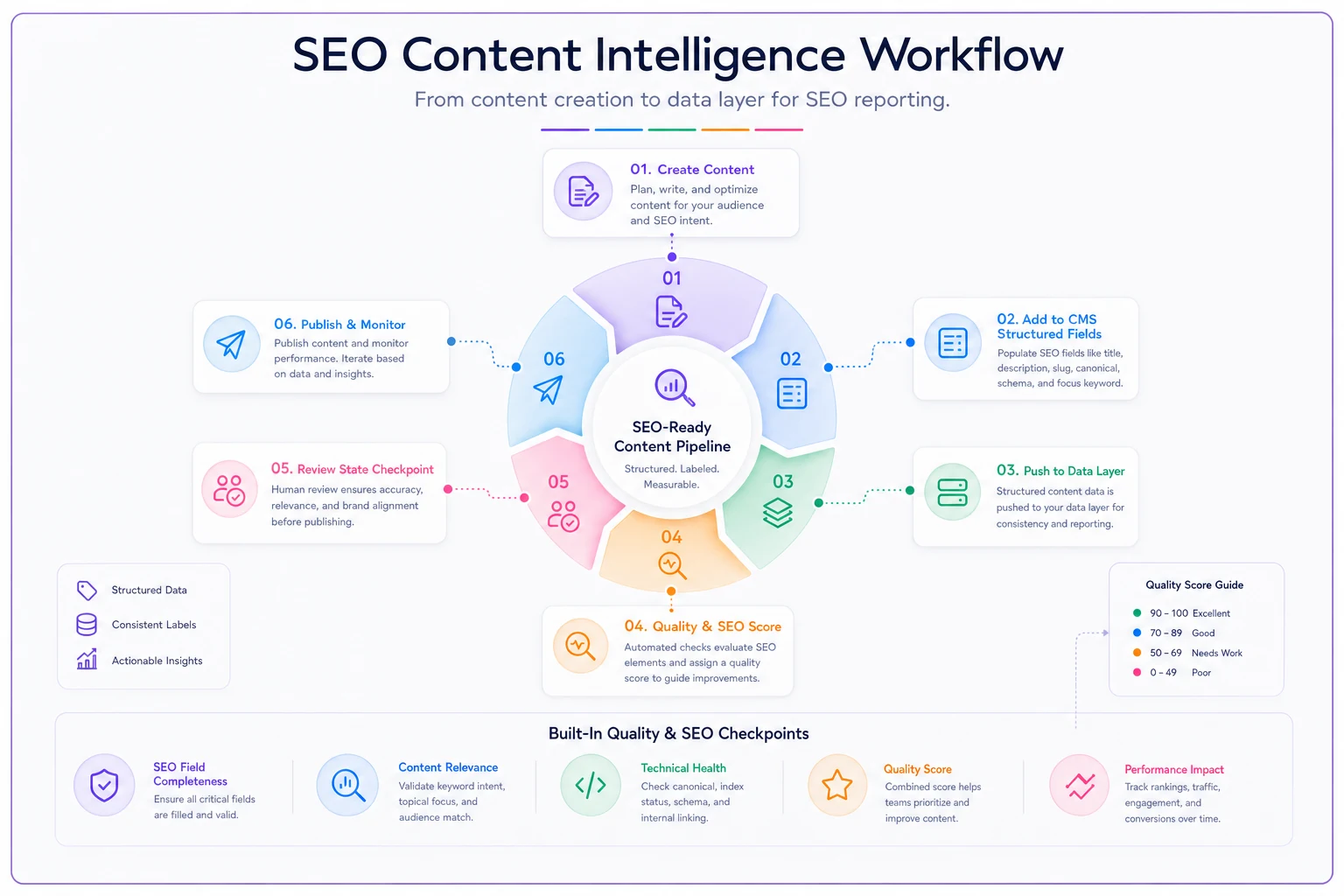
Content labels become just another dimension you can slice indexation and performance by.
Human-in-the-loop QA gates: where humans actually add value
The instinct when volume explodes is to try reviewing everything. That doesn't scale and it burns out your best people on low-stakes work. The better model is tiered gates, where the depth of human review is proportional to the risk and value of the content.
A workable gate structure:
| Content tier | Example | Review gate | Human involvement |
|---|---|---|---|
| High-stakes | Money pages, YMYL, brand-facing editorial | 100% pre-publish review | Full human edit + sign-off |
| Medium | Category copy, hub pages, comparison content | 100% pre-publish, checklist-based | Human reviews against rubric |
| High-volume templated | Product descriptions, location pages | Sample-based pre-publish + audit | Human reviews a % sample |
| Low-stakes automated | Spec tables, attribute-driven blocks | Automated validation only | Human handles exceptions/flags |
Human-in-the-loop doesn't mean humans-in-every-loop. It means humans are positioned at the points where their judgment actually changes the outcome. On high-volume templated content, one skilled reviewer checking a well-chosen sample catches systemic problems — like that duplicate-sentence issue — far more efficiently than ten reviewers each reading a handful of pages at random.
Embed the checklist in the CMS so reviewers update scores during review and you get an auditable trail.
A gate that quietly fails: reviewers who "approve" without a rubric. If you ask someone to check AI content and don't tell them exactly what to look for, they'll skim for typos and pass anything that reads smoothly. Smooth-reading garbage is exactly what modern AI produces. Your gate is only as good as the acceptance criteria behind it.
Quality scoring that means something
A quality score has to be specific enough that two different reviewers land within a point of each other. Vague 1–10 "how good is this" scores are useless — everyone anchors differently.
Build the score from concrete, checkable components. A version that holds up in practice:
-
Intent match (0–3)
Does the content actually answer the query it targets, or does it circle it?
-
Factual accuracy (0–3)
Are claims correct and, where needed, sourced? AI hallucination lives here.
-
Originality/differentiation (0–3)
Does this say something the top results don't, or is it a reshuffle of consensus?
-
Duplication risk (0–2)
Similarity against your own existing pages and against the source material.
-
Structural correctness (0–2)
Headings, schema, internal links, metadata present and correct.
-
Brand/policy compliance (0–2)
Tone, disclosures, prohibited claims.
Sum it, set a publish threshold, and — critically — log the sub-scores, not just the total. The sub-scores are what tell you where your generation process is weak. If originality scores are consistently tanking on one content type, that's a prompt or process problem you can fix at the source, not a page-by-page cleanup.
One pattern worth watching: originality is where AI content fails most quietly. Intent match and structure are easy to get right and easy to score high. Originality requires the content to contribute something, and generic AI output almost never does. Teams that only track the total score miss this because the stronger sub-scores mask the weak one.
Sampling audits: catching drift after publish
Pre-publish gates catch what's wrong at launch. They don't catch drift — the slow degradation as templates get reused in contexts they weren't designed for, as source data goes stale, or as someone tweaks a prompt and nobody re-checks the output.
Sampling audits are your ongoing quality monitoring. Run them on a schedule against your labeled content:
-
Stratify your sample by content tier and production source. Don't sample uniformly — weight toward high-volume automated content and anything that hasn't been audited recently.
-
Pull a statistically meaningful sample per stratum. For a bucket of 20,000 programmatic pages, a few hundred well-chosen pages tells you far more than a random 20.
-
Score against the same rubric you use pre-publish, so audit scores are comparable to publish scores.
-
Flag clusters, not just pages. If failures concentrate in one template or one data source, that's a systemic fix.
-
Feed results back into the labeling layer — update review state and quality score, set the next audit date.
The methodology here rhymes with what good teams already do for schema health monitoring at scale — you're not manually inspecting everything, you're sampling intelligently, detecting conflicts and clusters, and remediating at the pattern level. Same discipline, applied to content quality instead of markup.
A realistic audit finding: a home-services brand sampled their AI-assisted location pages six months post-launch. About 15% had gone stale — service areas had changed, a few listed staff who'd left, and the "areas we serve" sections referenced neighborhoods the business no longer covered. None of this had shown up in rankings yet, but it's exactly the kind of accuracy erosion that chips away at trust signals over time. The audit caught it before it became a reviews-and-reputation problem.
QA acceptance criteria that leave no wiggle room
Acceptance criteria are the contract. They define, unambiguously, what gets published and what gets sent back. Without them, "quality" is a matter of opinion and your gates leak.
Good acceptance criteria are binary wherever possible. Not "the content should be original" but:
-
Total quality score ≥ threshold, and no single sub-score at zero
-
Duplication similarity below X% against internal corpus
-
All factual claims either verifiable or removed
-
Required schema present and validating
-
Target query appears in a way that matches intent, not just keyword presence
-
No prohibited claims, proper disclosures where applicable
-
Internal links present and pointing to canonical targets
The mistake is writing criteria as aspirations instead of gates. "We aim for high originality" doesn't stop anything from publishing. "Originality sub-score must be ≥ 2 or the piece is rejected" does. If a criterion can't fail a piece of content, it's not a criterion — it's a wish.
One more thing that matters at scale: acceptance criteria should differ by content tier. Holding a spec-driven product attribute block to the same originality bar as an editorial guide makes no sense and will grind your pipeline to a halt. The criteria are strict; they're just calibrated to what each content type is supposed to do.
Tying content policy to actual SEO outcomes
This is the part that closes the loop — and the part most governance efforts never build. It's easy to measure whether content passed QA. It's harder, and far more valuable, to measure whether your content policy is producing better SEO outcomes than the alternative.
Index quality by production source. Slice indexation rate, crawl frequency, and impressions-per-indexed-page by your production-source label. If AI-generated-with-light-review pages index at a materially lower rate than AI-drafted-human-edited pages, that's a direct signal to shift your review investment.
Feature capture by quality score. Correlate rich result and SERP feature appearance against your quality sub-scores. In practice, feature capture tracks strongly with intent-match and structural-correctness scores — which validates that those parts of your rubric are pointed at the right things.
Decay curves by content type. Track how performance holds over time across production methods. A common pattern: fully-automated content ranks fine for a few weeks, then decays faster than human-edited content because it lacks the depth that earns durable position. Seeing that in your own data is what finally gets budget for review.
Cohort comparison. When you change a policy — raise a threshold, add a review gate — track the cohort of content produced under the new policy against the old one. This is the only honest way to know whether tightening governance actually improved outcomes or just slowed you down.
The point of all this measurement isn't dashboards. It's to make governance decisions with evidence instead of gut feeling. When someone argues "let's just publish it all, AI is fine now," you want to answer with your own index-quality-by-source numbers, not opinions.
Where automation genuinely helps — and where it doesn't
There's a real role for AI-assisted operational tooling inside this system, and it's not "generate the content." It's running the parts that are too high-volume for humans and too pattern-based to need them.
Duplication detection across tens of thousands of pages, first-pass rubric scoring to route content to the right review tier, flagging factual claims that need verification, monitoring published content for drift, keeping the labeling layer current as pages change — these are exactly the repetitive, scale-sensitive tasks where automation reduces manual work and cuts the mistakes that come from tired reviewers doing rote checks. The same logic applies to keeping spam and low-value content out of your index, which is why automated UGC moderation rules fit naturally into the same governance frame.
What automation should not do is make the final call on high-stakes content or replace the human judgment in your acceptance gates. The moment you let the machine both generate and approve, you've removed the only real check in the system. Governance exists precisely because generation is cheap and judgment isn't.
When a heavy governance system makes sense — and when it doesn't
Not every team needs this full apparatus. Building it prematurely is its own kind of waste.
This makes sense when:
-
You're publishing hundreds or thousands of pages a month and can't review each individually
-
You have programmatic or templated content at scale
-
You operate in a space where accuracy matters (YMYL, regulated, high-consideration purchases)
-
You've already had one indexation or quality scare and don't want a second
This is overkill when:
-
You publish a handful of carefully-edited pieces a month — just review them properly
-
Your AI usage is limited to drafting assistance on human-owned editorial
-
You're early enough that manual oversight genuinely covers your volume
Who should not do this: teams that build the taxonomy and scoring rubric but never wire it to outcomes. A governance system that produces labels and scores nobody uses to make decisions is pure overhead. If you're not going to measure content policy against index quality and feature capture, don't build the machinery — just review carefully and stay small.
A short real scenario
A mid-sized B2B software company was generating comparison and integration pages semi-programmatically — roughly 1,800 pages across product combinations. About 40% were AI-generated with a quick skim before publish. Indexation on those pages sat somewhere around 55%, and their better editorial content had started crawling less often.
They introduced a basic version of what's described above: labeled everything by production source, built a six-part scoring rubric, put a sample-based audit on the programmatic pages, and set hard acceptance criteria with a duplication threshold. Nothing exotic. It took about a quarter to fully roll out.
The immediate effect was that roughly 300 pages failed the new criteria and got consolidated or rewritten rather than left to rot. Over the following few months, indexation on the surviving programmatic set climbed into the 70s, feature capture on the reviewed cohort noticeably outpaced the old unreviewed batch, and — the part they actually cared about — crawl frequency on their money pages recovered. The win wasn't from producing more content. It was from producing content the system could actually stand behind.
The real point
AI content governance isn't about restricting output. Done right, it's what lets you safely increase output — because you have the labels to know what you shipped, the gates to keep quality above the line, the audits to catch drift, and the measurement to prove the policy is working.
Teams without this system don't publish less AI content. They just publish it blind, and pay for it later when the index turns against them. The difference between a team that scales AI content successfully and one that gets buried by it isn't the quality of their writers or their tools. It's whether they built the operational spine — taxonomy, gates, scoring, audits, acceptance criteria, measurement — before the volume forced the question. Build it early enough and scale stops being scary. Skip it, and every new batch of content is a bet you can't see the odds on.
AI content governance isn't about restricting output. Done right, it's what lets you safely increase output — because you have the labels to know what you shipped, the gates to keep quality above the line, the audits to catch drift, and the measurement to prove the policy is working.
Teams without this system don't publish less AI content. They just publish it blind, and pay for it later when the index turns against them. The difference between a team that scales AI content successfully and one that gets buried by it isn't the quality of their writers or their tools. It's whether they built the operational spine — taxonomy, gates, scoring, audits, acceptance criteria, measurement — before the volume forced the question. Build it early enough and scale stops being scary. Skip it, and every new batch of content is a bet you can't see the odds on.
Ready to elevate your search rankings?
Join 5,000+ businesses using GoSeofy to increase organic traffic, optimize content, and outperform competitors online.