



The ISM manufacturing index ticked up in October, with production growing at its fastest pace in years. The catch, as Reuters reported, is that input prices at the factory level stayed stubbornly high. More output, still-expensive materials. That combination doesn't stay on the factory floor — it travels downstream into wholesale costs, retail pricing, and eventually the little price and availability fields buried in your product schema.
For most e-commerce teams this lands at the worst possible time: a few weeks before the heaviest selling window of the year. When input costs are volatile and production is ramping, suppliers adjust prices more often, reroute stock, and discontinue SKUs without much warning. Your merchandising team reacts, your ERP updates, your storefront updates — and your structured data quietly falls out of sync somewhere in the middle. That gap is where the real damage happens.
This piece isn't about the ISM number. It's about what cost and supply volatility does to product schema specifically, why most teams don't notice until rankings or rich results have already slipped, and how to audit and harden things before the volatility hits full force.
Why manufacturing volatility is really a schema problem
The connection isn't obvious until you've watched it play out. A jump in input prices doesn't directly touch your markup. What it does is increase the frequency of change. Suppliers who repriced quarterly start repricing monthly. SKUs that sat in stock for 90 days now sell through in three weeks and go on backorder. Replacement SKUs appear with new part numbers.
Every one of those events is a write to your product data. And every write is an opportunity for your structured data to disagree with what's actually on the page.
The pattern worth internalizing: product schema breaks at the speed of change, not the speed of traffic. A low-traffic catalog that updates twice a day is far more exposed than a high-traffic one that updates weekly. Bloomberg's coverage framed October as the strongest production month since 2021 — which, read operationally, means change velocity across supplier catalogs is climbing right when your pipeline is already stressed by holiday prep.
Most schema audits assume a mostly-static catalog. That assumption quietly stops being true during cost shocks.
The three ways schema drifts during cost and stock swings
When prices and availability move fast, product schema tends to break in three distinct ways. They have different causes and different fixes, so it's worth separating them.
Stop losing visibility in search results.
GoSeofy helps you monitor, analyze, and improve your SEO performance with ease.
- Comprehensive keyword tracking
- Backlink quality monitoring
- Real-time SEO performance reports
No credit card required
1. Stale price in schema vs. live price on page. Your front-end updates from a pricing service in real time. Your structured data gets generated during a cache rebuild or a nightly feed job. During stable periods the lag doesn't matter because the price didn't change. During volatility, the visible price and the offers.price value can disagree for hours. Google re-crawls, sees a mismatch, and at scale that erodes trust in your Offer markup — sometimes dropping the price annotation entirely.
2. Availability signals that contradict each other. This is the messy one. You can simultaneously have availability: InStock in schema, an "Out of stock" button on the page, a sitemap that still lists the URL as a priority page, and a canonical pointing to a variant that's also sold out. Each system was technically correct at the moment it was written. Together they're a contradiction, and contradictions are what trigger soft 404s and wasted crawl on dead inventory.
3. SKU churn breaking entity continuity. When a discontinued product gets replaced by a new SKU, teams often spin up a brand-new URL and schema block instead of carrying forward the old page. You lose the product's history, ratings sometimes get orphaned, and the old URL lingers with InStock markup for something that no longer exists.
| Drift type | Root cause | What it breaks | Where it hides |
|---|---|---|---|
| Stale price | Schema generated on a slower cycle than live pricing | Offer trust, price annotation | Cache / feed timing |
| Availability conflict | Multiple systems writing independently | Soft 404s, crawl waste | Page vs. schema vs. sitemap |
| SKU churn | New URL per replacement product | Lost ratings, orphaned pages | Discontinued SKU tails |
The reason these are hard to catch is that no single system is "wrong." Each one is doing its job on its own schedule. The failure lives between systems.
A realistic example of what this costs
Consider a mid-sized home-goods retailer carrying roughly 9,000 active SKUs, sourcing heavily from suppliers affected by input-cost pressure. During a stable quarter they pushed maybe 40–60 price changes a week. When their suppliers started repricing in response to material costs, that jumped to somewhere around 300–400 changes a week, plus a steady stream of availability flips.
Their schema was generated during a nightly rebuild. So for most of each day, a meaningful slice of product pages carried yesterday's price in the Offer markup while displaying today's price to shoppers. Nobody flagged it internally because the storefront looked fine — the bug only existed in the structured data layer.
Over about six weeks they saw price rich results quietly thin out across a chunk of the catalog, and Search Console started reporting a rising count of "Price" and "Availability" warnings in the Merchant/Product reports. No dramatic ranking crash — just a slow bleed of enhanced listings that were converting above average. The impact landed somewhere in the low five figures of monthly revenue, mostly from losing the price annotation on pages that lived in competitive comparison-shopping territory.
The fix wasn't exotic. It was moving schema generation off the nightly cycle for price-volatile SKUs, and adding a check that compared schema price against live price before publish. But they only found the problem after the loss, which is the whole issue.
Audit first: what to check before volatility peaks
Before you build any monitoring, you need a baseline. A pre-season audit should be narrow and specific — not a generic "validate all schema" sweep, which tells you almost nothing about drift risk.
-
Price source parity. Does
offers.pricepull from the same service as the on-page price, or from a separate feed? If they're different sources, that's a drift candidate before anything even changes. -
Generation timing. How fresh is your schema at worst case? If it rebuilds nightly but pricing updates hourly, you have up to a 24-hour exposure window on any volatile SKU.
-
Availability mapping. Confirm every inventory state maps to exactly one schema value. Backorder, pre-order, limited stock, discontinued — each should resolve cleanly. Ambiguous states are where
InStockgets applied by default and lies. -
Sitemap and canonical alignment. Spot-check whether out-of-stock or discontinued URLs are still flagged high-priority in your sitemap or pointed at by canonicals.
-
Currency and priceValidUntil. Stale
priceValidUntildates can suppress rich results on their own, and they're almost never watched. -
Discontinued SKU handling. Find three recently retired products. Trace what happened to their URL, schema, and ratings. That tells you your churn pattern.
If you only do one thing from this list, make it the price source parity check. Separate sources for displayed price and schema price is the single most common root cause of the mismatch, and it's invisible in a visual QA pass.
If you only do one thing from this list, make it the price source parity check. Separate sources for displayed price and schema price is the single most common root cause of the mismatch, and it's invisible in a visual QA pass.
Hardening: moving from static validation to continuous monitoring
Auditing catches today's problems. Volatility creates new ones daily, so the real shift is from one-time validation to ongoing product schema monitoring — treating your structured data like a live signal that needs watching, not a file you publish and forget.
The practical difference is comparing schema against two moving reference points on a cadence: what the live page actually shows, and what Search Console reports back after crawling. When those three sources diverge, you want to know within hours, not after the enhanced listings have already thinned.
The mechanics worth building (or buying):
-
Fetch the rendered schema for a rotating sample of commercially-weighted URLs, prioritizing volatile and high-revenue SKUs rather than sampling evenly.
-
Compare schema price to live page price on each fetch. Any delta over a small tolerance fires an alert, scoped to the SKU.
-
Compare schema availability to on-page availability and sitemap priority to catch the contradiction class before it becomes a soft 404.
-
Poll Search Console's Product/Merchant reports for rising warning counts and correlate spikes with your recent deploy and feed-run times.
-
Score and route alerts by revenue impact, so a mismatch on a hero product escalates while a long-tail blip gets batched.
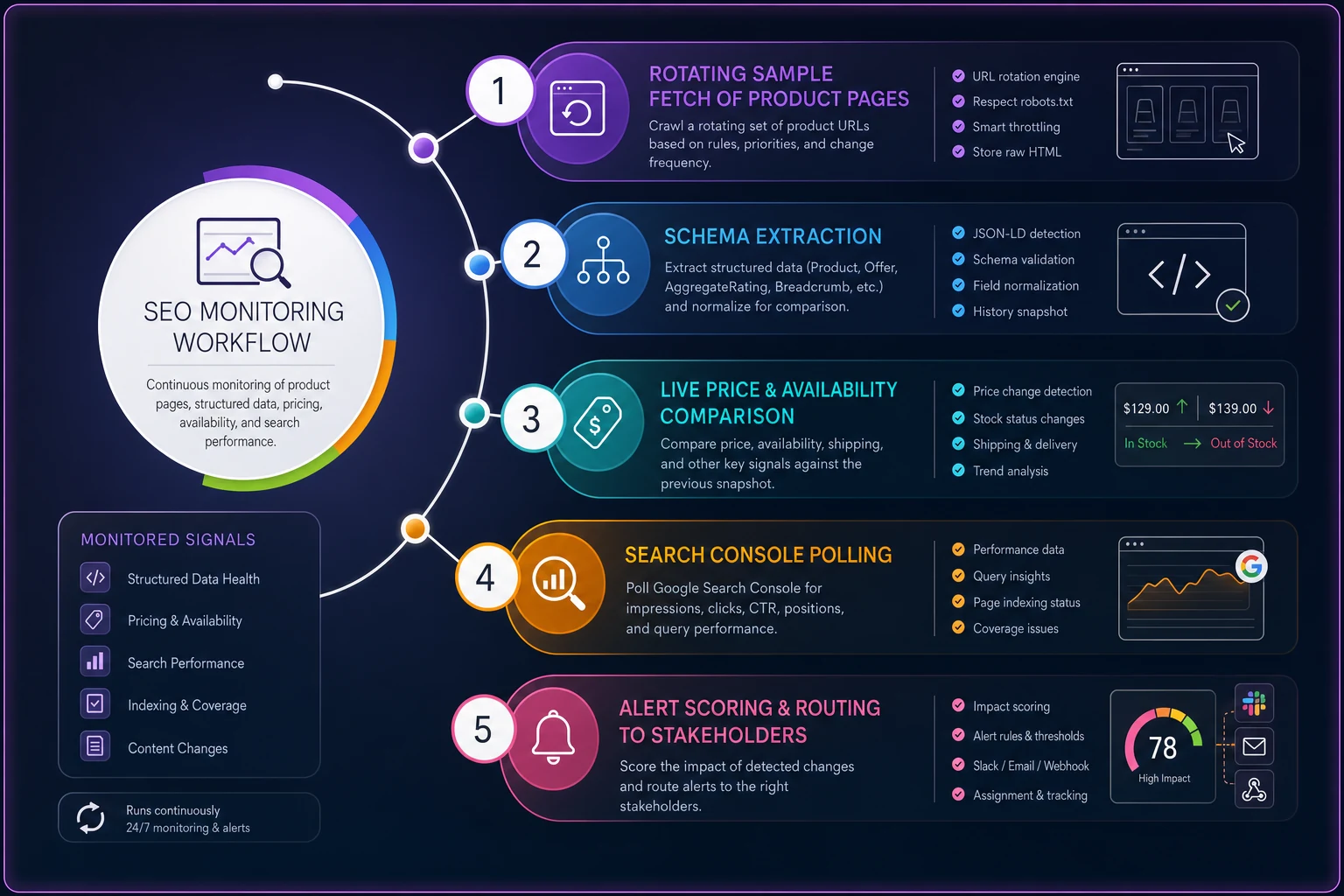
A simple visualization of that monitoring workflow.
That sampling-and-conflict-detection approach is the same discipline we broke down in schema health monitoring at scale — the principles there apply directly here, just pointed at price and availability volatility specifically rather than general schema hygiene.
What people underestimate is the conflict detection part. Validating that your schema is syntactically correct is easy and mostly useless during volatility — your markup can be perfectly valid and still wrong. What matters is whether it agrees with the other sources of truth. That's a comparison problem, not a validation problem.
When heavy monitoring makes sense — and when it doesn't
Not every catalog needs real-time schema monitoring, and pretending otherwise just burns engineering time.
Worth doing when: your catalog has genuine change velocity (hundreds of price and stock changes a week), your schema and live price come from different systems, and price/availability rich results are actually showing for your products and driving traffic. Comparison-shopping-adjacent categories — electronics, appliances, home goods — feel this most.
Probably overkill when: you have a small, stable catalog that updates weekly, your schema is generated inline from the exact same data the page renders from, and you're not currently earning price annotations anyway. A scheduled weekly audit is plenty in that case — building continuous monitoring is solving a problem you don't have.
Who should be careful: teams with a headless setup where schema is generated in a separate service from the storefront. That architecture is the most prone to drift because the two layers can legitimately get out of sync, and it's also the one where visual QA will never catch it.
For most mid-market retailers right now, given where supplier costs are sitting, the honest answer sits somewhere in between. You probably don't need second-by-second monitoring, but nightly schema generation on a catalog that's repricing throughout the day is a real liability worth closing before the season peaks.
Closing the loop with merchandising and ops
The part that lives outside SEO's control, and matters most: schema drift during cost volatility is usually a coordination gap, not a code bug. Merchandising changes a price. Ops flips a SKU to discontinued. Procurement swaps a supplier. None of them are thinking about structured data, and they shouldn't have to be — but the downstream effect on schema is real.
The fix that holds up is making schema a monitored output of those workflows rather than a side effect nobody owns. Someone needs to be accountable for the price-parity and availability checks, alerts need to route to a person who can act, and when a SKU gets retired there should be a defined pattern for what happens to its URL and markup. During a stable year you can get away without that. During a year where production is surging and input prices stay elevated, the catalog simply changes too often for undefined ownership to survive.
Get the audit done now, while you still have slack. Decide what level of monitoring your change velocity actually justifies. And make sure the people changing prices and stock levels are connected — even loosely — to the structured data that depends on them. The volatility isn't going to wait for your publishing pipeline to catch up.
Get the audit done now, while you still have slack. Decide what level of monitoring your change velocity actually justifies. And make sure the people changing prices and stock levels are connected — even loosely — to the structured data that depends on them. The volatility isn't going to wait for your publishing pipeline to catch up.
Ready to elevate your search rankings?
Join 5,000+ businesses using GoSeofy to increase organic traffic, optimize content, and outperform competitors online.