



The FTC just opened a public comment window on an enforcement policy for personalized pricing, and the part worth paying attention to is the disclosure angle. According to Reuters, the agency is weighing whether businesses need to tell customers when a price was shaped by an algorithm or personal data. The FTC's own press release frames it as a policy statement, not a final rule — but legal teams are already circulating memos, which usually means the direction is clear enough that waiting feels risky.
Most coverage is legal and policy-focused. That's fine, but it skips the part that actually lands on marketing and SEO teams: your product pages already broadcast prices through structured data, and if the price a customer sees doesn't match what your Product schema emits, you've got a problem that's both an SEO issue and, now, potentially a compliance one.
This isn't a new problem either. Personalized and dynamic pricing has been quietly breaking price consistency across variants, audiences, and cached pages for years. The FTC proposal just turns a background annoyance into something with a deadline attached. So instead of summarizing the news, here's what an SEO or e-commerce team should actually audit — and where the underlying operational cracks usually are.
The real problem isn't pricing — it's that nobody owns the price signal
The moment you start this audit, you usually discover the same thing: nobody actually owns the "price" field across the whole stack.
Marketing owns the promo copy. The pricing team owns the dynamic engine. Engineering owns the templates. SEO owns the schema. And the CDN owns whatever version of the page got cached at 3am. When a personalized price gets served, it passes through all of those layers, and each one can quietly drift from the others.
A typical example looks like this: the visible price on a product page reflects a personalized discount — a returning-customer segment sees $84 instead of $99 — but the JSON-LD offers.price still hardcodes $99 because the schema is templated server-side and the discount is applied client-side. Google reads $99. The customer sees $84. Merchant listings show a third number pulled from the feed. Three sources of truth, none agreeing.
Under current rules that's mostly a rich-result and trust problem. If a disclosure requirement lands, that same inconsistency becomes evidence that your price presentation isn't controlled — which is exactly what regulators look at. The Hunton client memo on the proposal is worth reading if you want the legal framing on business implications, but the operational takeaway is simpler: you can't disclose personalization cleanly if you don't know where all your prices are coming from.
Where price signals actually leak
Before the checklist, it helps to see the usual leak points, because "audit your schema" is useless advice until you know what actually breaks.
Stop losing visibility in search results.
GoSeofy helps you monitor, analyze, and improve your SEO performance with ease.
- Comprehensive keyword tracking
- Backlink quality monitoring
- Real-time SEO performance reports
No credit card required
| Leak point | What goes wrong | Who usually owns it | SEO side-effect |
|---|---|---|---|
| Client-side discount rendering | Schema shows list price, DOM shows personalized price | Frontend eng | Price mismatch flags, lost rich results |
| Cached personalized pages | CDN caches one segment's price for everyone | DevOps/CDN | Wrong price indexed, inconsistent snippets |
| Variant-level pricing | Parent product schema price ≠ selected variant price | Merch + eng | Confusing SERP prices, thin/duplicate variants |
| Feed vs. page drift | Merchant feed price updated on a different cadence than the page | Feed/ops | Disapprovals, mismatched shopping listings |
| A/B price experiments | Test buckets serve different prices, both get crawled | Growth/CRO | Duplicate content, canonical confusion |
| Currency/geo personalization | Geo price served to bot differs from schema currency | Localization | priceCurrency conflicts, indexing noise |
The pattern across almost all of these: the personalization happens after the schema is generated, or on a different cadence than the schema updates. That gap is where both the SEO damage and the disclosure risk live.
The audit checklist
Run this as a real pass, not a skim. Budget a couple of focused days for a mid-size catalog, more if you have heavy variant logic.
Schema and price accuracy
-
Pull a sample of 50–100 product URLs across categories, price tiers, and variant types — not just your top sellers.
-
For each, compare four numbers
visible DOM price, JSON-LD
offers.price, merchant feed price, and the price your pricing engine intends to serve for a default (non-personalized) user. -
Check whether
priceValidUntil,priceCurrency, andavailabilityare present and accurate, not stale placeholders from a template. -
Confirm variant selection updates the schema, not just the visible price. Many themes swap the DOM number and leave JSON-LD frozen on the parent.
-
Fetch pages as Googlebot (via URL Inspection and a server-side render check) to confirm the bot sees the non-personalized, canonical price — not a cached personalized one.
Personalization and disclosure surface
-
Map every place a price can be personalized
logged-in segments, geo, referral source, cart history, loyalty tier, A/B buckets.
-
For each, document what the "baseline" advertised price is, because that's the number you'll likely need to anchor any disclosure to.
-
Draft user-facing disclosure language now, even if it's not required yet, so legal and comms aren't scrambling later. Keep it out of indexable schema fields.
-
Make sure disclosure text, if added, doesn't accidentally inject into
descriptionor other structured fields.
Crawl, cache, and indexing hygiene
-
Check CDN cache rules
personalized responses must not be cached and served to bots or to the wrong segment.
-
Look for A/B price tests that expose both buckets to crawlers under indexable URLs — canonicalize or noindex the variant.
-
Review parameterized/personalized URLs for crawl-budget waste and duplicate content.
-
Confirm canonical tags on variant and personalized URLs point to the stable, default-price version.
Monitoring
-
Set up a recurring diff between schema price and feed price, alerting on mismatches above a threshold.
-
Alert on
Productschema errors and price-related rich-result drops in Search Console. -
Log render-time price vs. crawl-time price on a sample of pages so you catch client-side/server-side divergence early.
Run this as a real pass, not a skim. Budget a couple of focused days for a mid-size catalog, more if you have heavy variant logic.
A quick process for standing up price-drift monitoring
If you only do one thing after this audit, make it monitoring. A one-time pass goes stale the next time merchandising touches the pricing engine.
-
Define the canonical price source. Pick the one system that is the source of truth for the default, non-personalized price. Everything else is downstream and gets validated against it.
-
Instrument three checkpoints. Capture price at schema generation, at page render, and in the merchant feed. Store them with a timestamp and product ID.
-
Diff on a schedule. Run comparisons daily on high-revenue SKUs, weekly on the long tail. Weight alerts by conversion value so a mismatch on a $600 hero product screams louder than a $12 accessory.
-
Route alerts to an owner, not a channel. A price mismatch that lands in a busy Slack channel with no assignee just gets ignored. Assign it to someone.
-
Track drift over time. If the same template or category keeps drifting, that's a structural fix — not a whack-a-mole situation.
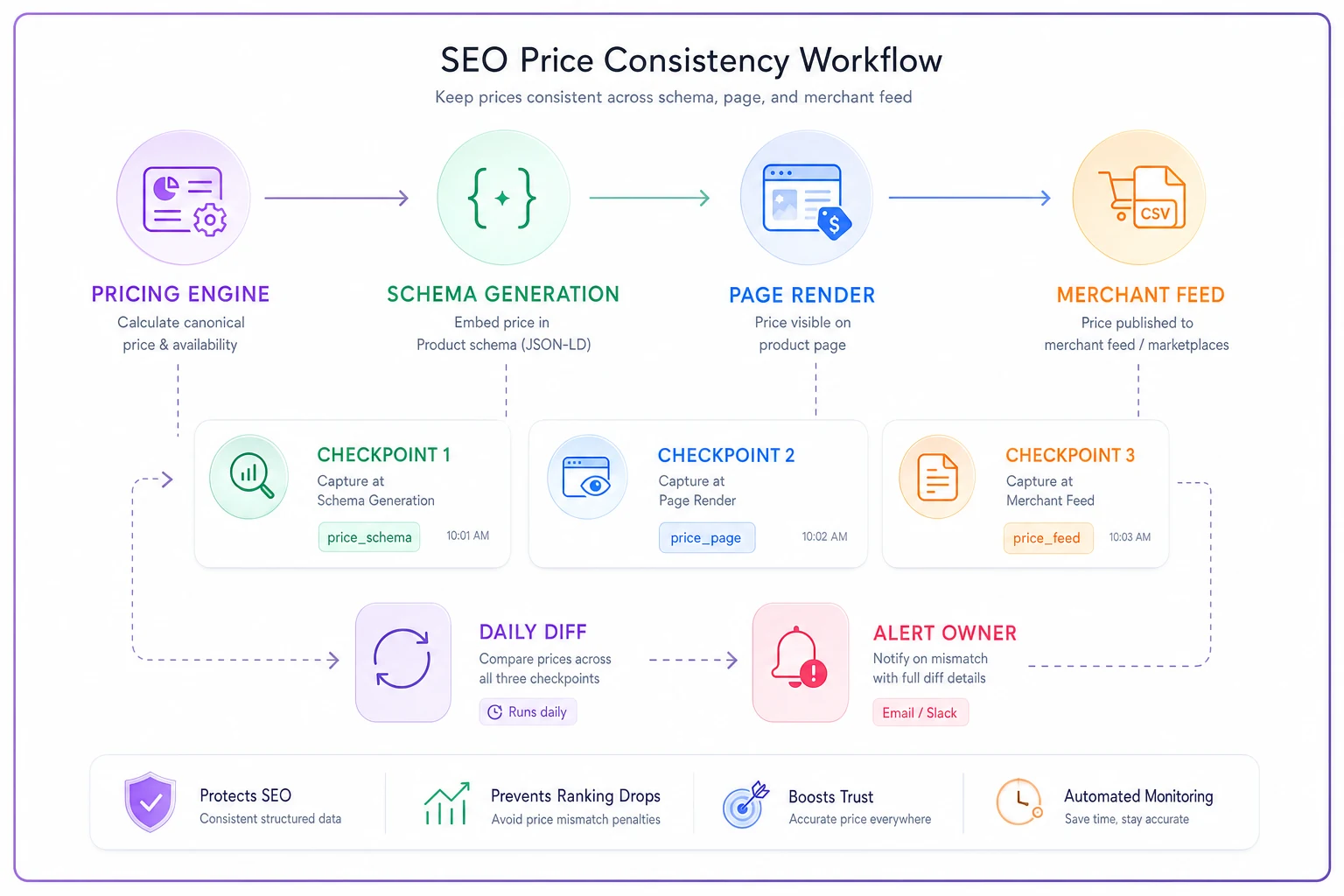
This kind of ongoing sampling-and-diff work is really just schema health monitoring pointed at a specific field. If you want the broader framework for doing it across your whole catalog rather than just prices, the approach in schema health monitoring at scale — sampling strategy, conflict detection, remediation — carries over almost directly. Prices are simply the highest-stakes field to keep clean right now.
A real scenario
A mid-sized apparel retailer with around 8,000 SKUs ran client-side loyalty discounts. Returning members saw roughly 10–15% off, applied in the browser after page load. Schema stayed on list price everywhere. For a long time this looked fine — until shopping listing disapprovals started climbing and rich-result price snippets began flickering in and out.
When they actually diffed schema vs. rendered price across a sample, close to a third of their catalog had a mismatch between what members saw and what the schema emitted. Nobody had decided that; it was just an artifact of where the discount logic lived. On top of the disapprovals, their CDN was occasionally caching a member-discounted page and serving it to logged-out users and to Googlebot — so the "advertised" price was inconsistent for the same product on the same day.
The fix wasn't glamorous. They moved discount application server-side so the price was resolved before schema generation, forced personalized responses to bypass the cache, and stood up a daily schema-vs-feed diff on their top few hundred SKUs. Disapprovals dropped off within a couple of weeks and price snippets stabilized. The quieter win: when the FTC news broke, their legal team asked "where do we personalize prices and what do customers actually see?" — and marketing could answer it in an afternoon instead of a month.
When to act now vs. when to wait
You don't need to overhaul everything this week. But a few situations move you to the front of the line.
Act now if:
-
You apply discounts or personalized prices client-side after schema renders.
-
You run price A/B tests that are crawlable.
-
You've seen shopping disapprovals or price-mismatch warnings and shrugged them off.
-
Your CDN caching rules were set up years ago and nobody has audited them since.
You can pace yourself if:
-
All pricing is resolved server-side and schema is generated from the same source.
-
You already run schema/feed reconciliation and have alerting on price fields.
-
You don't personalize prices at all — in which case, document that clearly so you can prove it if asked.
One thing worth flagging: teams sometimes try to "fix" this by stuffing disclosure text or extra price fields into structured data. That creates new schema conflicts and can hurt rich results. Disclosures belong in the visible UI and legal copy, not jammed into JSON-LD. Keep the two problems separate.
The underlying lesson
The comment period is open and this is still a policy statement, not a rule — so nothing is mandatory yet. But regulatory timelines have a way of overlapping with your busiest selling weeks, and "we'll deal with it later" has a habit of turning into a live patch during peak traffic.
The deeper issue the proposal exposes has nothing to do with the FTC specifically. Most e-commerce stacks treat price as a display value rather than a governed data field with a single owner. When a display value gets rendered five different ways across five systems, you get SEO drift and compliance exposure from the exact same root cause. Fixing ownership and monitoring solves both at once — which is a better use of your time than treating disclosure as a one-off legal checkbox.
Take the comment period as your cue to run the audit while it's cheap, before it becomes urgent. Clean price signals were always good for rich results and trust. Now there are a few more reasons to care.
Take the comment period as your cue to run the audit while it's cheap, before it becomes urgent. Clean price signals were always good for rich results and trust. Now there are a few more reasons to care.
Ready to elevate your search rankings?
Join 5,000+ businesses using GoSeofy to increase organic traffic, optimize content, and outperform competitors online.