



Most backlink "audits" are really just someone exporting a CSV from Ahrefs once a quarter, scanning it for obvious junk, and calling it done. That works fine — until the week a scraper network drops 4,000 forum profile links on your /pricing page, or a negative SEO run buries your clean link profile under casino anchors. By the time the quarterly export happens, the damage is already baked into your rankings and you're guessing at causation.
The fix isn't a fancier tool. It's a cadence. A weekly pipeline that ingests, normalizes, scores, and diffs your link profile against last week — so the system tells you what changed instead of you squinting at 200,000 rows. This post covers the implementation: where the data comes from, how to dedupe it without losing signal, the scoring heuristics that actually catch bad behavior, and the alert schema that keeps your SEO team and your external agency looking at the same numbers.
One assumption going in: you already know what a toxic link looks like and why anchor concentration matters. We're skipping the 101. This is about the plumbing.
Start with the diff, not the dump
The biggest design decision upfront is that an automated backlink audit pipeline should be built around change detection, not inventory. Nobody has time to review 200k live links every week. But reviewing the ~800 that are new, lost, or changed since last Tuesday? That's actually a human-sized job.
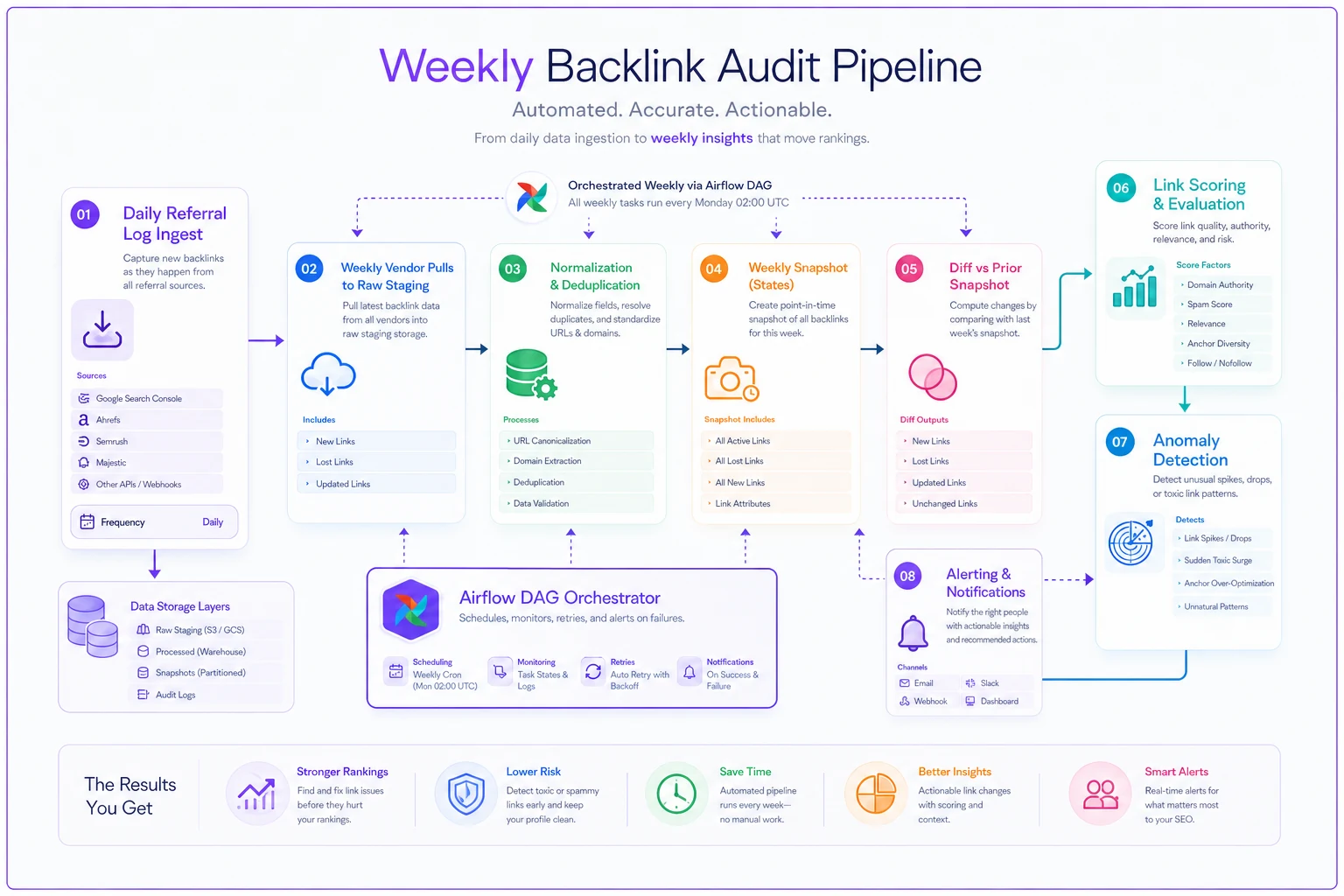
So before anything else, the architecture looks like this:
-
Pull fresh link data from multiple sources
-
Normalize everything into one canonical schema
-
Snapshot this week's state into a dated table
-
Diff against last week's snapshot
-
Score the deltas for risk
-
Fire alerts only on anomalies
Everything downstream depends on step 2 being clean, which is where most pipelines quietly fall apart.
Data sources and ingestion patterns
No single provider sees your whole link graph. Ahrefs and Majestic have different crawl priorities, GSC shows you what Google actually attributes, and your own server logs show referral traffic that proves a link is live and clicked — which third-party tools often miss or report stale.
Stop losing visibility in search results.
GoSeofy helps you monitor, analyze, and improve your SEO performance with ease.
- Comprehensive keyword tracking
- Backlink quality monitoring
- Real-time SEO performance reports
No credit card required
A practical source stack looks like this:
| Source | What it's good for | Refresh cadence | Gotcha |
|---|---|---|---|
| Ahrefs API | Broad discovery, new/lost links, DR | Weekly pull | Lagged by days; can report lost links that are still live |
| Majestic | Trust/Citation Flow, historic index | Weekly | Different crawl means different dedup keys |
| Google Search Console (Links report + API) | What Google actually counts | Weekly export | Sampled, capped row counts, no anchor detail via API |
| Server/CDN referral logs | Proof of live, clicked links | Daily ingest | Noisy; needs bot filtering |
| Disavow file (your own) | Already-actioned domains | On change | Must be joined so you don't re-alert on known-bad |
The ingestion pattern that holds up: land raw, then transform. Pull each source into a raw staging table with the provider name, pull timestamp, and the untouched payload. Don't normalize on ingest. If a provider changes their export format — and they do, without warning — you want the raw landing zone intact so you can re-run transforms without re-pulling data. This is the same land-raw discipline that keeps a revenue‑attribution pipeline debuggable, and you'll want to cross-reference link events back to that pipeline later anyway.
For GSC specifically, schedule the Links report pull on a fixed weekday. The row cap means you'll miss long-tail referrers, so treat GSC as a confirmation layer ("does Google see this domain?") rather than a discovery layer.
Deduplication and normalization rules
This is where the pipeline earns its keep. Three sources will report the same link three different ways, and if you don't collapse them you'll inflate your numbers and alert on phantom changes.
Normalize in this order:
-
Lowercase and strip the host.
HTTP//WWW.Example.com/ and
https://example.comare the same referring domain. Strip protocol, stripwww., lowercase everything. -
Collapse to registrable domain for domain-level metrics, but keep the full source URL for link-level dedup. You care about domains for diversity scoring and individual URLs for "is this exact link new."
-
Canonicalize target URLs. Strip tracking params (
utm*,gclid,fbclid, session IDs), resolve trailing-slash inconsistencies, and map known redirects to their final destination. A link to/product?utmsource=xand/producthit the same page. -
Normalize anchor text. Trim whitespace, collapse internal spaces, lowercase for grouping — but keep the original casing in a separate column. "Click Here" vs "click here" matters for display, not for concentration math.
-
Dedup key
md5(sourceurlnormalized + targeturlnormalized + anchornormalized). Same source URL, same target, same anchor = one link, regardless of how many providers reported it. Keep areportedbyarray so you know which sources saw it.
One normalization rule people consistently skip: handle sitewide links before you count. A footer or sidebar link appears on thousands of pages of a referring domain. Ahrefs might report it as 8,000 links; Majestic might report it as 1. If you don't collapse sitewide patterns — detecting when one referring domain has hundreds of source URLs all pointing to the same target with the same anchor — one spammy footer link looks like a massive coordinated attack. Flag it as sitewide=true, count it once for volume, but weight it heavily in risk scoring. Sitewide spammy links are genuinely dangerous.
Risk‑scoring heuristics with suggested weights
A single toxic score from a vendor isn't enough. It's a black box and it drifts. Build a composite score from signals you control, so when it fires you can explain why.
Here's a heuristic set that holds up reasonably well in practice. Scores are 0–100, higher = riskier.
Per-link risk contributors (with suggested weights):
-
Low/zero referring domain authority — weight 15. DR/TF below a floor (say DR < 5) when the link appeared in a cluster.
-
Spammy TLD or known-bad pattern — weight 20.
.xyz,.top,.loan, bulk-registered patterns, or domains on your internal blocklist. -
Anchor mismatch / commercial-spam anchor — weight 25. Anchors like "buy cheap," pharma, casino, or adult terms pointing at your corporate pages.
-
Sitewide + low authority combo — weight 20. The footer-spam pattern above.
-
Link velocity context — weight 10. This exact link appeared as part of a same-day burst from the same IP block or hosting ASN.
-
No referral traffic after 2+ weeks live — weight 10. Real editorial links usually send some clicks. Dead-on-arrival links from low-auth domains skew spammy.
Sum, cap at 100. A link scoring 70+ goes into the review queue automatically; 40–69 is watchlist; under 40 is noise.
The weights aren't gospel — tune them against your own confirmed-bad set. The mistake most teams make is treating vendor toxic scores as ground truth and never calibrating. Run your heuristic against the last 100 links you manually disavowed. If your top-scored links don't overlap with your actual disavow decisions, the weights are off.
Anomaly detection: the part that catches real attacks
Scoring tells you a link is bad. Anomaly detection tells you something changed — which is how you catch attacks and negative SEO early, before the aggregate score moves.
Spike / drop detection on referring domains
Compare this week's new referring domains against a rolling baseline. A healthy site gains links at a roughly steady rate. A sudden 5x spike in new low-authority domains is a flag.
WITH weekly AS ( SELECT datetrunc('week', firstseen) AS wk, count(DISTINCT registrabledomain) AS newdomains, count(DISTINCT registrabledomain) FILTER (WHERE referringdr < 5) AS newlowauthdomains FROM linksnapshot WHERE firstseen >= now() - interval '12 weeks' GROUP BY 1 ), baseline AS ( SELECT avg(newlowauthdomains) AS meanlowauth, stddevpop(newlowauthdomains) AS sdlowauth FROM weekly WHERE wk < datetrunc('week', now()) ) SELECT w.wk, w.newlowauthdomains, (w.newlowauthdomains - b.meanlowauth) / nullif(b.sdlowauth,0) AS zscore FROM weekly w CROSS JOIN baseline b WHERE w.wk = datetrunc('week', now()) AND (w.newlowauthdomains - b.meanlowauth) / nullif(b.sdlowauth,0) > 3;
A z-score above 3 on low-authority domain acquisition means this week is genuinely abnormal. Pair the spike detector with a drop detector on your clean links too — losing 200 editorial links in a week is often an infrastructure or reclamation problem, not spam, but you still want to know.
Toxic‑score jumps
Don't alert on absolute toxic score. Alert on the delta for a referring domain.
for each referringdomain in thisweek: prev = lastweekscore[domain] (default 0) curr = thisweekscore[domain] if (curr - prev) >= 25 and curr >= 50: emit anomaly(domain, prev, curr, severity based on jump)
A domain that jumped from 20 to 65 is more interesting than one that's been sitting at 60 for a year — the latter you've probably already reviewed.
Anchor‑text concentration
SELECT targeturlnormalized, anchornormalized, count() AS anchorcount, count() 1.0 / sum(count()) OVER (PARTITION BY targeturlnormalized) AS anchorshare FROM linksnapshot WHERE linkstatus = 'live' GROUP BY 1, 2 HAVING count() 1.0 / sum(count()) OVER (PARTITION BY targeturl_normalized) > 0.30 AND count() >= 15;
Any single anchor exceeding roughly 30% of a page's inbound anchors — with enough volume to matter — is worth a human look. For money pages, drop that threshold to 20%. The pattern that should make your stomach drop: a commercial exact-match anchor jumping from 5% to 35% of a page's anchors in one week. That's an attack signature, not organic growth.
A reusable notification schema
Alerts fail when they're inconsistent — the agency gets a Slack ping with different fields than the internal dashboard, and now two teams are arguing about numbers. Standardize one event schema and route it everywhere.
Core alert fields:
-
alert_id— stable UUID -
detected_at— timestamp -
anomalytype— enumspikelowauth,toxicjump,anchorconcentration,sitewidespam,cleanlink_drop -
severity— enumcritical,high,medium,info -
target_url— the affected page (null for domain-wide) -
metricbefore/metricafter— the numbers that moved -
evidence_sample— up to 10 example referring domains/URLs -
suggested_action— templated next step -
owner— routing tag (internal SEO vs agency) -
attribution_link— join key back to affected revenue pages
Severity tiers:
-
Critical — anchor concentration jump on a money page, or spike z-score > 4 on low-auth domains. Pages this with a human the same day.
-
High — spike z-score 3–4, toxic jump on a previously clean domain. Reviewed within 48h.
-
Medium — watchlist growth, clean-link drop. Weekly review queue.
-
Info — logged, no action, available for context.
> **[CRITICAL] Anchor concentration spike — /pricing> > Anchor "buy crm cheap" went from 4% → 33% of inbound anchors this week (18 new links). > Top sources: domain-a.xyz, domain-b.top, domain-c.loan … > Suggested action: review evidence sample, stage disavow candidates. > Owner: internal-seo · alert_id: a1f9…
The agency gets the same payload, different owner tag. One schema, one source of truth, no number-reconciliation meetings.
Orchestration, retention, and refresh cadence
Weekly is the right beat for the full audit, but anomaly checks on referral logs can run daily since that data already lands daily.
A workable schedule:
-
Daily (cron, ~03
00):
ingest referral logs, bot-filter, updatelivestatus flags. -
Weekly (Airflow DAG, Monday early AM) pull Ahrefs/Majestic/GSC → land raw → normalize → snapshot → diff → score → run anomaly detectors → emit alerts.
-
On-change re-ingest disavow file whenever it's edited, so you stop alerting on actioned domains immediately.
Airflow earns its place here because of task dependencies — you don't want the scoring task running before all three vendor pulls succeed. Set the vendor-pull tasks with retries and a trigger_rule so scoring only fires when normalization completed cleanly. A plain cron chain will happily score a half-loaded snapshot and page your team at 4am over a vendor API timeout.
Retention: keep weekly snapshots for at least 52 weeks. Year-over-year context matters — you want to know this October's link velocity against last October's, not just last week's. Keep raw landing-zone payloads for around 90 days since they're bulky, and keep the diffed/scored tables indefinitely. They're small and serve as your audit trail.
Cross‑referencing revenue without rebuilding it
The temptation is to re-derive page value inside the backlink pipeline. Don't. If you've already got a revenue‑attribution pipeline with page-level models, the backlink audit should reference its page-value table by URL, not recompute it.
The clean seam: your anomaly alerts carry target_url, and a lightweight join against the attribution model's page-value lookup lets you sort the review queue by revenue exposure. An anchor-concentration spike on a page driving real revenue is a critical; the same spike on an orphaned blog post from 2019 is an info. Keep the models separate, join at alert time. This keeps both pipelines independently testable and avoids the drift that happens when two systems both try to own "how much is this page worth."
A realistic scenario
A mid-market B2B SaaS running this pipeline caught an attack three days in. Their baseline was roughly 30–50 new referring domains a week, mostly DR 20+. One Monday the spike detector threw a z-score around 4.6: approximately 380 new domains, nearly all DR < 3, concentrated on .xyz and .top TLDs. The anchor-concentration check flagged their comparison page — an exact-match commercial anchor had jumped from under 5% to roughly 34% of that page's inbound anchors.
Because the alert carried the attribution join, it paged as critical. The comparison page was a meaningful revenue driver. The team staged a disavow for the clustered domains within the day, instead of discovering the attack weeks later inside a confusing ranking drop. No ranking loss materialized.
Without the weekly diff, this would've surfaced as a mystery traffic dip a month out — the kind you spend two weeks misdiagnosing as a content or technical issue.
That's the whole point of building around change detection. You're not trying to review every link. You're trying to be the first to know when something moved, and to have the evidence already assembled when you go to act on it.
Ready to elevate your search rankings?
Join 5,000+ businesses using GoSeofy to increase organic traffic, optimize content, and outperform competitors online.