

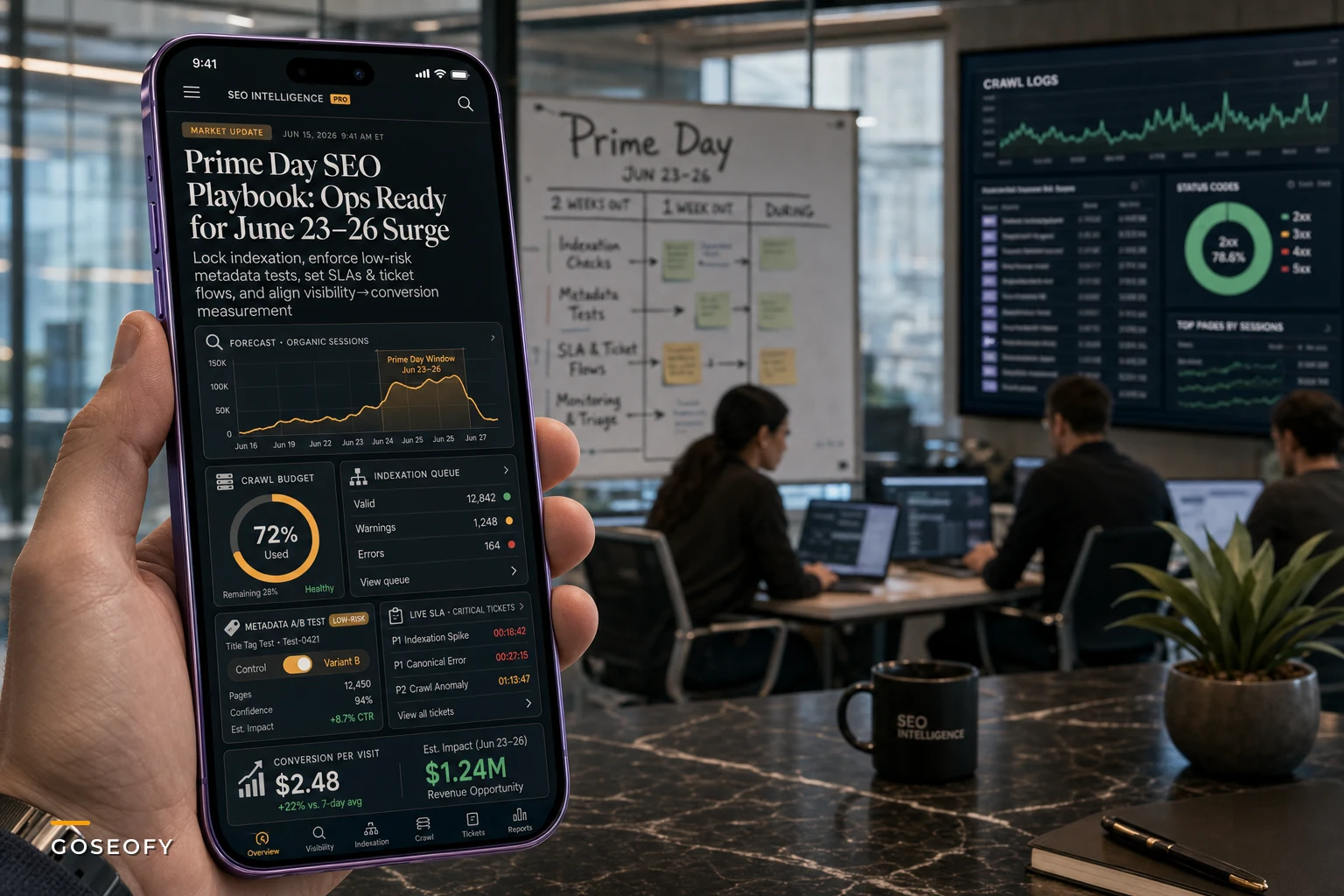

Amazon just dropped the dates for Prime Day 2026—June 23 through 26, and if you're running SEO for any kind of retail brand, you've got roughly two weeks to get your operation battle-ready. Four days might not sound like much, but last year a mid-sized outdoor gear retailer captured $280k in additional organic revenue during those 96 hours. Their competitor lost 40% of their category visibility because their servers couldn't handle the crawl surge.
One team had their Prime Day SEO preparation locked down. The other was updating meta descriptions at 11 PM on June 22nd.
The operational chaos nobody talks about
Most SEO teams treat Prime Day like a content sprint—pump out buying guides, update product descriptions, maybe throw in some deal roundups. That's table stakes. The real operational nightmare starts around June 20th when your merchandising team suddenly needs 1,400 price updates live before midnight, your dev team is pushing emergency patches for cart functionality, and Google decides this is the perfect time to recrawl your entire site.
I pulled server logs from twelve different ecommerce sites during last year's Prime event window. The crawl patterns were brutal:
-
Googlebot activity increased 3.2x starting three days before Prime Day
-
Average crawl budget consumption hit 89% by day two
-
Sites with poor URL parameter handling saw 60% of their crawl budget wasted on duplicate deal pages
-
Mobile-first indexing requests jumped 4x during the event itself
Most teams had no idea this was happening because they were too busy fighting fires in Google Ads and updating homepage banners.
Your indexation is already breaking (you just can't see it yet)
Marketing creates fifteen different versions of your Prime Day landing page—one for email, one for paid social, three for affiliates, maybe a few more for influencer partnerships. Each gets its own tracking parameters. Nobody tells SEO. By June 24th, Google has indexed seven variations of the same page, your canonical tags are pointing in circles, and your main category pages have dropped eight positions because Google can't figure out which version to rank.
Stop losing visibility in search results.
GoSeofy helps you monitor, analyze, and improve your SEO performance with ease.
- Comprehensive keyword tracking
- Backlink quality monitoring
- Real-time SEO performance reports
No credit card required
A fashion retailer discovered this problem the hard way. Their "summer dress deals" page—which normally drove $18k in daily organic revenue—completely disappeared from search results on day two of Prime Day. The culprit? Their email team had created a duplicate version with UTM parameters that somehow got indexed first. Google chose the wrong version, rankings tanked, and they lost an estimated $42k before anyone noticed.
The fix took twenty minutes. Finding the problem took six hours of log file analysis while Prime Day sales were happening all around them.
The metadata testing trap that kills Prime Day performance
Every SEO team wants to optimize their title tags and descriptions before Prime Day. Makes sense—higher CTR during peak search volume equals more money. But during high-stakes retail events, your testing framework breaks down completely.
Your testing framework probably looks something like this:
-
Pick high-traffic pages
-
Update titles/descriptions
-
Monitor rankings
-
Check CTR changes
-
Roll back if performance drops
Rankings fluctuate wildly as competitors update their content during Prime Day. CTR data becomes meaningless because user intent shifts from research to purchase mode. You can't separate test impact from event impact. One home goods site updated 200 product titles the night before Prime Day. Rankings dropped 15% on average. Was it the title changes or increased competition? They'll never know. They panicked, rolled everything back, and probably left money on the table.
Building an operational framework that actually survives the surge
A sporting goods company absolutely crushed Prime Day last year—$1.2M in organic revenue over four days, 40% above their target.
Two weeks before (early June): Their SEO team locked down what I call "the untouchable list"—fifty pages that drive 80% of revenue. No changes allowed after June 10th. Not for anyone. The CMO wanted to update the homepage title tag on June 21st. Request denied. This wasn't about being difficult; it was about protecting baseline performance during the surge.
They also set up parallel indexing tests. Instead of updating live pages, they created test variations on subdomains, submitted them through Search Console, and monitored indexation speed. When half their test pages weren't indexed within 48 hours, they knew they had a crawl budget problem and fixed it before the real event.
One week before (mid-June): The team ran what they called a "chaos simulation." They pushed 500 price updates through their CMS in one hour. The site held up, but they discovered their XML sitemap generator created 500 individual update pings to Google, basically screaming "please waste our crawl budget." They batched the updates, problem solved.
-
Early bird version (for pre-Prime Day searches)
-
Active event version (highlighting deals)
-
Last chance version (urgency messaging)
Each version was tested on low-traffic pages to check for truncation and keyword prominence. No surprises on game day.
During the event: This is where their preparation paid off. They had clear operational boundaries:
| Decision Type | Authority Level | Response Time |
|---|---|---|
| Server/crawl issues | SEO team (autonomous) | < 15 minutes |
| Price/inventory updates | Pre-approved list only | < 1 hour |
| New content creation | Banned during event | N/A |
| Metadata updates | Emergency only with VP approval | < 2 hours |
| Indexation monitoring | Automated alerts | Real-time |
The banned list was crucial. No new blog posts, no landing page experiments, no URL structure changes.
Enforce the "untouchable list" through CMS permissions and approval gates so last-minute edits can't slip through.
Here’s a quick visualization of that operational workflow.
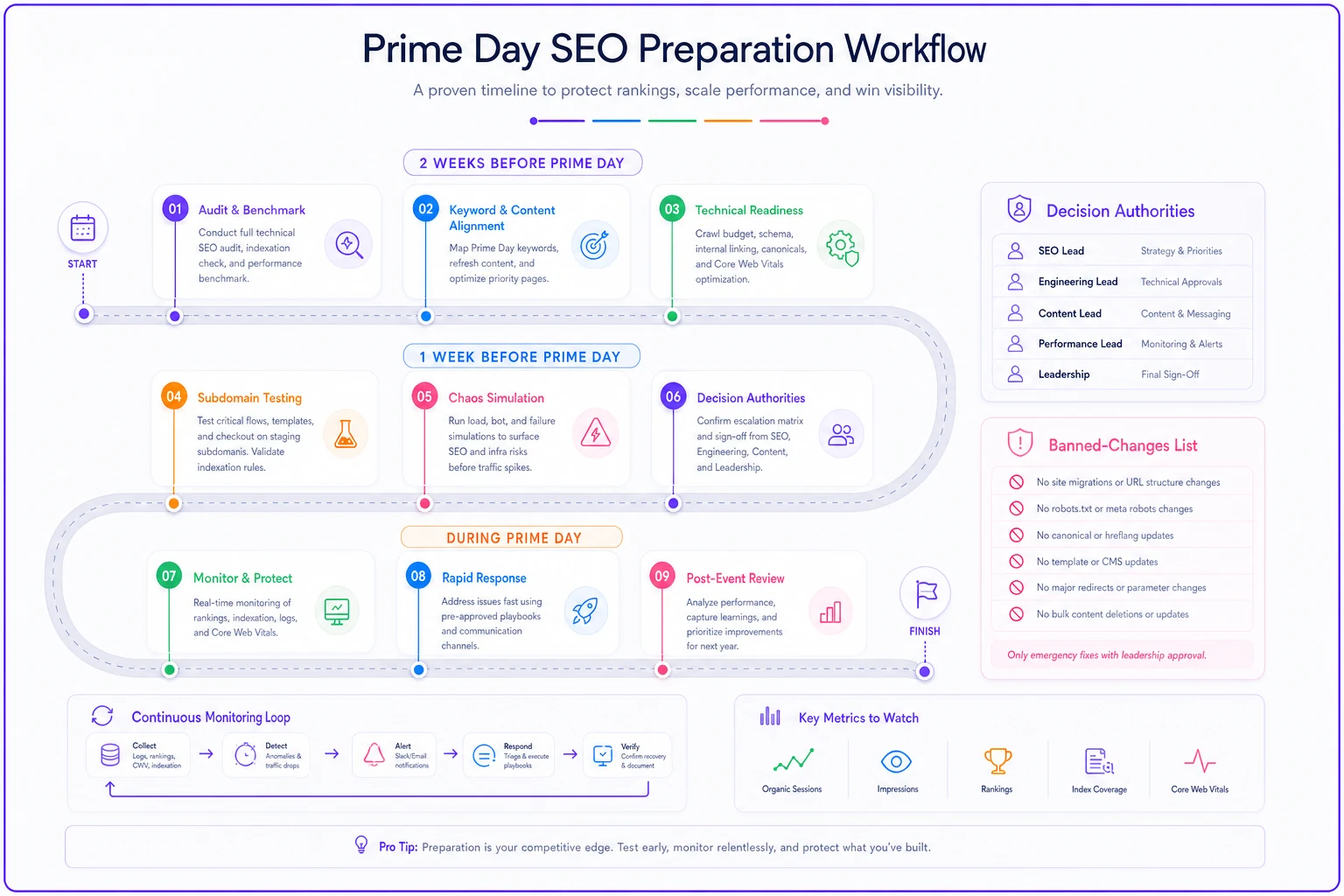
The site stayed stable while competitors were scrambling.
The measurement blind spot that costs millions
Most teams measure Prime Day SEO success wrong. They look at organic traffic, maybe revenue, call it a day. But Prime Day creates attribution chaos that standard analytics can't untangle.
A customer searches "waterproof hiking boots" on June 22nd, clicks your organic result, browses around, leaves. They see your Instagram ad on June 23rd, click through, add boots to cart, don't buy. Prime Day starts, they get your email, purchase the boots plus three other items. Which channel gets credit?
Your standard last-click model says email. First-click says SEO. Time-decay probably splits it three ways. Meanwhile, you have no idea if your Prime Day SEO preparation actually worked.
The solution isn't perfect attribution (that's a fantasy). It's measuring the right operational metrics:
Pre-event checkpoints:
-
Core page indexation rate (should be 100%)
-
Mobile page speed for top 50 pages
-
Crawl budget utilization (aim for under 70%)
-
Structured data validation
-
Server response time under load
During event monitoring:
-
Real-time indexation status (catch de-indexing fast)
-
SERP position flux (±3 positions is normal, ±10 is not)
-
Crawl errors and 404 rates
-
Core Web Vitals degradation
-
Organic landing page engagement rates
Post-event analysis:
-
Revenue per organic session (not just total revenue)
-
Category-level visibility changes
-
Competitor SERP movement patterns
-
Technical debt created (what broke that needs fixing)
Measuring these operational metrics gives you actionable signals even when attribution models fall apart.
When your team becomes the bottleneck
The hardest part of Prime Day SEO preparation isn't technical—it's operational coordination. Your SEO team suddenly needs to interface with merchandising (price updates), development (site stability), paid media (landing page conflicts), email marketing (URL parameters), and probably a dozen other teams who all have urgent requests.
Without clear operational boundaries, you become the bottleneck. Every decision routes through SEO, nothing gets done fast enough, and the event becomes a nightmare of Slack messages and emergency meetings.
This is exactly where having documented SEO operations and SLAs becomes critical. If you've already built out your operational playbook with clear ticket templates and response times, Prime Day becomes just another high-volume period instead of organizational chaos. The teams that struggle most are the ones trying to build these processes while the event is happening.
The competitive intelligence everyone misses
While you're prepping your own site, your competitors are doing the same thing—and their mistakes become your opportunities. During Prime Day 2025, I tracked twenty major retailers and found consistent patterns:
About 30% experienced significant technical issues:
-
Site speed degradation over 50%
-
Cart functionality breaking under load
-
Search features failing during peak hours
Another 25% made strategic SEO errors:
-
Noindexed their deal pages accidentally
-
Created massive duplicate content problems
-
Let their SSL certificates expire (yes, really)
The smart teams had monitoring set up not just for their own properties but for their top five competitors. When a competitor's site went down for two hours on Prime Day morning, one of my clients quickly pushed budget into paid search for those exact keywords and captured an extra $45k in revenue.
Your three-week sprint starts now
If NBC's retail coverage is right about early bird deals starting before June 23rd, you're looking at a week-long marathon, not a four-day sprint. Your operational priority stack:
Week 1 (Now through June 12): Lock down your technical foundation. Run a full crawl, fix critical errors, verify your XML sitemaps actually work. Test your server capacity—better to crash now than on June 23rd. Set up real-time monitoring for everything that matters. Document your current rankings for post-event analysis.
Week 2 (June 13-19): Content freeze on revenue-critical pages. Run your metadata updates if you absolutely must, but only on non-critical pages first. Create your operational run book—who owns what, escalation paths, approval chains. Pre-write your urgent response templates.
Week 3 (June 20-26): Execute only. No experiments, no major changes, no "quick fixes" that could break everything. Monitor, respond, document. Your job is to keep the plane flying, not redesign the engine mid-flight.
The uncomfortable truth about Prime Day SEO
Most Prime Day SEO preparation is theater. Teams spend weeks optimizing content that gets maybe 2% more traffic, while ignoring the operational failures that could cost 50% of their visibility.
A perfectly optimized title tag doesn't matter if your site can't handle the crawl load. Your amazing deal pages are worthless if Google indexes the wrong version. Your keyword research is pointless if your team can't execute updates fast enough.
The companies that win Prime Day from an SEO perspective aren't the ones with the best content or the most sophisticated technical setup. They're the ones with operational discipline. They know what not to change. They have clear boundaries and stick to them. They measure what matters and ignore what doesn't.
Your competition is probably updating meta descriptions right now, thinking they're prepared. You should be stress-testing your operational workflows and making sure your indexation monitoring actually works.
That's the difference between capturing an extra $200k during Prime Day and explaining to your CEO why organic revenue dropped 30% during the biggest shopping event of the summer.
The clock's ticking. June 23rd doesn't care if you're ready.
Ready to elevate your search rankings?
Join 5,000+ businesses using GoSeofy to increase organic traffic, optimize content, and outperform competitors online.