

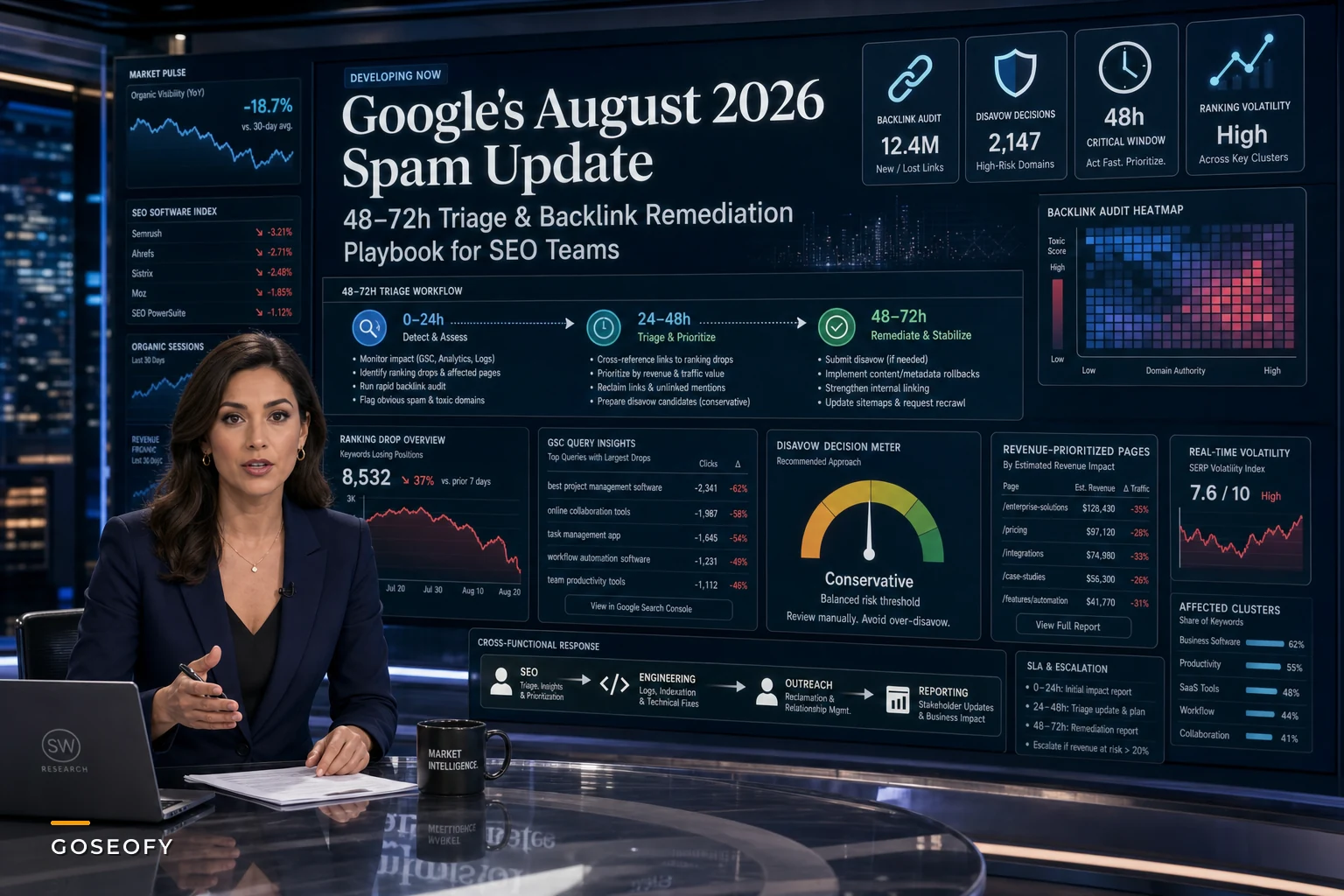

The August 18 spam update is still crawling through Google's index, and if your site runs on organic traffic, you've probably already felt something shift. Some pages jumped. Some fell hard. And a lot of people are staring at a Search Console graph trying to figure out if that dip is the update, seasonality, or something someone broke last Tuesday.
Google confirmed the rollout on its Search Status Dashboard, and it's going global across all languages, which means the volatility window is wide. Search Engine Land's coverage of the release noted the rollout could take several days to finish — and that detail matters more than people give it credit for. A multi-day rollout means your data is noisy. Reacting on day two the way you'd react on day fourteen is how good teams make expensive mistakes.
This isn't a "what is a spam update" post. You know what it is. This is about what you actually do in the first 48 to 72 hours when the numbers are still moving and stakeholders are already Slacking you asking if the site is "penalized."
First: don't remediate anything in the first 24 hours
The most common mistake during a spam update rollout is emergency surgery on a patient that isn't done bleeding yet. Rankings during an active rollout swing both directions. A page can drop 12 spots on Tuesday and recover 9 by Friday — purely because Google is still reprocessing signals across the index.
If you disavow links or rewrite content on day one based on a mid-rollout snapshot, you've changed two variables at once — the update and your fix. Now you'll never cleanly attribute what actually happened. The first 24 hours are for instrumentation, not action. You want clean baselines and segmented monitoring so that when the rollout finishes, you can tell the difference between real damage and rollout noise.
-
Segment your GSC data by query type, not just by page. Branded queries behaving normally while non-branded queries crater tells a very different story than the reverse.
-
Snapshot rankings for your top 50 revenue URLs before the rollout completes, so you have a fixed reference point.
-
Pull server logs from the 14 days before the update. You need to know Googlebot's behavior before so you can spot crawl shifts after.
-
Tag recent changes. Any content, redirect, or link acquisition from the last 60–90 days needs a timeline entry. Spam updates often expose things you did months ago.
That last point is where most of the real damage hides.
The problem spam updates actually expose
Spam updates don't invent penalties from thin air. They re-evaluate signals you've been accumulating — sometimes for a long time. The sites that get hit hardest usually aren't running black-hat schemes. They're running quietly decayed link profiles and thin content that passed muster under old thresholds and stopped passing under new ones.
Stop losing visibility in search results.
GoSeofy helps you monitor, analyze, and improve your SEO performance with ease.
- Comprehensive keyword tracking
- Backlink quality monitoring
- Real-time SEO performance reports
No credit card required
In practice, this tends to show up in one of three patterns:
Pattern one — the forgotten link buy. A company ran a link campaign eighteen months ago, the agency relationship ended, nobody documented what was acquired, and now a batch of low-quality contextual links is suddenly a liability. The team doesn't even know those links exist because the person who bought them is long gone.
Pattern two — programmatic content sprawl. Thousands of near-duplicate pages generated from a template — location pages, filtered category variants, auto-spun product descriptions. Fine when Google was lenient. A target when it isn't.
Pattern three — link rot on the good stuff. This one's sneaky. Your legitimate editorial links — the ones that actually protected you — have quietly broken over the years. Mentions that lost their hyperlink, redirects that collapsed, publisher migrations that dropped your URL. The ratio of low-quality to high-quality links has silently worsened without you acquiring a single bad link.
That third pattern is the one people rarely think about during a spam update, and it's often the most fixable.
Triage priority: sort by revenue exposure, not by drop size
Once the rollout finishes and data settles, you'll have a list of pages that moved. The instinct is to fix the biggest drops first. Resist it. A page that fell from position 4 to 9 on a term driving real bookings matters far more than a page that fell from 22 to 60 on a term nobody converts on. Triage by revenue exposure — roughly, current traffic value multiplied by how much of it is now at risk.
| Tier | Signal | Response window | Action posture |
|---|---|---|---|
| P0 | High-revenue URL, sharp drop, confirmed post-rollout | 0–24h after rollout ends | Diagnose immediately, prep fix |
| P1 | Mid-revenue URL, moderate drop, stable trend | 24–48h | Investigate root cause |
| P2 | Low-revenue URL, any drop | 48–72h+ | Batch review, don't rush |
| Watch | Volatile but not trending down | Monitor only | No action yet |
Teams that recover fastest spend their first two days almost entirely on P0 and refuse to get distracted by the long tail of small movements that'll probably self-correct anyway.
A realistic scenario
A mid-sized outdoor gear retailer — somewhere in the $60k–$70k monthly organic revenue range — saw non-branded traffic drop about 28% in the first four days of the rollout. Panic set in. The initial instinct was to disavow a large batch of links flagged by a third-party tool.
Good thing they waited. When they actually segmented the drop, most of it was concentrated in roughly 40 thin category pages built from a filter template — pages that had accumulated over two years and offered almost nothing unique. Their backlink profile was mostly fine. The real fix wasn't a disavow at all. It was consolidating those thin pages into a smaller set of genuinely useful category hubs, plus reclaiming around a dozen broken editorial links from outdoor publications that had migrated their sites. Recovery took about six weeks, and non-branded traffic came back slightly above where it started — because the consolidation also concentrated internal link equity.
If they'd fired off the disavow on day one, they'd have removed some legitimate links and never identified the actual cause.
Where backlink work fits in the response
Once you've ruled out or handled content-quality issues, the link side of the audit deserves real attention — but it's more about strengthening than disavowing.
Disavow is a blunt tool. Google's own guidance for years has been that most sites should almost never touch it, and spam updates don't change that. Reflexive disavowing during volatility usually causes more harm than the links themselves.
The higher-leverage move is reclaiming and repairing the good links you already earned. Broken mentions, unlinked brand references, lost citations from site migrations — that's free authority sitting there. After a spam update, recovered legitimate signals are exactly what helps you climb back. If you want the full process for finding and repairing those, the backlink reclamation workflow for brands walks through it in detail and pairs naturally with post-update recovery work.
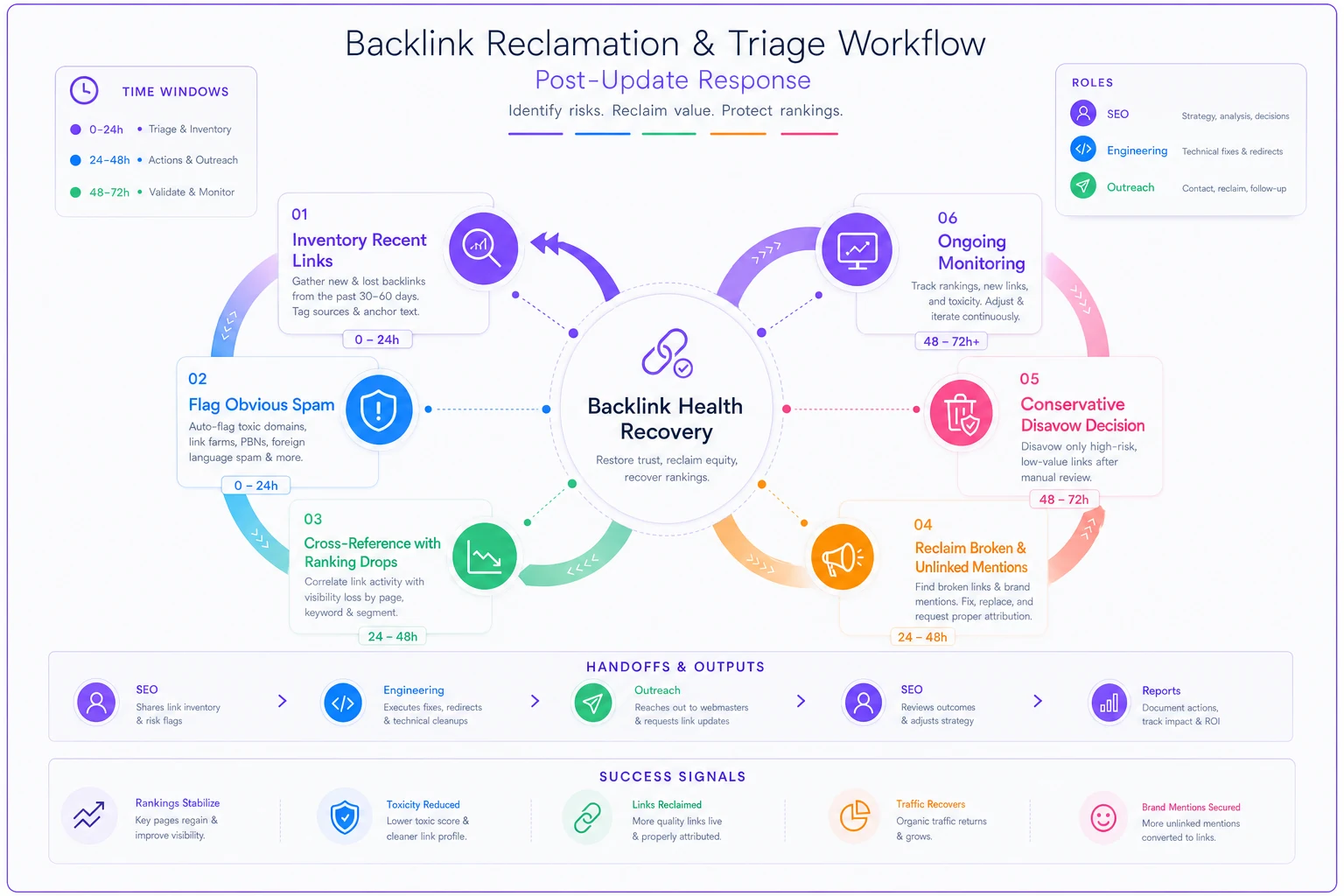
A quick visual of the link-side workflow to pair with the steps below.
Start by reclaiming broken mentions first — big upside with very little downside.
-
Inventory every link acquired in the last 90 days. Recent, deliberate acquisitions are your highest-risk category. Document source, anchor, and how it was obtained.
-
Flag obvious spam — link networks, irrelevant foreign-language directories, comment spam pointing at you. Note them, don't act yet.
-
Cross-reference flagged links against ranking drops. If your dropped pages aren't the ones receiving the questionable links, links probably aren't the problem.
-
Reclaim broken and unlinked mentions first. Upside with almost zero downside.
-
Only disavow when you have clear evidence of manipulation you can't remove any other way — and even then, be conservative.
Start with the link-side order of operations before reaching for the disavow file.
Keeping stakeholders sane during the rollout
One of the quieter operational failures during updates is communication. Leadership sees a traffic dip, assumes catastrophe, and pressures the team into rushed fixes that make attribution impossible.
Get ahead of it. Send a short note when the rollout is confirmed that covers three things: the update is active, data will be noisy for several days, and remediation begins only after the rollout finishes. Set expectations that recovery — if one is needed — is measured in weeks, not days. That one message prevents most of the day-two panic decisions.
For teams managing multiple sites or a large URL set, coordination itself becomes the bottleneck — tracking which pages moved, which changes correlate, who owns which fix, and what response window each tier is on. This is where an operational platform that centralizes monitoring signals, ties them to owners, and holds a triage cadence together actually earns its keep. Not because it does the SEO thinking, but because it keeps a fast-moving, multi-day response from collapsing into fifteen people editing the same spreadsheet.
When aggressive remediation makes sense — and when it doesn't
When it makes sense: you have a clearly documented manipulative link campaign, or a large block of genuinely thin or auto-generated content that adds nothing for users. In those cases, decisive action after the rollout ends is the right call.
When it's a bad idea: the rollout is still in progress, your drop is diffuse across many pages, or you're acting on a third-party "toxicity score" without corroborating evidence. Those scores are estimates, not verdicts, and treating them as gospel has tanked plenty of healthy sites.
Who should mostly hold steady: established sites with strong branded demand and a clean history. If the drop is modest and fundamentals are solid, the best move is often disciplined patience plus link reclamation — not surgery.
The 72-hour checklist
Working through this in order matters more than working through it fast.
-
[ ] Rollout confirmed on Google's status dashboard
-
[ ] Top 50 revenue URLs baselined before rollout completes
-
[ ] GSC segmented by branded vs non-branded and by query cluster
-
[ ] Pre-update server logs pulled and stored
-
[ ] All content/redirect/link changes from last 90 days timelined
-
[ ] Stakeholder expectation-setting note sent
-
[ ] Pages sorted into P0–P2 by revenue exposure, not drop size
-
[ ] Recent link acquisitions inventoried
-
[ ] Broken and unlinked mentions queued for reclamation
-
[ ] No disavow or major rewrites executed until rollout ends
Get through that list without panic-editing anything mid-rollout and you're already ahead of most teams.
Closing thought
Teams that come out of a spam update stronger aren't the ones who move fastest — they're the ones who move last but with the cleanest data. Instrument first, wait for the rollout to finish, sort your response by what actually earns money, and lean harder on recovering the legitimate authority you already built than on nuking links out of fear.
Volatility is uncomfortable, but it's temporary. The habits you build during it — clean baselines, revenue-first triage, disciplined communication — are what protect you through the next one. And there's always a next one.
Ready to elevate your search rankings?
Join 5,000+ businesses using GoSeofy to increase organic traffic, optimize content, and outperform competitors online.