



May's job openings data tells a frustrating story. According to the BLS JOLTS release, openings rose to 7.6 million while actual hiring stayed soft. For SEO teams and marketing departments, this creates a specific operational headache: you need people, the roles are technically open, but getting candidates through the door takes months longer than it did last year.
This disconnect between openings and actual hires hits digital marketing operations particularly hard. SEO isn't something you can pause for three months while waiting on the perfect candidate. Rankings decay. Competitors move into your keyword territory. Technical debt compounds. Content calendars fall behind.
The real challenge isn't finding workarounds—it's accepting that this hiring slowdown might be your new normal for the next year or more, and building systems that can hold up under that pressure.
Why traditional SEO team structures break during hiring delays
Most SEO teams operate on what I'd call the "specialist dependency model." You've got your technical SEO person handling crawl issues and site architecture. Your content lead manages the editorial calendar and keyword research. Maybe there's a link-building specialist or an analytics person rounding things out.
This works great when everyone's in place. But pull out one person—say your technical SEO lead leaves for a better offer—and suddenly you're watching indexation issues pile up while HR tells you it'll be another eight weeks before first-round interviews.
The specialist model assumes replaceability. It assumes you can find someone with the exact skill set you need within a reasonable timeframe. That assumption doesn't hold when hiring remains sluggish despite open positions.
What ends up happening: marketing leads start pulling double duty. Your content person tries to handle technical audits they're not really equipped for. Agencies get called in at premium rates. Projects that should take two weeks stretch to two months.
The hidden cost structure of SEO hiring delays
Direct revenue impact: A mid-size ecommerce site typically pulls 15–20% of organic traffic from technical optimization work—proper indexation, crawl budget management, site speed. Leave those unmanaged for a quarter and you're looking at gradual traffic erosion. Not a cliff, but a slow decline that compounds.
Stop losing visibility in search results.
GoSeofy helps you monitor, analyze, and improve your SEO performance with ease.
- Comprehensive keyword tracking
- Backlink quality monitoring
- Real-time SEO performance reports
No credit card required
Contractor premium: Freelance technical SEO consultants know the market right now. Rates that were $150–200/hour eighteen months ago now start closer to $250, and a lot of the good ones are already booked out. One agency head mentioned they're paying contractor rates that exceed what a full-time senior hire would cost, just to maintain coverage.
Opportunity cost: Every week without proper keyword research is a week competitors can capture emerging search trends. Every month without link reclamation is lost domain authority you can't recover. These aren't dramatic losses—they're the slow bleed that shows up in year-over-year comparisons.
Team burnout: When your remaining team has to cover for missing roles, quality drops. Not because they're bad at their jobs, but because context switching between specialties is cognitively expensive. Your content strategist doing technical audits isn't just slower—they're more likely to miss things that matter.
Building triage systems that actually work
The mistake most teams make is trying to maintain business as usual with fewer people. That doesn't work. You need explicit triage criteria that everyone actually follows.
Start with revenue protection. Which pages drive actual conversions? Not traffic, not impressions—conversions. Those pages get first priority on everything: technical fixes, content updates, internal links. Everything else waits.
-
Indexation problems on revenue pages
24 hours
-
Broken internal links on category pages
48 hours
-
Meta description updates on blog posts
next sprint
-
Content refreshes on non-converting pages
when capacity allows
This isn't about being harsh. It's about being realistic. Your team needs explicit permission to deprioritize work that doesn't directly protect revenue—otherwise they keep spinning on low-value tasks because nobody told them to stop.
-
Issue reported
-
Is it on a revenue-generating page? Yes → Assign SLA based on issue type → Resolve within window No → Queue for next sprint or backlog
-
Document resolution → Flag if it recurs
The point isn't to build a perfect system. It's to stop your team from making judgment calls on every single ticket without any framework to lean on.
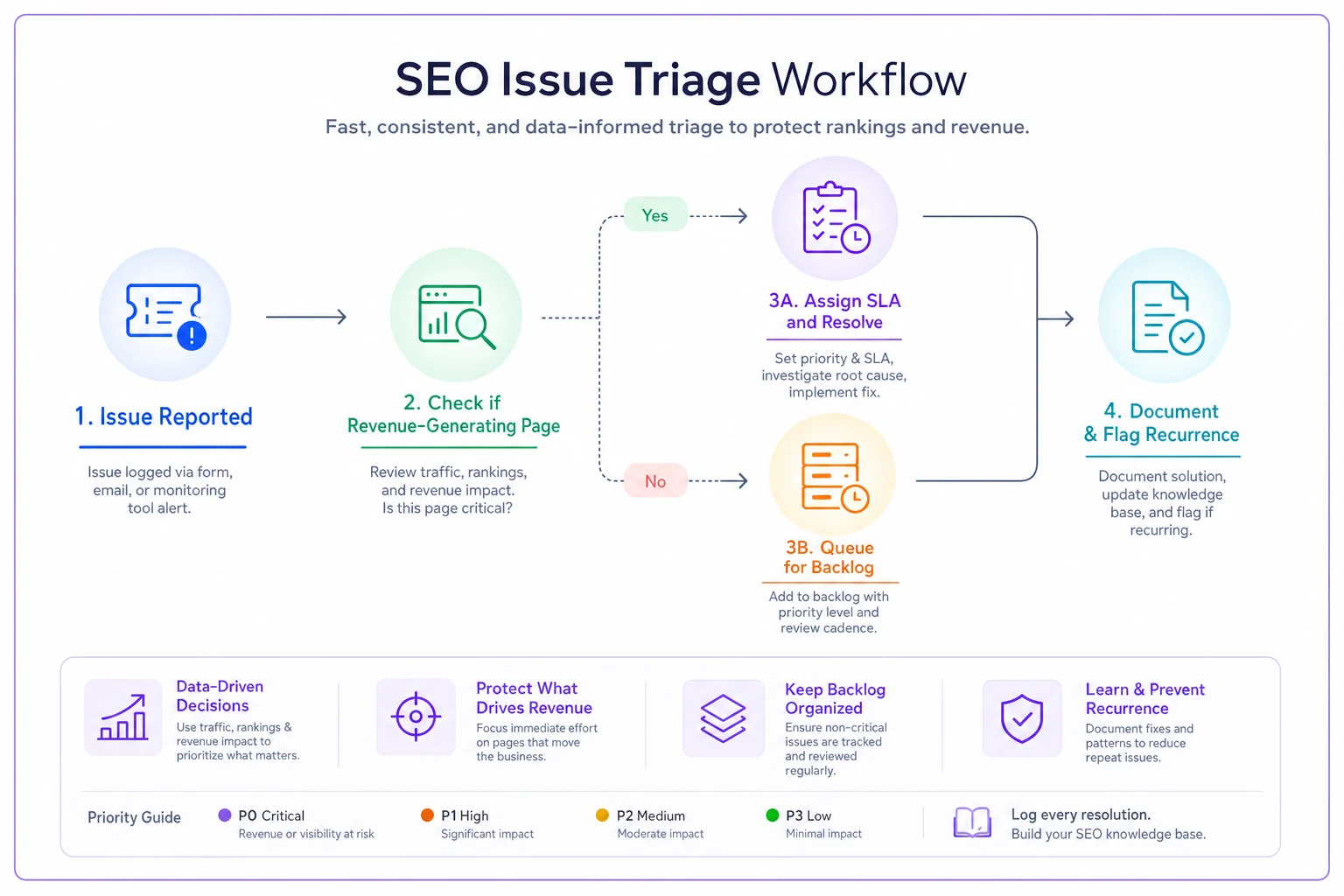
A few teams handle this well by running a weekly triage call—15 minutes, no longer—just to re-rank the active issue queue against current revenue priority. It's low overhead and it stops the wrong things from quietly eating up the week.
The automation conversation nobody wants to have
A lot of traditional SEO work doesn't need human intervention anymore. Keyword tracking, rank monitoring, broken link detection—these are solved problems. The main reason teams still handle them manually is inertia.
The hiring slowdown forces this conversation. When you can't hire, you either do less work or automate the repetitive stuff.
Automate crawl monitoring to send actionable alerts rather than raw reports so engineers only see issues that matter to revenue pages.
Not talking about replacing SEO expertise with ChatGPT prompts. Talking about operational automation for the grunt work that eats up maybe 40% of your team's time. Crawl monitoring that actually alerts you to problems instead of generating reports nobody reads. Keyword research workflows that automatically surface gaps based on competitor movements. Link monitoring that creates tickets when high-value backlinks drop.
These capabilities exist right now across different platforms. The resistance usually comes from SEO professionals worried about being replaced. But the current hiring market proves the opposite: there's more SEO work than people available to do it. Automation just lets your team focus on the work that actually requires judgment.
Restructuring from specialists to operators
The specialist model assumes abundance—talent, time, budget. The current market doesn't offer much of any of those.
The teams adapting best are restructuring around operational capability rather than deep specialization. Instead of a "technical SEO specialist," they're hiring people who can handle 80% of technical issues, 80% of content optimization, and 80% of link building.
You lose some depth. But you gain resilience. When someone leaves, others can cover without the whole operation grinding to a halt. When hiring drags, you can function with fewer people.
This requires a different training approach too. Instead of sending people to advanced technical SEO conferences, you're teaching them operational workflows. Instead of deep-diving into log file analysis, you're showing them how to identify and escalate the issues that actually matter.
What contract structures make sense now
The traditional agency retainer model breaks down when you need specialized help for unknown durations. You don't want to lock into a 12-month contract if you might hire someone in month three. But you also can't rely on ad-hoc freelancer availability when most of the good ones are already booked.
| Contract Type | Best For | Risk |
|---|---|---|
| Full agency retainer | Long-term gaps, full program coverage | Cost, misaligned incentives |
| Pure hourly freelance | Specific project bursts | Availability, budget uncertainty |
| Baseline retainer + hourly | Ongoing monitoring + ad-hoc projects | Requires negotiation upfront |
| Shared fractional pod | Small teams splitting costs across companies | Coordination overhead |
A few marketing teams are running a "pod" structure—sharing fractional contractors across three or four companies to ensure coverage while splitting costs. It takes coordination, but it's more sustainable than everyone competing for the same scarce freelancer pool.
The sweet spot seems to be baseline retainers for essential monitoring, with pre-negotiated hourly rates for project work when it comes up.
Technical debt: pay now or pay forever
Every SEO team accumulates technical debt. Old redirect chains. Duplicate content that should be consolidated. Orphaned pages missing internal links. When you're fully staffed, you chip away at these during slower periods.
When you're understaffed, technical debt starts collecting interest. Those redirect chains cause crawl budget problems. Duplicate content cannibalizes rankings. Orphaned pages quietly drop out of the index.
The hiring slowdown forces a real decision: actively manage technical debt now with whatever resources you have, or accept you'll be dealing with compounded problems for years.
This is where having clear operational systems becomes critical. You need standardized processes for identifying, prioritizing, and resolving technical issues—processes that don't depend on a specific person being available to run them. When those processes live in one person's head, they leave with that person.
The teams that handle this well tend to keep a living technical debt register—nothing fancy, just a shared doc or project board that logs known issues, estimated impact, and current status. It means when someone new comes in, or a contractor steps in to cover, they're not starting from scratch.
The competitive advantage of operational discipline
Most of your competitors are facing the same hiring challenges. Same delayed recruitments, same contractor costs, same team burnout. The differentiator isn't who hires faster—it's who operates better with less.
That means documented workflows that new team members or contractors can actually follow. Not hundred-page manuals, but practical runbooks for common scenarios. What do you check when organic traffic drops 15% week-over-week? How do you investigate indexation problems? What's the escalation path for site speed issues?
It means measurement focused on what's actually happening, not vanity metrics. Revenue per organic session, not just traffic. Indexation rate for high-value pages, not total indexed pages. Link equity flow to money pages, not total backlinks.
And it means accepting that perfect is the enemy of functional. Your keyword research might not be as thorough as when fully staffed. Your technical audits might miss some edge cases. Maintaining 80% effectiveness with 60% of your ideal headcount is still a win.
Building systems for the next hiring crunch
Nobody wants to admit this: this won't be the last time hiring gets difficult. Economic cycles, competitive markets, skill shortages—there will always be periods where you can't hire who you need when you need them.
The smart move isn't hoping for better conditions. It's building operational systems that flex with available resources. Modular workflows where tasks can be redistributed without losing context. Automation for repetitive work that doesn't require human judgment. Clear documentation that lets contractors contribute quickly without weeks of onboarding.
Some teams are going further, building what you'd call an "SEO operating system"—integrated platforms that handle monitoring, alerting, workflow management, and reporting in one place. Instead of juggling seven tools that don't talk to each other, they consolidate around operational platforms that maintain continuity regardless of who's running them. When the next hiring gap hits, the operation doesn't collapse because it was built around systems, not individuals.
The hard conversation about priorities
When you can't do everything, you have to choose. Most SEO teams are bad at making these choices explicitly. They try to maintain all existing initiatives at lower quality rather than cutting some entirely.
Half-hearted link building is worse than no link building—it wastes time without moving the needle. Sporadic content publishing undermines any topical authority you've built. Partial technical fixes often create new problems.
Better to explicitly pause certain initiatives while maintaining others at full strength. Maybe you stop all link building for three months and focus entirely on technical optimization and content refreshes. Maybe you pause new content creation to concentrate on improving existing high-value pages.
These decisions need to be documented and communicated. Your CMO needs to understand why you're not publishing new content this quarter. Your sales team needs to know competitor comparison pages won't be updated. Setting clear expectations is the only way to stop the constant fire drills that burn out whoever's left.
Eventually, hiring will normalize. Maybe not to where it was, but to something more manageable. The teams that thrive post-recovery won't just be the ones that survived—they'll be the ones that used the constraint to build better operations.
Because when you finally hire that technical SEO specialist you've been waiting on: if you've built good systems, they multiply your capability immediately. If you've been running on pure effort and duct tape, they spend six months just trying to understand the mess.
The hiring slowdown is forcing a professionalization of SEO operations that was probably overdue anyway. Teams that come out stronger will have learned that operational discipline beats specialist expertise when resources are constrained—and they'll have the documentation and processes to prove it. The current environment isn't just a temporary problem to endure, and the teams that recognize that while competitors are just grinding through it will be in a much better position when conditions eventually improve.
Ready to elevate your search rankings?
Join 5,000+ businesses using GoSeofy to increase organic traffic, optimize content, and outperform competitors online.