

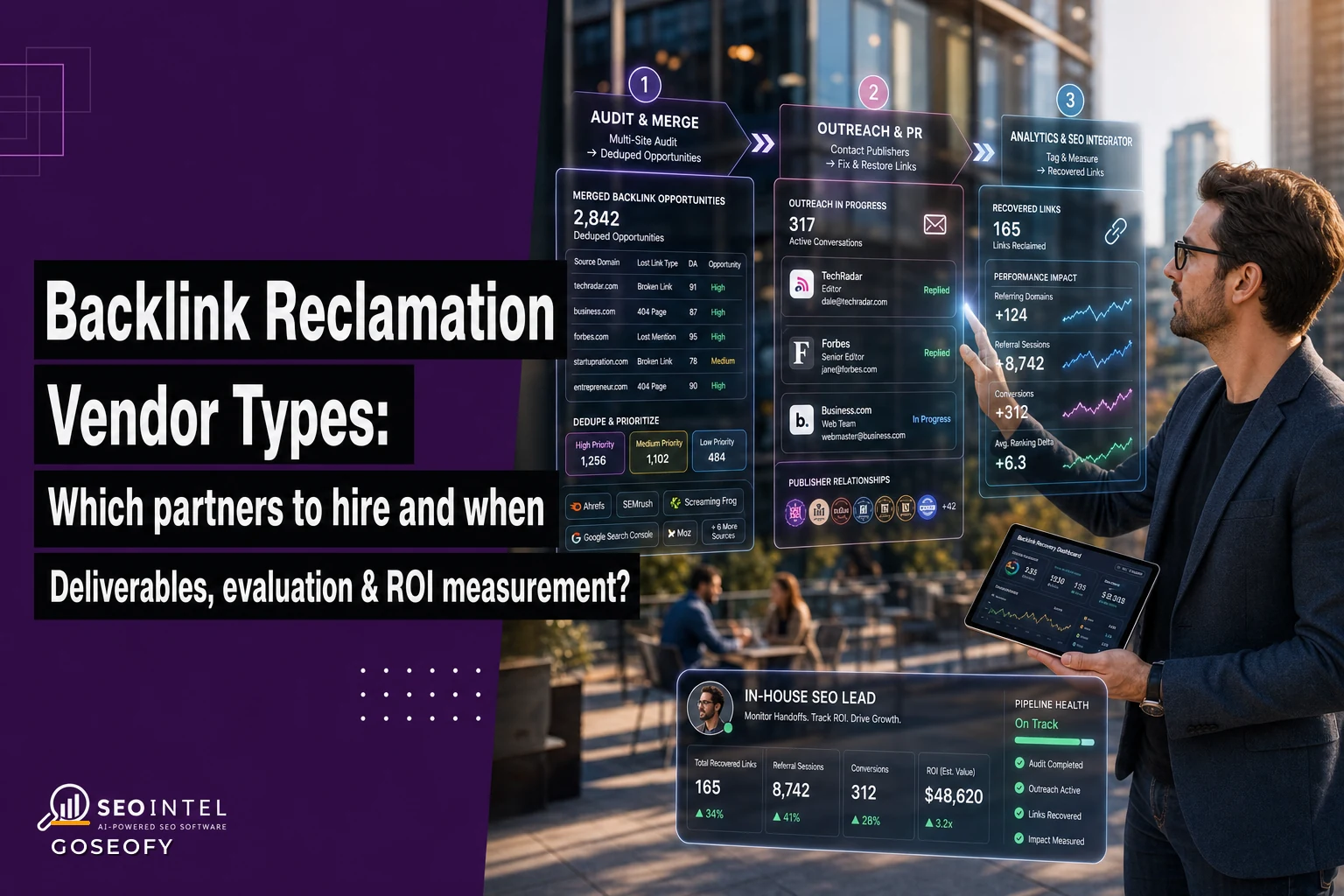

Most brands don't fail at backlink reclamation because they picked a bad vendor. They fail because they hired one vendor expecting it to do three completely different jobs. The agency that's great at outreach has no idea how to parse your log files. The audit platform spits out a 40,000-row spreadsheet and calls it a deliverable. And nobody on either side can tell you whether the links you reclaimed actually drove traffic.
The reclamation work itself—finding legacy mentions, broken links, unlinked brand references—is well understood. If you need the internal process, the backlink reclamation workflow for brands covers how to discover those opportunities and turn them into measurable traffic. This article is about the layer most teams skip: deciding who to bring in from outside, what each type of partner should actually hand you, and how to keep them accountable on ROI.
The three vendor types (and why you usually need more than one)
Think of reclamation as a relay. Someone finds the broken or missing links at scale. Someone contacts publishers and gets the fixes made. Someone connects those recovered links back to real traffic numbers so finance doesn't think you spent six months on a vanity project.
| Vendor type | What they're actually good at | What they're *not* good at | When you bring them in |
|---|---|---|---|
| Multi-site audit platforms | Crawling, backlink discovery, broken-link detection across properties | Human outreach, relationship nuance, attribution | First—you need the target list before anything else |
| Outreach / PR providers | Contacting webmasters, editors, journalists; negotiating edits | Technical attribution, crawl depth | Second—once you have a prioritized list |
| Analytics / SEO integrators | Tying reclaimed links to sessions, conversions, revenue | Discovery volume, publisher relationships | Throughout—ideally scoped before outreach starts |
Teams that get burned usually only hire from the middle column. They sign a PR shop, hand over a messy list, and have no way to prove the work paid off. Six months later the contract gets cut because "we couldn't see the impact"—even though the impact was real, just unmeasured.
There are three vendor types worth knowing. They're complementary, not interchangeable, and the biggest mistake is treating them like they overlap.
Vendor type 1: Multi-site audit platforms
This is your discovery engine. For brands with more than one domain—regional sites, acquired properties, a separate blog subdomain, legacy microsites from old campaigns—the audit has to run across all of them at once. That's the part generic tools consistently miss.
Stop losing visibility in search results.
GoSeofy helps you monitor, analyze, and improve your SEO performance with ease.
- Comprehensive keyword tracking
- Backlink quality monitoring
- Real-time SEO performance reports
No credit card required
A real example: a mid-size outdoor-gear brand had five properties, including two from acquisitions. Their last "backlink audit" only covered the main .com. The acquired domains had something like 1,100 broken inbound links pointing at dead product URLs—press mentions, review sites, affiliate roundups—all returning 404s. Nobody had looked because nobody had scoped those domains into the audit.
-
Multi-site backlink auditing — a single consolidated view across every property you own, not five separate exports you have to stitch together manually
-
Broken inbound link detection with the exact target URL, referring page, anchor text, and surrounding context
-
Unlinked brand mention discovery — places your brand is named but not hyperlinked
-
Link authority scoring so you can sort by which recoveries are actually worth outreach time
-
Historical/lost link tracking — links you used to have that vanished after a migration or redesign
-
Deduplication and ownership tagging so a mention hitting three of your domains doesn't get worked three separate times
Watch for platforms that crawl one site fine and get clumsy on the second. Before signing, make them demo the audit on two of your actual domains simultaneously and show you a merged, deduplicated list. If they can only hand you separate reports, you're paying for a spreadsheet you could have exported yourself.
The platforms worth talking to are the ones built to handle multi-property complexity without requiring you to manually reconcile everything afterward. That's a higher bar than most tools clear.
Vendor type 2: Outreach and PR providers
Discovery is cheap compared to outreach. This is the labor-heavy part—finding the right contact, writing something a busy editor will actually respond to, and following up without being annoying.
The quality gap between outreach vendors is enormous. Cheap ones blast identical templates to 500 webmasters and report "500 emails sent" as a meaningful metric. The good ones segment by opportunity type—a journalist who mentioned you needs a completely different message than a webmaster whose affiliate link just broke.
-
Segmented outreach templates built per scenario — broken link fix, unlinked mention, outdated URL, acquired-domain redirect request—each treated differently
-
Contact discovery and verification — actual editor and webmaster emails, not generic info@ addresses that go nowhere
-
Personalization at the first-touch level, not just a merged first name in a canned paragraph
-
Follow-up cadences with defined touch limits (usually two or three, then stop)
-
Response tracking and categorization — fixed, declined, no response, needs follow-up
-
A clean handoff log showing which URL was requested, who was contacted, and the outcome
"Automated" shouldn't mean "identical." The strongest setups use template frameworks—a reliable skeleton per scenario—with specifics filled in per recipient: the exact broken URL, the page it should point to, the context of the original mention. That's the difference between a 3% reply rate and something closer to 15–20% on broken-link requests, which are the easiest wins in the category because you're actually doing the publisher a favor.
Ask any outreach vendor for reply rates by opportunity type. If they only quote a blended number, they're probably hiding how badly the cold, low-relevance outreach is performing.
Vendor type 3: Analytics and SEO integrators
This is the vendor type brands forget—and quietly the main reason reclamation programs die. You can recover 300 links and still have nobody able to answer "what did that actually do for traffic?"
An integrator's job is to wire recovered links into your measurement so each win connects to sessions, assisted conversions, or revenue. In practice, that means tagging reclaimed links and watching referral and organic behavior around the URLs they point to.
-
A method to attribute reclaimed links to traffic KPIs — referral sessions from the recovered link, plus any ranking lift on the target page
-
Baseline capture for each target URL before the link is restored, so you have an actual comparison point
-
Referral-path tracking to confirm traffic is arriving via the reclaimed link
-
Integration with your existing analytics stack (GA4, Search Console, your data warehouse) rather than a siloed dashboard nobody checks
-
A reporting cadence that separates direct referral traffic from downstream ranking improvements
-
Link-persistence monitoring — alerts if a reclaimed link gets removed again later
The honest thing nobody usually says: not every reclaimed link drives measurable referral traffic. A broken link on a low-traffic blog from 2019 might send two visits a month. The value is aggregate link equity and the occasional high-traffic recovery. A good integrator will tell you this upfront and focus attribution on the links that can actually move KPIs, rather than pretending all 300 recoveries deserve equal credit.
A vendor-evaluation checklist
Run every candidate through this before signing anything:
-
[ ] Can they demonstrate the capability on your actual domains, not a sample case study?
-
[ ] For audit platforms
does the multi-site report come back merged and deduplicated?
-
[ ] For outreach
do they share reply rates segmented by opportunity type?
-
[ ] For integrators
can they capture a pre-reclamation baseline for target URLs?
-
[ ] Do they define who owns the handoff between discovery → outreach → attribution?
-
[ ] Is reporting tied to traffic/revenue KPIs, or just "links recovered"?
-
[ ] Do they monitor for re-broken or removed links after the win?
-
[ ] Can their data export cleanly into your own tools without lock-in?
-
[ ] Are deliverables defined by outcome, not activity volume?
That last point matters most. A vendor who commits to "500 emails/month" is selling activity. A vendor who commits to verified link recoveries with attribution is selling an outcome. Only one of those survives a budget review.
Contract and tech-integration considerations
The place these engagements fall apart isn't usually the work—it's the seams between vendors.
-
Define the handoff format up front. The audit platform's export needs to feed directly into the outreach vendor's workflow, and the outreach vendor's results log needs to feed the integrator. Agree on the field structure before work starts, or you'll lose weeks reformatting spreadsheets between three parties.
-
Assign one owner for the full pipeline. Usually your in-house SEO lead. Without this, each vendor optimizes for their slice and nobody owns the end-to-end number.
-
Scope attribution before outreach begins, not after. If baselines aren't captured before links get restored, you can't prove lift. This is the single most common sequencing mistake.
-
Clarify data ownership. Your backlink data, contact lists, and attribution reports should belong to you and export freely if you switch vendors.
-
Set a monitoring tail. Build in 60–90 days of post-reclamation link-persistence checks so recovered links that disappear again get flagged.
Agree on the field structure before work starts, or you'll lose weeks reformatting spreadsheets between three parties.
When hiring these vendors actually makes sense
Outside help pays off when volume justifies it—typically multiple domains, a long brand history, or a backlog of migrations and acquisitions that left broken links scattered across properties.
If you've got a thousand-plus broken inbound links and no internal bandwidth, vendors are a clear win.
When it's a bad idea
If you're a single-domain brand with a few hundred total backlinks, hiring three vendors is overkill. You can run the whole thing in-house using the reclamation workflow and a basic outreach sheet.
And if you can't commit someone internally to own the pipeline, don't hire vendors yet. Uncoordinated vendors produce activity reports, not recovered equity. Fix the ownership gap first.
A quick real scenario
A regional home-goods retailer with three domains—main store, a design blog, and an acquired competitor site—ran this as a two-vendor-plus-integrator engagement over about four months. The audit surfaced roughly 1,400 broken or unlinked opportunities across all three properties, most of them on the acquired domain nobody had been maintaining.
Outreach focused on broken-link recoveries first, since those were the easiest approvals. They recovered somewhere around 180 links over the engagement. The integrator attributed a modest but real referral lift—a few hundred extra monthly sessions landing on previously orphaned product pages—plus ranking improvement on about a dozen target URLs that had lost equity during the acquisition migration.
Nothing explosive. But the recovered pages were ones they already owned and had already paid to build, so the return-on-effort was solid. What made it work wasn't any single vendor—it was that attribution was scoped on day one, so when the quarterly review came, the SEO lead had referral numbers tied to specific recovered links instead of a bare "we got 180 links" slide.
Bringing it together
Backlink reclamation isn't a one-vendor purchase. The audit platform finds opportunities across all your properties, the outreach provider turns them into actual fixes, and the integrator proves the whole thing moved traffic. Skip the integrator and your program dies at the first budget review. Skip multi-site scoping and you'll miss the acquired-domain backlinks that are often the richest source of recoverable equity.
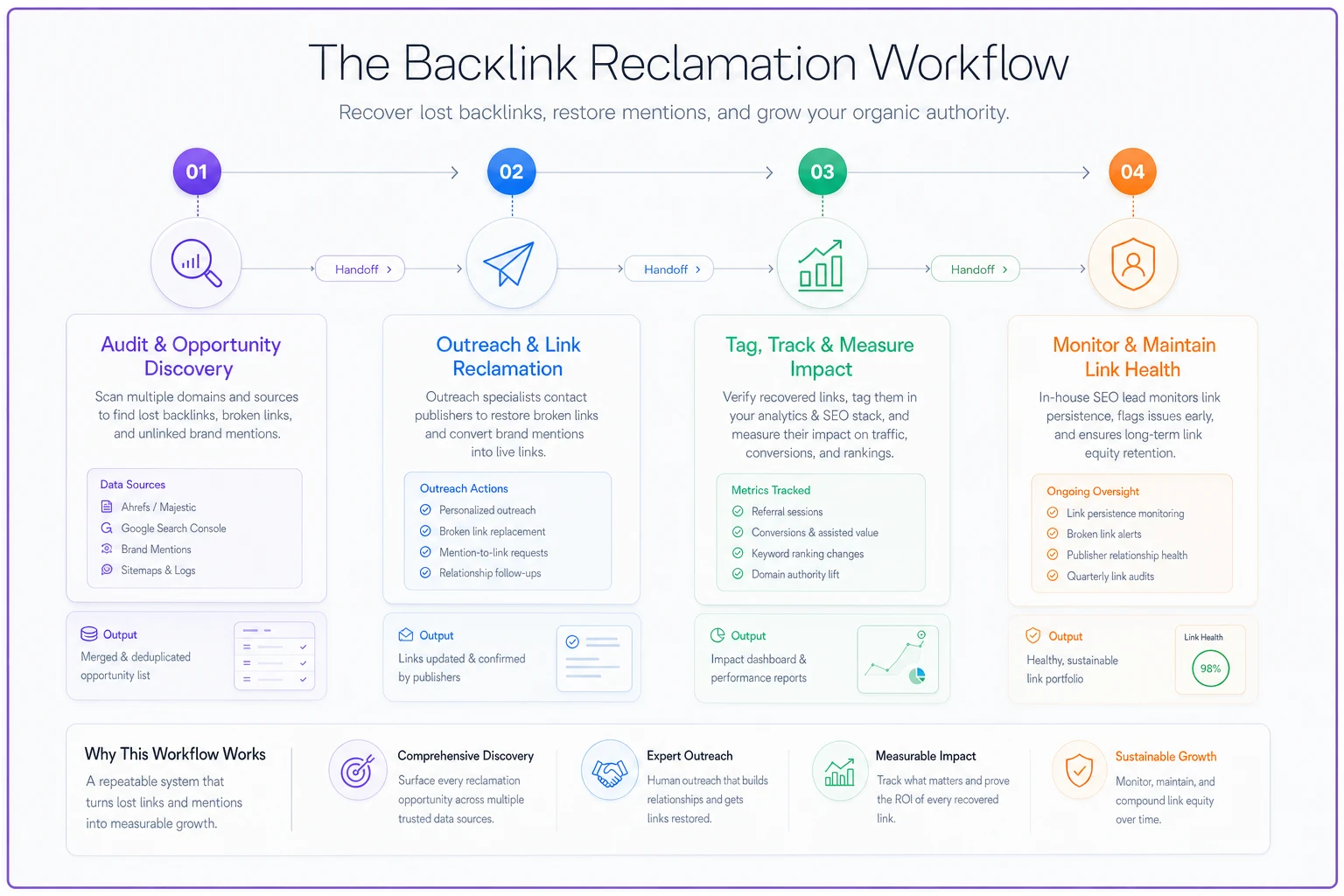
A simple visual of the pipeline helps teams align responsibilities and see where each vendor plugs into the process.
Before you hire anyone, make sure your internal process is solid—the backlink reclamation workflow for brands is where the operational alignment lives. Vendors should plug into that workflow, not replace your understanding of it. Hire outside help to scale what you already know how to run, with one owner holding the pipeline together and attribution scoped before the first email goes out.
Before you hire anyone, make sure your internal process is solid—the backlink reclamation workflow for brands is where the operational alignment lives. Vendors should plug into that workflow, not replace your understanding of it. Hire outside help to scale what you already know how to run, with one owner holding the pipeline together and attribution scoped before the first email goes out.
Ready to elevate your search rankings?
Join 5,000+ businesses using GoSeofy to increase organic traffic, optimize content, and outperform competitors online.