


Most affiliate pages don't lose rankings because of a penalty. They lose because ten partners published the exact same product blurb you gave them, three of those partners have higher domain authority, and Google picked one of them as the canonical version of your content. You wrote it. They rank for it. That's the whole game most people don't see happening.
This playbook is narrow on purpose. It covers the operational side of affiliate and partner pages: how you disclose properly, how you control canonicalization when your content lives in twelve places, how you set nofollow/noreferrer rules without tanking your legit links, and how you actually monitor for syndicated duplication and cloaking when you have hundreds of these pages. Not "write good content." The mechanical stuff that decides whether your affiliate program helps or quietly cannibalizes you.
Start with the failure that costs the most: duplicate content you handed out yourself
Here's the pattern that shows up constantly. A brand builds a partner program or affiliate hub. They write clean product descriptions, comparison blurbs, and landing copy. Then they distribute that copy to affiliates so everyone's messaging stays consistent. Feels smart. Brand-safe.
Six weeks later the original page's impressions start to erode — not a cliff, just a slow bleed. Because the same 400-word description now exists on eight partner sites, and Google is choosing which URL best deserves the ranking. When a partner has stronger link signals, they win the SERP slot for your own words. You've effectively donated your ranking equity.
A typical version of this: a mid-size gear retailer syndicated its "best beginner kayaks" roundup to around 15 affiliate blogs. Within two months, three of those blogs were outranking the retailer's own version for the head term. The retailer was paying commission to partners who were ranking on content the retailer created. Paying twice for one asset.
The fix isn't "stop syndicating." Syndication drives revenue. The fix is deciding, per page, who is allowed to be the canonical source — and enforcing it technically, not just contractually.
Canonicalization rules that actually hold up when content is everywhere
Canonical tags are the single most misused control on affiliate pages. People either forget them entirely or apply them so inconsistently that Google ignores the signal.
Stop losing visibility in search results.
GoSeofy helps you monitor, analyze, and improve your SEO performance with ease.
- Comprehensive keyword tracking
- Backlink quality monitoring
- Real-time SEO performance reports
No credit card required
Two scenarios you need clear rules for:
When you are the source and partners republish. Every partner copy should carry a rel="canonical" pointing back to your original URL. This is the only clean way to consolidate ranking signals back to you. The catch: you have to enforce it in the syndication agreement and verify it, because most partners strip it, forget it, or their CMS quietly overwrites it.
When you host affiliate or partner landing pages that are near-duplicates of each other. Say you spin up /partners/acme and /partners/beta and both are 90% templated. Either pick the strongest one as canonical or make each page genuinely differentiated. Self-referencing canonicals across near-identical templated pages just tells Google "these are all the same," and it'll index one and quietly drop the rest.
| Scenario | Canonical points to | nofollow on outbound affiliate links? | Index or noindex |
|---|---|---|---|
| Your original content, syndicated to partners | Your URL (on partner pages) | N/A (their page) | Index (yours) |
| Partner-supplied content you host | Partner's original URL | Yes, sponsored | Often noindex if thin |
| Templated affiliate landing pages (near-dupe) | Strongest single page | Yes, sponsored | Index the canonical only |
| Unique review/comparison you wrote | Self-referencing | Yes/sponsored on money links | Index |
| Coupon/deal pages refreshed constantly | Self-referencing | Yes, sponsored | Index if genuinely useful |
The mistake people make: treating canonical as a "set once" tag. On affiliate pages, the content, the partners, and the templates all shift monthly. A canonical that was correct in March is pointing at a redirected or pruned URL by August. If you've done any content pruning work, you already know how fast canonical targets rot when pages get consolidated underneath them.
Disclosure: get it right or the whole page becomes a liability
Disclosure isn't just an FTC checkbox. Sloppy disclosure creates two separate problems — a compliance one and an SEO one — and most people only think about the first.
The compliance side is straightforward: a clear, conspicuous statement that you earn commissions, placed above the first affiliate link, not buried in a footer. "As an affiliate we may earn from qualifying purchases" near the top of the page. Simple enough.
The SEO side is where things get missed. Disclosure text should be real HTML text — not baked into an image, not injected only via JavaScript that some crawlers don't render, not hidden behind an expandable that loads on click. When your disclosure only appears after a user interaction, you've created a soft cloaking situation: the crawler sees one page, the user sees another. That's exactly the kind of inconsistency that gets affiliate-heavy sites scrutinized.
A disclosure setup worth standardizing across every affiliate page:
-
One-line disclosure in server-rendered HTML, positioned before the first monetized link
-
Same disclosure on every page in the affiliate section — no exceptions, no "we forgot this template variant"
-
Both machine-readable and human-readable versions present (visible text, not just a schema field)
-
A link to a fuller disclosure or affiliate policy page for anyone who wants the legal detail
Something worth flagging: brands who put thorough disclosure on their flagship review pages and nothing on the 300 programmatically generated deal pages. Google evaluates the section, not just the showcase page.
nofollow, sponsored, and noreferrer — stop treating them as one setting
This is where otherwise-clean affiliate sites leak trust in weird directions.
Money links — the actual affiliate and tracking links — should be marked rel="sponsored". That part most people get right.
Where it breaks:
Blanket nofollow on everything. Some CMS plugins or affiliate managers apply nofollow to every outbound link on affiliate pages, including editorial links to sources, manufacturer spec pages, and internal navigation. Now your internal linking on those pages passes no signal, which quietly weakens the topical structure you built. If you've set up any topic-cluster interlinking, a blanket-nofollow affiliate template can silently cut those hub pages off from the equity you intended to flow through them.
noreferrer confusion. noreferrer strips the referrer header — useful for privacy and sometimes for obscuring outbound source data — but if your affiliate network needs the referrer to attribute the sale, adding noreferrer can break tracking and cost you commissions. Some networks handle it fine. Others silently drop conversions. Test it before you assume.
The rule set that holds up:
-
Affiliate/tracking links →
rel="sponsored" -
Editorial or reference outbound links → normal follow (unless there's a real reason not to)
-
Internal links → always follow, never nofollow
-
noreferrer→ only when privacy requires it AND your network still attributes correctly
The rule set that holds up:
The part almost nobody operationalizes: monitoring for syndicated duplication and cloaking at scale
Setting canonical and disclosure rules is a one-time policy decision. Enforcing them across hundreds of pages and dozens of partners over time is where every program eventually falls apart. Partners change CMSs. A theme update strips your canonical. A syndication feed republishes without the tag. Someone scrapes your content and doesn't tell you.
[Fingerprint source content] ↓ [Weekly web search for distinctive phrases] ↓ [Identify non-owned URLs surfacing your text] ↓ [Fetch partner pages → verify canonical present] ↓ [Crawl affiliate pages as Googlebot + browser → diff rendered output] ↓ [Alert on changes, not full-report review] ↓ [Log: domain, URL, canonical status, cloaking flag]
Visualized workflow for the monitoring loop:
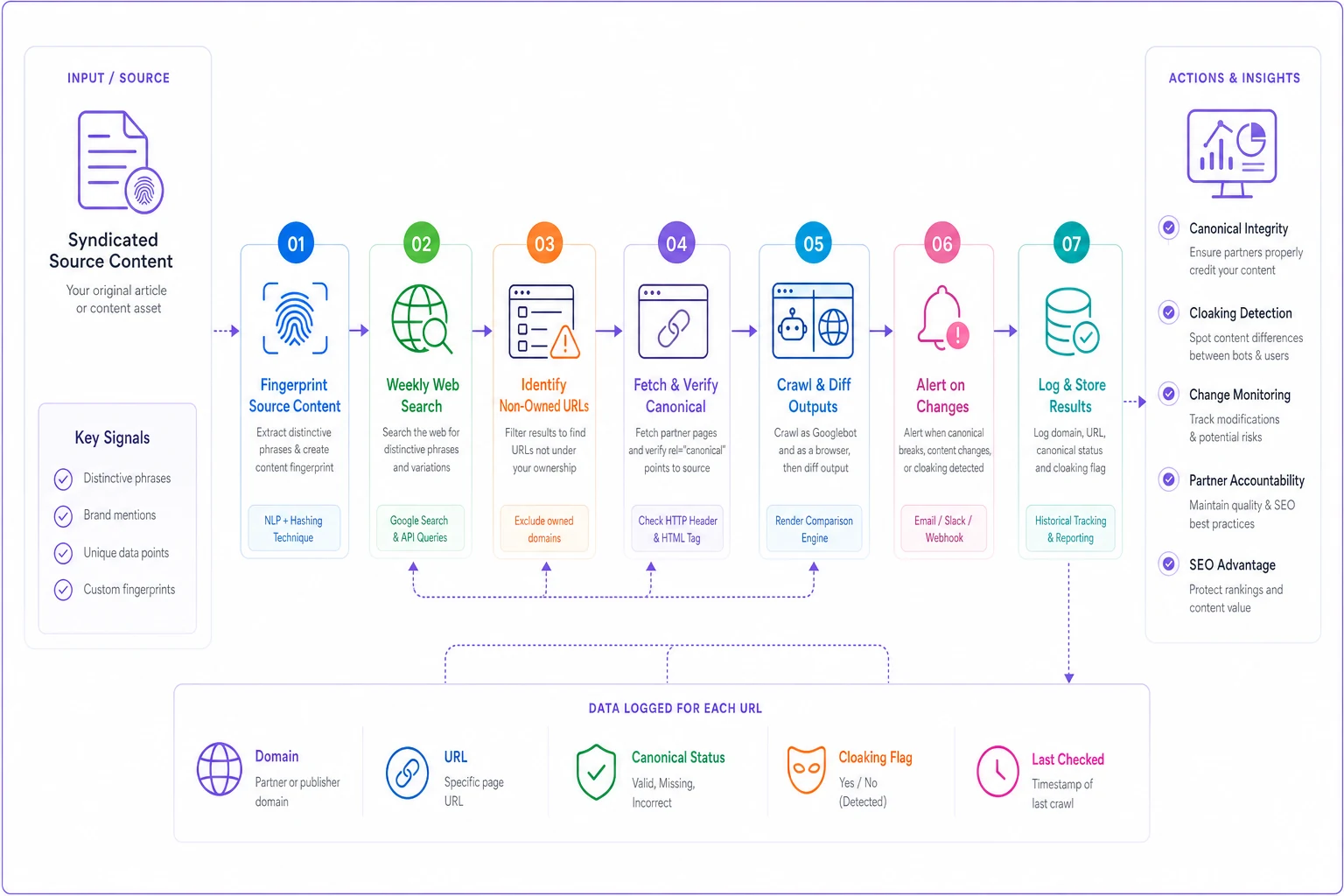
Store fingerprints with timestamps so you re-scan only changed pages and reduce noisy alerts.
Step 1 — Fingerprint your source content. For each original page you syndicate, store a normalized text fingerprint — a hash of the meaningful body text, stripped of nav and boilerplate. This is your reference point for what's yours.
Step 2 — Search the web for that fingerprint on a schedule. Pull the first sentence or a distinctive phrase and run it through search weekly or every two weeks. Every result that isn't your URL is a syndication or a scrape. Log the domain, the URL, and whether it carries your canonical.
Step 3 — Verify the canonical on partner copies. For each known partner republishing your content, fetch the page and confirm rel="canonical" points back to your URL. Flag any that dropped it. This single check catches more ranking loss than anything else on the list.
Step 4 — Detect cloaking on your own pages. Crawl your affiliate pages as Googlebot user-agent AND as a normal browser, then diff the rendered content. If the disclosure, the affiliate links, or the body text differs between the two, you have an accidental cloaking problem. This catches JavaScript-injected content, geo-redirects, and disclosure that only renders for users.
Step 5 — Alert on drift, not on state. Don't review a giant report weekly. Alert only when something changes: a partner's canonical disappeared, a new domain started ranking with your text, a page's bot-rendered version diverged from what users see. Change-based alerts are what make this sustainable across hundreds of pages.
A monitoring checklist you can run against every affiliate page:
-
Canonical present and pointing to the intended URL
-
Disclosure server-rendered above first monetized link
-
Affiliate links carry
rel="sponsored" -
Internal links are follow
-
Bot-rendered and user-rendered content match
-
No unexpected external domains outranking you for the page's core phrase
-
Partner republications carry your canonical
This visual maps the monitoring steps and helps teams standardize checks before rankings move.
A real scenario, numbers included
A specialty supplement brand ran an affiliate program with around 40 active partners and roughly 220 monetized pages. Traffic to their own review hub had been sliding for a quarter with no obvious cause — no algorithm hit, no manual action, nothing in Search Console that looked alarming.
When they fingerprinted their top 30 pages and searched for the text, they found that 6 partners had republished full articles without the agreed canonical. A CMS migration on the partners' side had stripped it. Two of those partners were outranking the brand's originals for terms the brand's own pages should have owned. On top of that, about 25 of the brand's templated deal pages had disclosure that only loaded via a click-to-expand widget — invisible to crawlers.
The fixes were unglamorous. They got partners to restore canonicals, and for the two that dragged their feet, the brand rewrote those pages to be substantially different and stronger than what the partners had. All disclosure moved into server-rendered HTML. Over the next couple of months, the hub's impressions recovered to roughly pre-slide levels, and a few head terms they'd lost to partners came back to their own URLs. Not an overnight jump — a steady recovery once the actual leak was plugged.
Nothing was penalized. The brand was just quietly losing to its own distributed content, and no one had built anything to watch for it.
When this level of rigor makes sense — and when it doesn't
When it's worth it: You syndicate content to partners, run programmatically generated affiliate pages at volume, or have partners with stronger domains than yours. At that point, duplication and canonical drift are near-guaranteed. The monitoring loop pays for itself the first time it catches a stripped canonical before rankings move.
When it's overkill: You have a handful of hand-written review pages, no syndication, and you control every URL. A quarterly manual audit is plenty. Building fingerprinting and bot-vs-user diffing for 15 pages is more process than the problem warrants.
Who should not bolt this on blindly: Anyone whose affiliate content is thin or duplicative to begin with. If your pages are templated near-duplicates with no real differentiation, monitoring won't save them. You need to consolidate or genuinely differentiate them first. Monitoring protects pages that deserve to rank. It doesn't rescue pages that shouldn't be indexed in the first place.
Where this quietly goes wrong over time
The failure mode isn't the initial setup — teams usually get the launch right. It's month four, when a partner re-themes their site, or your own dev team ships a template change that drops the canonical from a page variant, or a new batch of programmatic pages goes live inheriting an old disclosure snippet. Every one of those is a silent regression. No error, no warning, just a slow drift back into duplication and inconsistency.
That's why the monitoring loop matters more than the rules themselves. Rules decay. Partners change things. Templates get touched. The check that runs every week and only pings you when something changed is what keeps an affiliate program from cannibalizing itself.
Set the canonical policy, standardize disclosure, get your sponsored and follow rules straight — then assume all of it will break somewhere, and build the small system that tells you the moment it does.
Ready to elevate your search rankings?
Join 5,000+ businesses using GoSeofy to increase organic traffic, optimize content, and outperform competitors online.