



Most marketing teams start their topic cluster strategy with genuine enthusiasm. They map out pillar pages, create supporting content, add internal links. Six months later? The same team has 47 orphaned articles, three competing hubs covering nearly identical territory, and no clear way to tell what's actually working.
The problem isn't the topic cluster model. It's that teams treat content hubs like one-time projects instead of living systems that need governance, maintenance, and clear performance metrics.
Why topic cluster governance breaks down
Topic cluster governance typically falls apart around month four. That's when the original content roadmap runs out, new writers join the team, and someone realizes the "customer success" hub overlaps significantly with the "user onboarding" cluster.
Without governance structures, content teams end up with multiple articles targeting the same keywords, hub pages that haven't been updated since launch, supporting content that doesn't link back to pillar pages, no clear ownership when topics span multiple teams, and zero visibility into which clusters drive actual business results.
A SaaS company I worked with had created four separate content hubs around "project management" over 18 months. Different product marketers, content writers, even the CEO had commissioned pieces. The result was internal competition, confused readers, and diluted topical authority spread across all four clusters—with nothing ranking particularly well.
The real cost of ad-hoc content operations
Beyond the obvious SEO problems, poor topic cluster governance creates expensive operational drag. Writers waste time researching topics already covered elsewhere. Subject matter experts answer the same questions for different articles. Marketing ops spends hours untangling internal linking conflicts.
Stop losing visibility in search results.
GoSeofy helps you monitor, analyze, and improve your SEO performance with ease.
- Comprehensive keyword tracking
- Backlink quality monitoring
- Real-time SEO performance reports
No credit card required
One B2B software company calculated they were spending close to $5,000 monthly on duplicate content efforts. Writers were essentially creating parallel universes of content—each slightly different but targeting the same search intent. Domain authority suffered, writers felt frustrated, and the content budget produced diminishing returns.
The editorial team tried fixing it with spreadsheets. Then a content calendar tool. Then weekly alignment meetings. Nothing worked because they were treating symptoms instead of addressing the underlying governance problem.
Hub template architecture that scales
Effective topic cluster governance starts with standardized hub templates. Not rigid formulas that make every cluster feel identical, but operational frameworks that ensure consistency while leaving room for creative flexibility.
Core hub template components
A deployable hub template should include:
1. Hub ownership matrix
-
Primary owner (usually subject matter expert)
-
Editorial owner (manages publishing schedule)
-
Technical owner (handles SEO and linking)
-
Stakeholder list (product, sales, customer success)
2. Content inventory structure
-
Pillar page specifications (2,500+ words, comprehensive coverage)
-
Supporting content tiers (how-to, comparison, definition pieces)
-
Content gaps tracker (missing subtopics based on keyword research)
-
Competitor coverage analysis (what they cover that you don't)
3. Interlinking blueprint
-
Primary navigation paths (how users flow through content)
-
Contextual link requirements (minimum links per article)
-
Hub isolation rules (when NOT to link between clusters)
-
Cannibalization prevention guidelines
4. Performance benchmarks
-
Traffic targets by content tier
-
Engagement metrics (time on page, scroll depth)
-
Conversion goals (demo requests, newsletter signups)
-
Internal link click-through rates
Lifecycle stages for content hubs
Stage 1: Foundation (Months 0-3) Build the core pillar page and five to eight supporting pieces. Focus on coverage breadth over depth. Primary metric: indexed pages and initial rankings.
Stage 2: Expansion (Months 4-6) Add ten to fifteen supporting articles targeting long-tail keywords. Begin internal link optimization. Primary metric: organic traffic growth rate.
Stage 3: Optimization (Months 7-9) Update the pillar page based on performance data. Prune underperforming content or consolidate thin pages. Primary metric: engagement and conversion rates.
Stage 4: Authority (Months 10-12) Develop advanced content pieces, earn backlinks, expand into adjacent topics. Primary metric: share of voice and featured snippets.
Stage 5: Maintenance (Ongoing) Regular content refreshes, competitive gap analysis, performance monitoring. Primary metric: sustained rankings and conversion stability.
Interlinking rules that prevent chaos
Random internal linking destroys topical relevance. You need explicit rules about when, where, and how to connect content pieces.
The hub-and-spoke model
Each content hub should function like a solar system. The pillar page is the sun—all supporting content links there. Tier 1 content sits closest, directly supporting the main topic. Tier 2 content is related but not central. External clusters are separate solar systems with limited interconnection.
Specific linking guidelines
Always link:
-
Every supporting article to its pillar page (within the first 150 words)
-
Between closely related supporting pieces (contextual relevance)
-
From older content to newer expansions (freshness signals)
Never link:
-
Between competing pillar pages targeting similar keywords
-
From high-converting pages to experimental content
-
Using the same anchor text repeatedly (over-optimization)
Contextual link density targets:
-
Pillar pages
20-30 internal links
-
Supporting content
5-10 internal links
-
Definition/glossary pieces
3-5 internal links
Link governance enforcement
Manual link audits don't scale. You need systematic checks built into the workflow.
Monthly spot checks on new content ensure writers follow linking guidelines. Quarterly hub audits surface orphaned content and broken link paths. Annual cluster reviews reveal cannibalization patterns and consolidation opportunities.
Automated tools can flag linking issues, but nothing fully replaces human judgment about contextual relevance and user intent.
KPI cadence and measurement recipes
Most content teams check traffic monthly and call it measurement. Real topic cluster governance requires different metrics at different time horizons.
3-month sprint metrics
At the three-month mark, the goal isn't traffic—it's confirming the foundation is solid. Track new content published per hub, internal link click-through rates, initial keyword rankings in the 50-100 range, and content production velocity. These early indicators tell you whether your hub structure and content quality meet basic SEO requirements.
6-month growth metrics
Six months gives you enough data to see which hubs are gaining traction. Organic traffic by hub, page one rankings achieved, average position improvement, and user engagement signals like time on site and pages per session all matter here. You can start reallocating resources from underperforming clusters toward the ones that are actually moving.
12-month authority metrics
Annual metrics reveal true topical authority. Track share of voice against competitors, featured snippet ownership, backlink acquisition by hub, conversion contribution across both last-touch and multi-touch attribution, and brand search correlation. You should start seeing compound effects by now—older content ranking better, new content ranking faster, users spending more time inside specific hubs.
Measurement recipe example
Here's a practical framework for tracking hub performance:
| Metric | 3-Month Target | 6-Month Target | 12-Month Target |
|---|---|---|---|
| Published pieces | 8-10 | 20-25 | 35-40 |
| Page 1 rankings | 2-3 | 8-10 | 15-20 |
| Organic traffic | 500-1,000 visits | 5,000-8,000 visits | 20,000+ visits |
| Conversion rate | Baseline established | 1.5-2% | 2.5-3.5% |
| Internal CTR | 3-5% | 7-10% | 12-15% |
These targets aren't universal—adjust them based on your domain authority, publishing velocity, and competitive landscape. The table is a starting point, not a contract.
Avoiding duplication through systematic planning
Content duplication happens gradually. A writer creates a "beginner's guide to email marketing." Three months later, another writer publishes "email marketing fundamentals." Six months after that, someone writes "getting started with email marketing." Nobody catches it until you have three thin articles splitting traffic three ways.
Pre-publication governance checks
-
Search your CMS for existing content targeting similar terms and check if proposed keywords already rank. Review hub inventories for topical overlap.
-
Compare searcher intent with existing content. Identify whether you're filling a gap or duplicating effort, and determine if consolidation makes more sense than creation.
-
Confirm which cluster owns the topic. Verify the piece fits within hub scope and check for cross-hub cannibalization risks.
The consolidation decision matrix
Consolidate when:
-
Multiple thin pieces target the same keyword
-
Traffic is split between similar articles
-
Neither piece ranks well individually
-
Combined content would be more comprehensive
Keep separate when:
-
Each targets distinctly different intent
-
Both pieces rank for different keyword sets
-
Audiences are clearly different
-
Each serves different funnel stages
Delete when:
-
Content has zero traffic for six months or more
-
The topic no longer aligns with business goals
-
Quality is too poor to salvage
-
Better content already exists elsewhere
This connects directly to a proven content pruning framework that minimizes traffic loss while cleaning up your content inventory.
Building workflow systems that prevent entropy
Even solid governance frameworks fail without proper workflow systems. You need clear processes for content planning, creation, publishing, and maintenance—not just a document that lives in a shared drive nobody opens.
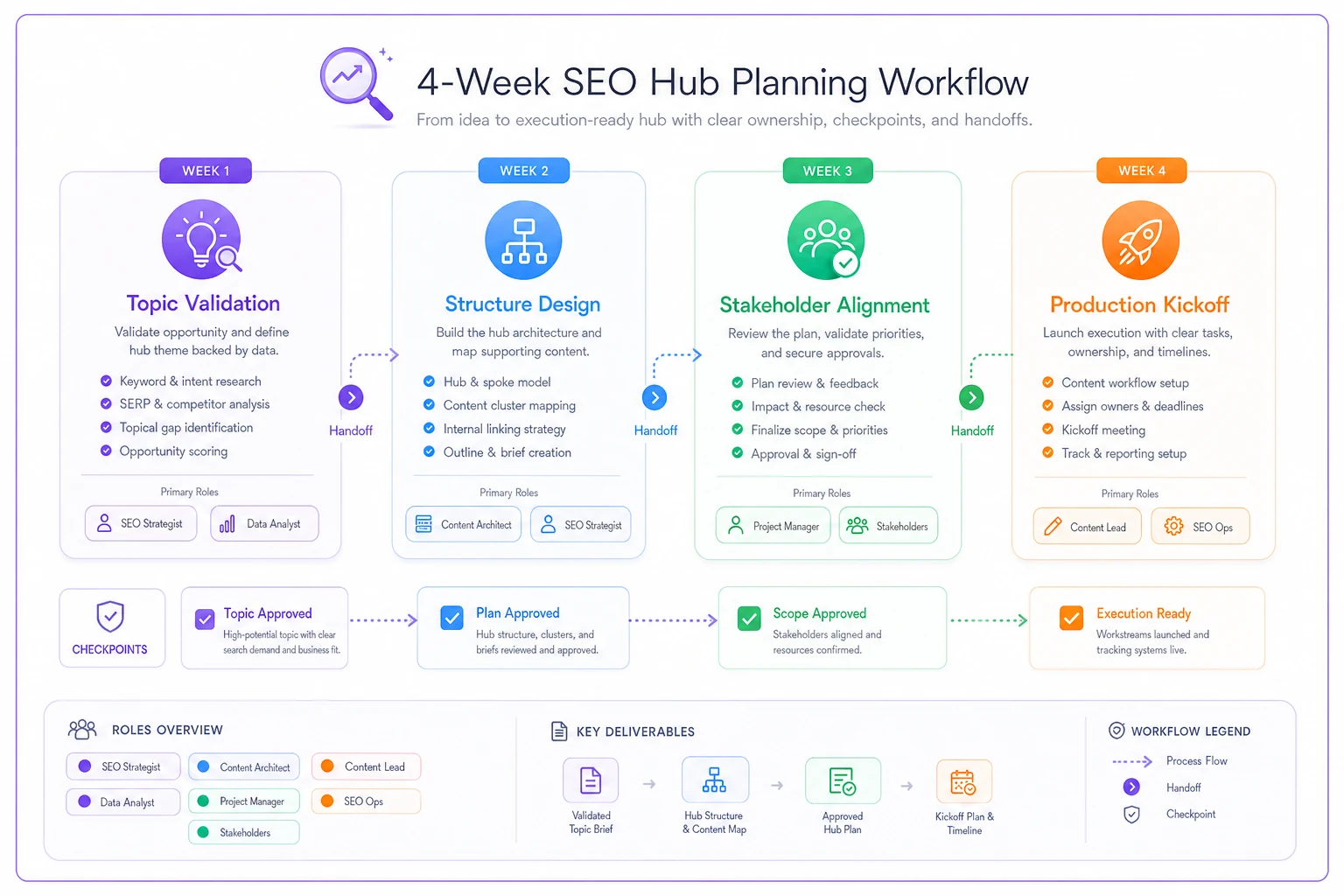
The hub planning workflow
Week 1: Topic validation
-
Keyword research and gap analysis
-
Competitor content audit
-
Internal subject matter expert consultation
-
Business value assessment
Week 2: Structure design
-
Pillar page outline creation
-
Supporting content mapping
-
Internal linking architecture
-
Timeline and resource planning
Week 3: Stakeholder alignment
-
Review with product marketing
-
SEO technical requirements
-
Sales and customer success input
-
Final approval and ownership assignment
Week 4: Production kickoff
-
Writer briefs and background materials
-
SME interview scheduling
-
Design and visual asset planning
-
Publishing calendar integration
Here's a visual of the hub planning workflow.
Ongoing governance rituals
Monthly hub reviews keep clusters healthy. Check new content for linking compliance, update hub inventories with fresh pieces, review performance against KPI targets, and identify content gaps or redundancies.
Quarterly deep dives reveal more strategic insights—comprehensive performance analysis, competitive landscape changes, hub expansion or consolidation decisions, and resource reallocation based on ROI. These sessions are where you make the bigger calls that monthly check-ins can't handle.
When governance actually matters (and when it doesn't)
Not every content operation needs elaborate topic cluster governance. Small teams publishing five to ten pieces monthly can manage reasonably well with spreadsheets and regular communication.
Governance becomes critical when you publish 20+ pieces monthly across multiple topics, multiple teams or freelancers create content, you manage 500+ indexed pages, content drives significant revenue, or you compete in saturated markets where topical authority matters.
Governance is overkill when you're just starting out with content marketing, your team has fewer than three people, you publish primarily thought leadership or opinion pieces, or content serves brand awareness more than SEO. Don't build a governance bureaucracy before you actually have a content operation worth governing.
Technology and automation in cluster governance
Manual governance breaks down somewhere around 200 pieces of content. That's when spreadsheets become unwieldy, link audits take days, and duplicate content starts slipping through.
Modern content operations platforms can automate the tedious parts of governance while keeping human judgment in the loop for strategy. AI-powered tools now handle keyword overlap detection, internal link suggestions, and content gap identification—freeing editorial teams to focus on quality and creative direction rather than administrative tracking.
The key is choosing tools that fit your workflow rather than ones that try to dictate it. Features like automated content inventory tracking, real-time cannibalization alerts, and hub performance dashboards can turn governance from a burden into something that actually gives you an edge.
These systems also enable something manual processes genuinely can't: predictive governance. By analyzing historical performance patterns, well-configured platforms can surface which topics are likely to overlap, which hubs need refreshing, and where duplicate content risks are building. That shifts governance from reactive cleanup to proactive optimization.
For teams serious about scaling topical authority, connecting content governance to a broader SEO measurement framework ensures content investments stay aligned with actual business outcomes.
Common governance failures and recoveries
The "too many cooks" syndrome
Marketing hires multiple freelancers to scale content production. Each writer operates independently, creating their own interpretation of topics. Within a few months, you have five articles about "customer retention strategies" with conflicting advice and fragmented rankings.
Recovery path: Audit all overlapping content immediately. Choose the strongest piece as your canonical version. Pull valuable sections from the others, consolidate them, then redirect or delete the duplicates. Implement strict brief requirements and topic assignment protocols going forward.
The "forgotten hub" problem
A product manager champions a content hub around a new feature. After launch excitement fades, the hub sits dormant for eight months. Outdated information confuses visitors and quietly erodes credibility.
Recovery path: Assign hub ownership to someone with long-term accountability. Set minimum update frequencies—quarterly works for most hubs. Build sunset protocols for hubs tied to deprecated features or abandoned strategies.
The "SEO land grab" mistake
Someone spots a high-volume keyword and demands immediate content. Writers rush to publish without checking existing coverage. You end up with three similar pieces competing against each other for the same term.
Recovery path: Consolidate competing pieces into one comprehensive resource. Implement mandatory pre-publication keyword checks. Create a central keyword ownership database that everyone on the content team can actually access. This last part sounds obvious but it's where most teams skip a step.
Scaling governance as you grow
Topic cluster governance has to evolve with your operation. What works for ten hubs breaks at fifty. What works at fifty becomes unmanageable at two hundred.
Early-stage governance across one to ten hubs is mostly about establishing foundations—basic templates, clear ownership, simple tracking. Spreadsheets and weekly syncs usually get the job done. Growth-stage governance across ten to fifty hubs requires more systematic processes. Hub templates become mandatory, interlinking rules need documentation, and performance tracking moves to dashboards. You'll need dedicated content operations support at some point.
Scale-stage governance across fifty or more hubs demands automation and specialization. Manual hub audits simply aren't feasible. You need automated duplicate detection, intelligent link suggestions, and predictive performance modeling. Content operations becomes a full team with specialized roles.
The teams that successfully scale topical authority understand this evolution and invest in governance infrastructure before it becomes painful—not after the chaos has already set in.
Making governance sustainable
The best topic cluster governance system is one your team actually follows. Complex frameworks that require enormous overhead will eventually get ignored. Sustainable governance balances structure with flexibility and automation with human judgment.
Start with minimum viable governance: hub templates, basic interlinking rules, and quarterly performance reviews. Add complexity only when specific problems show up repeatedly. If duplicate content isn't a real issue yet, don't build elaborate detection systems. If hub ownership is already clear, skip the heavy RACI matrices.
Governance should enable creativity, not stifle it. Writers should understand how it helps them produce better work—not see it as bureaucratic overhead. When governance makes everyone's job easier, it becomes self-sustaining.
Topic cluster governance isn't about control. It's about building content systems that compound in value over time rather than creating exponentially more complexity. With the right frameworks, workflows, and measurement systems in place, your content hubs become strategic assets that drive predictable organic growth rather than operational headaches that drain resources and frustrate everyone involved.
Ready to elevate your search rankings?
Join 5,000+ businesses using GoSeofy to increase organic traffic, optimize content, and outperform competitors online.