

Most backlink "monitoring" isn't really monitoring. It's someone opening Ahrefs or GSC once a quarter, exporting a list, staring at it briefly, and closing the tab. Then a few months later rankings slip on a money page, and that same person spends a frantic weekend wondering whether a link spike from some pharma network back in October is why a category page dropped from position 4 to 11.
The gap between a bad link appearing and someone noticing it is where all the damage happens. And that gap is almost never a tooling problem — it's a workflow problem. The data is there. There's just no system surfacing the right subset of it, fast enough, in a format someone can actually act on without a two-hour investigation first.
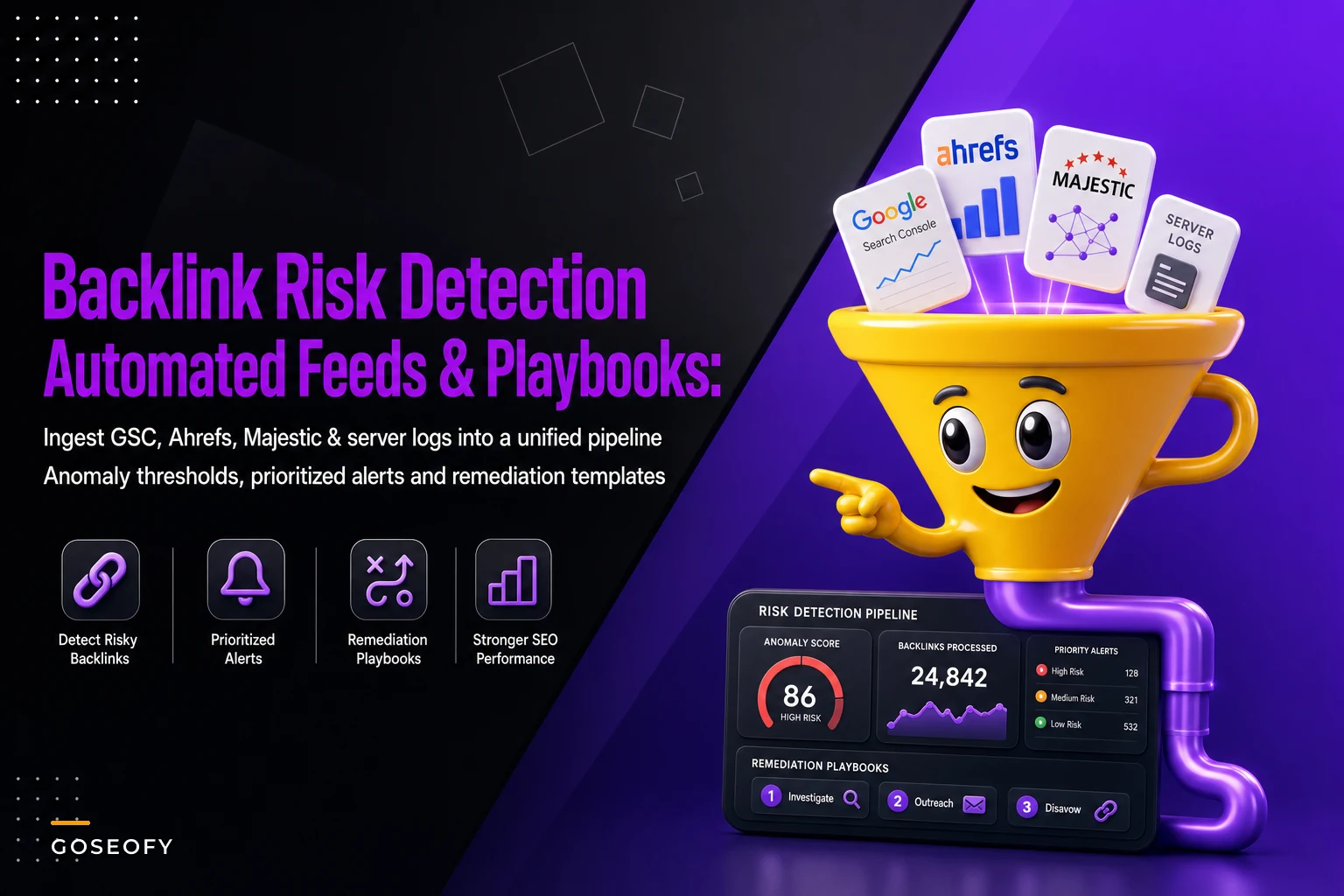
This post is about closing that gap. Not link building, not disavow philosophy — just the detection layer. Pulling from multiple feeds, setting thresholds that actually fire, classifying links automatically enough that a human isn't grading 4,000 URLs by hand, and getting a remediation doc in front of the right person before the problem compounds.
The core failure: single-source, single-cadence checking
The pattern repeats across almost every mid-sized site. The team relies on one backlink source — usually whichever tool the SEO lead prefers — and checks it on a human cadence, meaning "when someone remembers."
Two things break because of this.
First, coverage gaps. No single backlink index sees everything. Ahrefs, Semrush, Majestic, and Google Search Console all crawl different parts of the web at different refresh rates. A spammy PBN link can show up in one index a full three weeks before it appears in another. If you're watching only one feed, you're systematically blind to whatever that feed indexes slowly.
Second, timing gaps. Even if the link exists in your data, checking quarterly means the average bad link sits undetected for around 45 days. Negative SEO attacks and low-quality link deals don't announce themselves. By the time rankings visibly move, the correlation window is muddy and you're mostly guessing.
The fix isn't "check more often" as a discipline. Discipline erodes. The fix is a multi-source feed that pulls automatically and a threshold system that pings you only when something is actually worth looking at.
What a multi-source feed actually looks like
The goal is a merged, deduplicated view of new referring domains across every source you can access, refreshed on a schedule you don't have to think about.
Stop losing visibility in search results.
GoSeofy helps you monitor, analyze, and improve your SEO performance with ease.
- Comprehensive keyword tracking
- Backlink quality monitoring
- Real-time SEO performance reports
No credit card required
-
GSC link export — Google's own view, which matters more than any third-party tool because it's the closest thing to "what Google actually associates with your site"
-
One large third-party index (Ahrefs or Semrush) for breadth and historical velocity
-
A second index (Majestic or whichever of the two you didn't pick first) purely to catch what the first one misses
-
Optional
server logs, if you want to catch referrer spikes that indexes haven't picked up yet
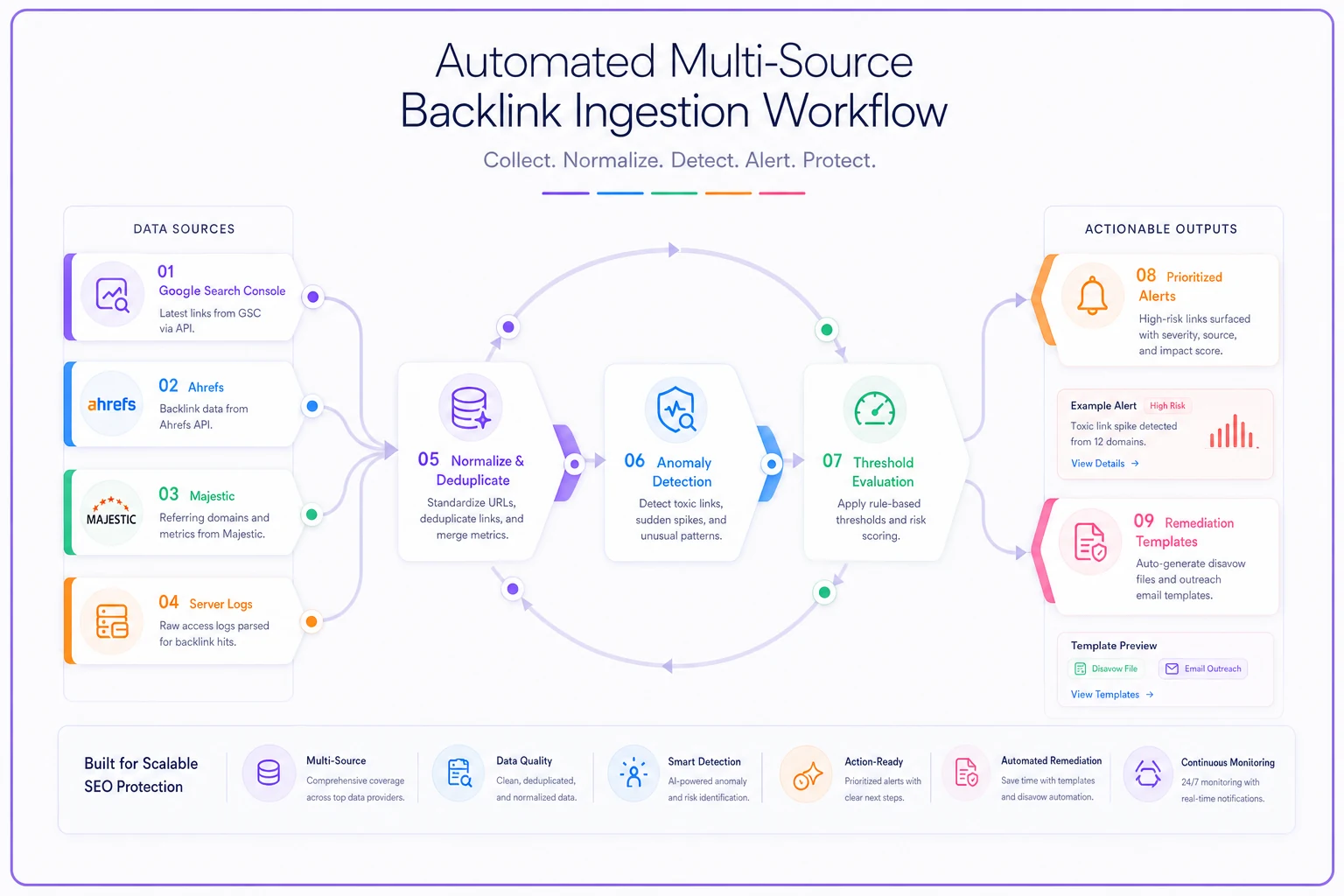
The hard part is deduplication and normalization. The same referring domain shows up formatted five different ways across sources — with and without www, http vs https, trailing slashes, subdomain variations. If you don't normalize on ingest, your "new links" list is about 40% noise from formatting mismatches, and people stop trusting it fast. Once a team gets two false-alarm lists in a row, they quietly stop opening the third.
This is the same discipline problem covered in SEO data observability: lineage, ownership and alerts to trust GSC/GA joins — if you can't trust where the data came from or whether it's clean, no alert built on top of it survives contact with a busy week.
Anomaly thresholds: the difference between alerts and noise
A raw "new links today" report is useless because most days have some new links and most of them are fine. What you actually want is to be told when something is abnormal for your site specifically.
That means baselining first. You need to know your site's normal referring-domain acquisition rate before any threshold means anything. A brand picking up 15–30 new referring domains a week has a very different "spike" than a site that normally sees 2 or 3.
| Signal | Baseline approach | Fires when |
|---|---|---|
| New referring domains / day | 30-day rolling average | Daily count exceeds ~2.5x the average |
| Links from a single IP / subnet | Count of distinct linking IPs | 5+ new domains share one IP block |
| Anchor text concentration | Distribution of anchors over trailing 90 days | One exact-match commercial anchor jumps >15% of new links |
| Links to a single URL | Per-URL link velocity | One page gains links far faster than the site average |
| TLD / language mismatch | Your normal geo/language mix | Sudden cluster from unrelated ccTLDs or languages |
The anchor-text and single-URL velocity signals are the ones people skip, and they're usually the most diagnostic for a negative SEO push. A classic attack pattern isn't just "lots of links" — it's lots of links with the same over-optimized commercial anchor pointed at one page you're trying to rank. When you see 60 new domains all using "cheap [product] online" pointing at your best category page over a five-day window, that's not organic growth.
One caution on thresholds: set them a little loose at first and tighten over time. A threshold that fires constantly gets muted. Better to miss a couple of edge cases in month one and earn trust than to blast the channel with 40 alerts and train everyone to ignore it.
Automated classification: getting from 4,000 links to the 30 that matter
Once a spike fires, nobody wants to hand-review the full list. You need heuristics that pre-sort links into rough buckets so a human only deals with the ambiguous middle.
The classification doesn't need to be perfect. It needs to be good enough to triage. A small set of scored heuristics gets you most of the way there:
-
Domain reputation signals — is the referring domain indexed, does it have organic traffic, does it rank for anything real, or is it a ghost with a fresh registration date?
-
Link neighborhood — how many other sites does this domain link out to per page? Pages with 200+ outbound links to unrelated sites are a strong footprint of a link network.
-
Content relevance — does the linking page have any topical relationship to yours, or is it a random directory or scraped-content page?
-
Anchor risk — branded and URL anchors are almost always fine; exact-match commercial anchors on a low-quality domain are the high-risk combination.
-
Registration and hosting footprint — many bad domains cluster on the same registration date, nameservers, and hosting provider. Shared footprint is a fast tell.
Score each link across these and you naturally get three buckets: clearly fine, clearly toxic, and needs a human. The whole point is that the human only opens the third bucket. On a spike of 400 new links, that's often 30–50 that need a real look instead of all 400.
Worth saying plainly: automated classification is a filter, not a judge. Auto-disavowing based on a heuristic score is how people accidentally disavow legitimate links from real sites that happened to score weird. The heuristics decide what a person reviews. The person decides what gets actioned.
Prioritization: not all bad links deserve the same urgency
A toxic link pointing at a page nobody ranks for or monetizes is a very different problem than the same link pointing at your top revenue driver. Yet most disavow workflows treat every flagged link as equally urgent, which means people burn hours on links that don't matter and get to the dangerous ones late.
Prioritize by what the link points at, not just how bad the link looks:
-
Links to pages driving revenue or leads → top priority
-
Links to pages currently ranking in positions 3–15 (most vulnerable to movement) → high priority
-
Links to pages already ranking #1 with strong authority → lower priority; they're more resilient
-
Links to low-value or already-noindexed pages → lowest; often not worth actioning at all
This is the same conversion-weighted thinking you'd apply anywhere in ops — spend attention where movement actually translates to money. A cluster of 25 spammy links aimed at a page sitting at position 6 for a commercial term deserves same-week action. The same cluster aimed at a stale blog post from 2019 can wait or be ignored entirely.
A real scenario
A regional e-commerce retailer — home goods, roughly $70k/month in organic-attributed revenue — noticed one of their main category pages slide from around position 5 to position 12 over about three weeks. No content changes, no migration, nothing on their end that explained it.
When they finally pulled a full backlink export, they found close to 90 new referring domains from the prior month, most sharing two hosting footprints and pushing exact-match commercial anchors at that one category page. It looked like either a negative SEO attempt or a very cheap link package a former contractor had bought without telling anyone.
The data wasn't hidden. It was sitting in their tools the entire time. The problem was that nobody was watching link velocity per URL, so a slow-motion spike across three weeks never triggered anything. By the time rankings moved enough to notice, they'd lost roughly six weeks of that page's traffic.
After they set up a merged feed with a per-URL velocity threshold and anchor concentration alerts, the next questionable cluster fired an alert on day two — at about 12 domains instead of 90. They filed a disavow, documented it, and the page never moved. The difference wasn't better tools. It was detection that fired early enough to act on.
Stakeholder-ready remediation templates
The last mile everyone skips: getting the finding into a format a decision-maker can approve without scheduling a meeting. When someone has to write a fresh explanation every time a link spike happens, remediation stalls. A reusable template turns a two-hour writeup into a ten-minute fill-in.
-
What triggered this — which threshold fired, on what date, the raw numbers
-
The affected asset — which page(s), current ranking, revenue or lead relevance
-
The evidence — the flagged domains, their shared footprint, anchor distribution, a couple of screenshots
-
The recommended action — disavow, outreach for removal, or monitor-only, with a one-line reason
-
Risk if we do nothing — plain language, tied to the page's business value
-
Who signs off — an actual name, not "SEO team"
That last point matters more than it sounds. Ambiguous ownership is why remediation docs sit unread for two weeks. When the template names a specific approver, it moves.
When this level of monitoring is overkill
Not every site needs anomaly thresholds and merged feeds. Worth being honest about scale:
-
A small local business with a stable, mostly branded link profile probably doesn't need automated velocity alerts. A quarterly manual glance is genuinely fine.
-
Sites with no ranking pages in the vulnerable 3–15 band have less to lose from a bad link and can run lighter.
-
Anyone without the bandwidth to act on alerts shouldn't build them. An alert nobody responds to is worse than no alert — it creates false confidence.
The setup pays off when you have real revenue tied to competitive rankings, a link profile large enough that manual review isn't feasible, and someone who can action findings within a few days. Below that threshold, you're building machinery for a problem you don't have yet.
Where detection connects to the rest of your link work
Detection is only half the picture. The links you want to protect and the broken mentions you want to reclaim run on the same infrastructure — the same feeds, the same normalization, the same ownership model.
If you're already building a system to spot toxic velocity, surfacing lost and broken legitimate links is a small additional step. That's the whole premise of a backlink reclamation workflow for brands. One pipeline, two outputs: what to disavow and what to recover.
Bringing it together
Backlink risk detection fails for boring, fixable reasons: one data source instead of several, human-cadence checking instead of automated thresholds, no baselines so nothing ever looks abnormal, and no template so findings never turn into action. None of that is exotic. It's just workflow discipline that nobody built because everyone assumed "checking the backlinks" was a task rather than a system.
The teams that get this right aren't the ones with the fanciest tools. They're the ones where a bad link cluster fires an alert at 12 domains instead of getting noticed at 90 — and where the person who sees the alert already has a template that gets it approved by Friday. Build the detection layer so it surfaces the right 30 links, prioritized by what they actually threaten, and the remediation part gets a lot less dramatic.
The teams that get this right aren't the ones with the fanciest tools. They're the ones where a bad link cluster fires an alert at 12 domains instead of getting noticed at 90 — and where the person who sees the alert already has a template that gets it approved by Friday. Build the detection layer so it surfaces the right 30 links, prioritized by what they actually threaten, and the remediation part gets a lot less dramatic.
Ready to elevate your search rankings?
Join 5,000+ businesses using GoSeofy to increase organic traffic, optimize content, and outperform competitors online.