



Most enterprise SEO programs still think in pages and keywords. That model quietly stops scaling somewhere around the point where you have 40,000+ URLs, a dozen content owners, and three teams all describing the same product line with slightly different language. Nobody notices the exact moment it breaks. You just wake up one quarter and realize your "topical authority" is actually a pile of overlapping pages fighting each other for the same concepts, and no one can tell you which page Google thinks is your brand's canonical answer for a given topic.
Entity-first taxonomy fixes the modeling problem. But the reason most enterprise entity SEO efforts stall isn't modeling — it's that they never build the plumbing to deploy entities consistently or measure whether the search engine actually picked them up. This piece is about that plumbing: the taxonomy, the canonical entity URIs, the schema templates you can actually ship, and the measurement recipes that turn "we did entity SEO" into numbers a CFO won't roll their eyes at.
Why the page-and-keyword model runs out of road
The keyword-target model works beautifully until you have enough content that your own definitions start to drift.
A pattern that shows up constantly at scale: a B2B software company sells something they internally call a "unified inbox." Marketing writes about it as "shared inbox." The product docs say "team inbox." A partner integration page calls it "collaborative email." Sales enablement content calls it "customer conversations hub." Five phrases, one thing. Each got its own page, each earned a handful of links, each ranks weakly for a fraction of the demand, and none of them consolidates authority because the organization never agreed the concept was a single entity.
That's not a content problem. It's a taxonomy problem wearing a content costume.
The keyword architecture layer — intent tiers, canonical targets, reconciliation — solves phrasing overlap. If you haven't built that foundation yet, our enterprise keyword architecture and reconciliation playbook pairs directly with what follows here; entities sit one layer of abstraction above keywords. A keyword is a query. An entity is a thing your business is authoritative about — a product, a location, a person, a service category, a proprietary concept — that many keywords point at.
When you model entities first, that "unified inbox" mess collapses into one canonical entity with five surface phrasings. Everything else — URLs, schema, internal links, measurement — hangs off that single node.
The three artifacts every entity needs
Before writing a line of content, an entity in a real enterprise system needs three production artifacts. Skip any one and the thing falls apart at scale.
Stop losing visibility in search results.
GoSeofy helps you monitor, analyze, and improve your SEO performance with ease.
- Comprehensive keyword tracking
- Backlink quality monitoring
- Real-time SEO performance reports
No credit card required
1. A canonical entity URI. A stable, internal identifier for the entity that is not the page URL. This is the part teams skip and regret. Your URL might change (migrations, restructures, localization). The entity shouldn't. Something like entity:product/unified-inbox or a URN-style urn:acme:entity:svc:unified-inbox. This ID becomes the join key across your CMS, your schema, your analytics, and your log files. Everything downstream references it, not the URL.
2. A canonical page (or a deliberate no-page decision). Not every entity gets a landing page. Some entities exist only to be referenced in schema (sameAs, about, mentions) and never rank directly. Deciding this upfront prevents the "we made a thin page for every tag" disaster.
3. A schema template bound to the entity. Not hand-written JSON-LD per page. A template that pulls from the entity record so a Product entity always emits the same @id, the same sameAs links to Wikidata/Crunchbase/LinkedIn, the same relationships — every single time, on every page that references it.
| Artifact | Purpose | Lives in | Changes when |
|---|---|---|---|
| Canonical entity URI | Stable join key across systems | Entity registry / graph | Almost never |
| Canonical URL | The rankable page for the entity | CMS | Migrations, restructures |
| Schema template | Machine-readable entity definition | Template layer, bound by URI | Schema strategy shifts |
| Surface phrasings | Keyword variants pointing at the entity | Keyword map | Demand/language shifts |
The insight most teams miss: the entity URI and the URL must be decoupled. When they're the same thing, every URL change silently breaks your entity graph, your @id references go stale, and Google starts treating your reorganized page as a brand-new unknown thing. Decoupling is boring infrastructure work. It's also the difference between an entity model that survives three replatforms and one that dies at the first.
What actually breaks at enterprise scale
Small sites can get away with sloppy entity handling because a human can hold the whole thing in their head. Past a few hundred entities, coordination is the bottleneck — not knowledge.
Duplicate entities from parallel teams. The product team creates an entity for a feature. Six weeks later the demand-gen team, not knowing it exists, creates a near-identical one for a campaign. Now you have two @ids for one concept, internal links split between them, and schema that contradicts itself. Without a registry that enforces uniqueness, this happens roughly every time two teams touch the same product area in the same quarter.
Schema drift. Someone edits a template. A localization team hardcodes a different @id. A dev "fixes" a validation warning by stripping a sameAs. Six months later a sample of your pages emit entity markup that no longer agrees. This is the entity-layer version of schema health monitoring — conflicting definitions across a large template surface — except here the conflict is about identity, which is far more damaging than a missing property.
@id reference rot. Page A references entity:product/unified-inbox in its about. That entity's URL changes. If the @id was tied to the URL, Page A now references a dead identity. Multiply across tens of thousands of cross-references and your carefully built entity graph quietly disconnects.
Measurement invisibility. The most expensive failure. A team does six months of entity work and cannot answer "did it help?" because they never instrumented entity-level impressions or feature capture. They fall back to page-level traffic, which is noisy, seasonal, and confounded by twelve other changes shipped the same quarter.
Deployable schema templates, not artisanal JSON-LD
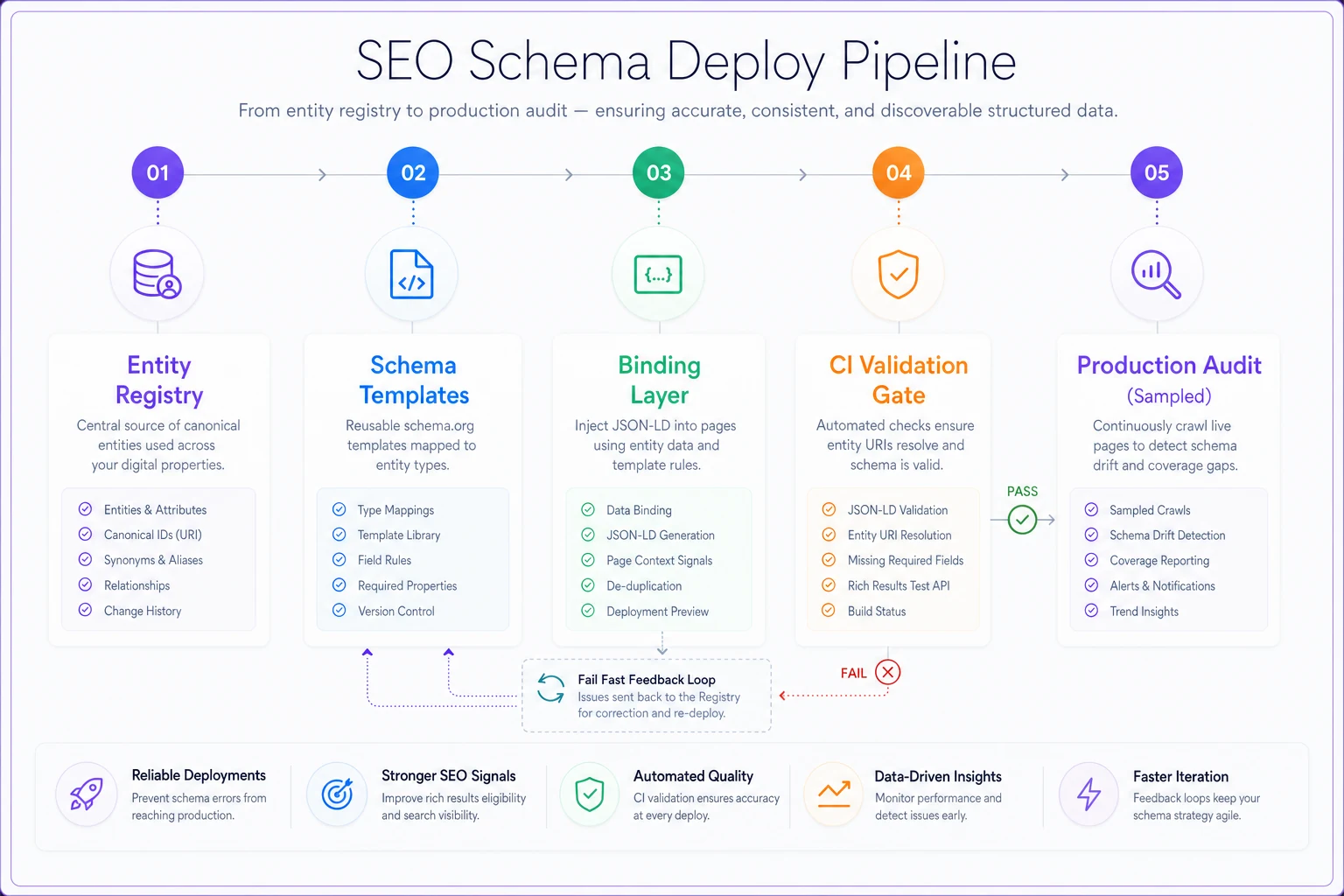
Hand-authored schema doesn't scale and doesn't stay consistent. The model that holds up at any real enterprise size:
-
1. Entity registry holds the canonical record
URI, type,
sameAslinks, relationships, human-readable label and its approved variants. -
2. Schema template for each entity type (
Product,Service,Organization,Place,Person, customDefinedTermfor proprietary concepts) reads from that record. -
3. Binding layer — when a page declares it's "about" an entity URI, the template auto-injects the correct JSON-LD block with the correct
@idand relationships. -
4. Validation gate in CI blocks any deploy where a referenced entity URI doesn't resolve in the registry, or where
@idvalues collide. -
5. Sampled production audit crawls live pages and compares emitted schema against the registry to catch drift the CI gate missed.
The unlock is step 4. Treating "does this entity reference resolve?" as a build-breaking test is what stops reference rot before it ships. Most enterprises validate schema syntax (is the JSON-LD well-formed?) but never validate entity integrity (does this identity actually exist and match?). Syntax passing while identity is broken is exactly how you ship 10,000 pages that validate perfectly and describe nothing coherently.
A quick sketch of the deploy pipeline:
A quick note on proprietary concepts: if your business coined a term — a methodology, a framework, a product-category name you're trying to own — model it as a DefinedTerm entity with a stable URI and consistent definition everywhere it appears. This is how you build authority for a concept you invented rather than one you're competing for. It only works if the definition is genuinely identical across every mention, which is precisely what template binding enforces and human copywriting does not.
Pro-tip: Treat "does this entity reference resolve?" as a build-breaking test to avoid reference rot.
The unlock is step 4. Treating "does this entity reference resolve?" as a build-breaking test is what stops reference rot before it ships. Most enterprises validate schema syntax (is the JSON-LD well-formed?) but never validate entity integrity (does this identity actually exist and match?).
Measuring entity SEO: impressions and feature capture
This is where enterprise entity SEO earns its budget or dies. Two measurement layers matter.
Entity impressions. Roll up Search Console impressions and clicks from the query level to the entity level using your keyword-to-entity map. Instead of tracking 200 scattered queries, you track one entity's total search presence. When "shared inbox," "team inbox," and three other phrasings all map to one entity URI, you finally see whether that concept's visibility is growing — the thing consolidation was supposed to achieve.
The map is the hard part. You need the same query-to-target reconciliation discipline that underpins good keyword architecture, extended one level up so every query resolves to an entity URI. Without that map, entity impressions are guesswork.
Feature capture. Which SERP features does each entity earn — knowledge panel presence, sitelinks, PAA inclusion, FAQ/HowTo rich results, image packs, entity carousels? These are the observable signals that Google recognizes your entity, not just your keywords. Feature capture is the closest proxy you get for "did the search engine internalize this thing as an entity."
A realistic instrumentation setup:
-
Entity impressions, weekly, per entity URI, from GSC + your query map. Trend it, don't spot-check it.
-
Feature capture rate
for each entity's tracked queries, what percentage of SERPs show a feature you occupy. Track your capture and total available separately — losing a feature you never held isn't a regression.
-
Entity coverage
how many pages correctly reference the entity URI in schema vs. how many should. A coverage gap is your deployment backlog made visible.
-
Reference integrity
percentage of live
@idreferences that resolve. This should sit near 100%; anything else is rot in progress.
A measurement query you can actually run
SELECT m.entityuri, DATETRUNC(gsc.date, WEEK) AS wk, SUM(gsc.impressions) AS entityimpressions, SUM(gsc.clicks) AS entityclicks, SAFEDIVIDE(SUM(gsc.clicks), SUM(gsc.impressions)) AS entityctr FROM gscquerydaily gsc JOIN queryentitymap m ON LOWER(gsc.query) = LOWER(m.query) GROUP BY m.entityuri, wk ORDER BY entityimpressions DESC;
Nothing fancy — the value is entirely in the join. The queryentitymap is the real asset. Building and maintaining it is the actual work, and it's the artifact that turns entity SEO from a philosophy into a dashboard. Pair this with the broader instrumentation in our business-aligned SEO measurement framework so entity metrics feed the same revenue view as everything else, instead of living in a separate spreadsheet nobody trusts.
A real scenario
A mid-market SaaS company — workflow-automation product, roughly 22,000 indexable URLs — had five loosely related content clusters describing the same three core product concepts. Internal language was inconsistent, schema was hand-written per page, and about one in six pages either missed entity markup entirely or referenced an @id that no longer resolved after a replatform the prior year.
They spent a quarter on the unglamorous work: defining canonical entity URIs for around 120 core entities, decoupling those URIs from page URLs, building three schema templates bound to the registry, and adding a CI gate for reference integrity. They also built out the query-to-entity map and started tracking entity impressions weekly.
The first visible win wasn't traffic — it was clarity. Consolidating the five phrasings of their flagship concept onto one canonical entity, with the others pointing in via schema and internal links, moved that concept from a scatter of page-9-ish rankings into consistent top-of-page-1 presence over roughly two quarters. Feature capture followed: PAA and FAQ results they'd never held started appearing for the consolidated entity. Entity impressions for that single concept grew somewhere in the 40–60% range year-over-year, and because they were measuring at the entity level, they could actually attribute it rather than guessing.
The reference-integrity gate quietly paid for itself too — it caught two migrations mid-deploy that would have otherwise re-broken hundreds of @id references, the exact failure that caused their original mess.
When entity-first is worth it — and when it isn't
This is real infrastructure investment. It's not right for everyone.
It makes sense when:
-
You have thousands of URLs and multiple teams describing overlapping concepts.
-
You own proprietary terms or product categories you're trying to make yours.
-
You've already got keyword architecture and clean data joins, and page-level measurement has stopped telling you anything useful.
-
You keep replatforming or restructuring, and identity keeps breaking with the URLs.
It's a bad idea when:
-
You're under a few hundred pages and one person can hold the whole map in their head. You'll build machinery to solve a problem you don't have.
-
Your fundamentals are broken — if you're fighting soft 404s, indexing chaos, or untrustworthy analytics joins, fix those first. Entity SEO on a broken foundation just adds a broken layer.
-
Nobody owns it. An entity registry with no owner drifts into the same duplicate-and-contradict mess you were trying to escape.
Who should skip this entirely: teams without warehouse-level GSC access or the ability to maintain a query-to-entity map. Without measurement, entity work becomes faith-based, and faith-based SEO investment doesn't survive a budget review.
If you're between "too small to need it" and "ready for full entity infrastructure," the intermediate move is topic-cluster governance — it delivers a lot of the consolidation benefit with less plumbing. Our topic-cluster governance playbook covers hub templates and interlink rules that pave the road toward an entity model later.
Bringing it together
Enterprise entity SEO isn't a content tactic bolted onto an existing program. It's a shift in what your organization treats as the unit of authority — from pages Google might rank to entities Google should recognize.
The taxonomy defines the things. The canonical URIs make them stable. The deployable schema templates make them consistent at a scale no human could hand-author. And the measurement recipes — entity impressions and feature capture, joined through a query-to-entity map — are the only reason you'll ever know if the work paid off.
The programs that get this right don't win because they wrote better JSON-LD. They win because every team finally agrees on what things are, those definitions ship identically across tens of thousands of pages, and someone can pull up a dashboard and show exactly which entities gained recognition this quarter. That combination — shared definitions, consistent deployment, honest measurement — is what compounds into durable topical authority. The rest is just plumbing, and plumbing is entirely solvable once you decide the entity, not the page, is the thing worth governing.
Ready to elevate your search rankings?
Join 5,000+ businesses using GoSeofy to increase organic traffic, optimize content, and outperform competitors online.