



Most SEO teams don't fail at experimentation because they run bad tests. They fail because they run good tests that quietly contaminate each other, and nobody notices until the quarterly numbers make no sense. One team ships a title change across a category. Another team ships an internal-linking change that touches the same category. A third team pushes a schema update site-wide. Three months later someone asks, "so which of those actually moved revenue?" and the honest answer is: nobody can tell anymore.
That's the real problem at scale. A handful of tests a year, you can eyeball. Once you're running dozens or hundreds simultaneously across a large site, the governance layer is the program. The tests themselves are almost the easy part.
This is about that governance layer — how you keep parallel experiments from interfering, how you bucket URLs so tests don't overlap, how you think about statistics when you've got 40 things running at once, and how you decide what to roll out versus kill.
Why simultaneous tests quietly poison each other
The core issue is that SEO doesn't give you clean isolation. In a normal product A/B test, a user is either in variant A or variant B, full stop. In SEO, your "unit" is usually a URL or a template, and URLs are connected to each other through internal links, shared templates, sitemaps, and crawl paths. Google also doesn't evaluate pages in a vacuum — sitewide signals leak.
-
Template collisions. Two teams edit the same product template for different reasons. Test A changes the H1 logic, Test B changes the breadcrumb structure. Both ship. Now every page in that template is in both experiments and you can't attribute anything.
-
Link-graph bleed. A hub-page interlinking test changes how authority flows to hundreds of leaf pages — some of which are the control group for a completely different test. Your "untouched control" just got touched.
-
Crawl-budget knock-on. One team's canonical cleanup frees up crawl budget, which speeds indexation of another team's new pages. The second team celebrates a win they didn't earn.
-
Seasonality masquerading as effect. Everything moved in Q4. Half your "winning" tests were just the category getting hot.
The interference usually isn't dramatic. It's a slow, low-grade contamination that makes effect sizes look noisier than they should — real winners get buried and random noise gets promoted. The team loses trust in the whole program, and eventually experimentation gets quietly defunded because "we could never prove it worked."
The one decision that fixes most of it: URL bucketing
Before you run a single test, you need a rule for who owns which URLs. Not a spreadsheet somebody updates when they remember — an actual assignment layer that every test has to pass through.
Stop losing visibility in search results.
GoSeofy helps you monitor, analyze, and improve your SEO performance with ease.
- Comprehensive keyword tracking
- Backlink quality monitoring
- Real-time SEO performance reports
No credit card required
The idea is simple. You slice your indexable URL set into buckets, and each bucket can only be enrolled in one conflicting experiment at a time. Non-conflicting tests can share a bucket. The hard part is defining "conflicting."
A workable classification looks like this:
| Test type | Touches | Can share a bucket with | Conflicts with |
|---|---|---|---|
| Title / meta description | Serialized head content | Internal-link tests, content tests | Other head/CTR tests |
| On-page content / body | Rendered body | Title tests, schema tests | Other body-content tests |
| Internal linking | Link graph | Title tests, schema | Other link-graph tests, crawl tests |
| Schema / structured data | Markup layer | Most tests | Other schema tests |
| Crawl / indexation (robots, canonicals) | Discovery + indexing | Nothing, really | Almost everything |
The takeaway: crawl and indexation changes are radioactive. They affect the plumbing every other test depends on, so they should almost never run concurrently with attribution-sensitive tests on the same bucket. In practice this usually means freezing new experiments on any bucket where a migration or canonical change is live.
For bucketing itself, hashing works well. Take a stable URL identifier, hash it, mod it into a few hundred buckets. Now "assign 20% of category pages to Test X" becomes a deterministic, repeatable rule instead of a manual selection someone can accidentally overlap. The hash approach also gives you clean holdouts — you can permanently reserve, say, bucket 0–4 as a never-touched global control to sanity-check that your whole program isn't drifting.
Orchestration: who's allowed to ship what, and when
Bucketing tells you where tests can run. Orchestration tells you when and in what order.
-
Intake. A test proposal declares its type, its target bucket range, its expected effect, and its minimum runtime. No proposal moves forward without a stated hypothesis and a stated kill condition.
-
Conflict check. The proposed bucket range gets checked against every live experiment. If it collides with a conflicting test, it either waits or moves to a different bucket range.
-
Power check. Roughly how many URLs and how much traffic does the target bucket carry? If a title test lands on 40 low-traffic pages, it will never reach significance — reject it before it wastes a slot.
-
Launch with a registry entry. Every live test is logged with start date, buckets, owner, and expected end date. This registry is the single source of truth.
-
Interim monitoring, not interim decisions. You watch for breakage (indexation drops, ranking cliffs) but you don't call the test early just because week two looked good.
-
Readout and decision. At the pre-committed end date, the test is evaluated against the pre-committed metric and the decision taxonomy (below).
The step people skip is #3, and it's the one that quietly kills programs. Teams launching 50 tests a quarter where only 8 of them are on enough traffic to ever produce a signal — the other 42 are just noise generators clogging the buckets. Fewer, better-powered tests beat a firehose of underpowered ones every time.
A quick diagram of the orchestration steps makes handoffs and gates clearer.
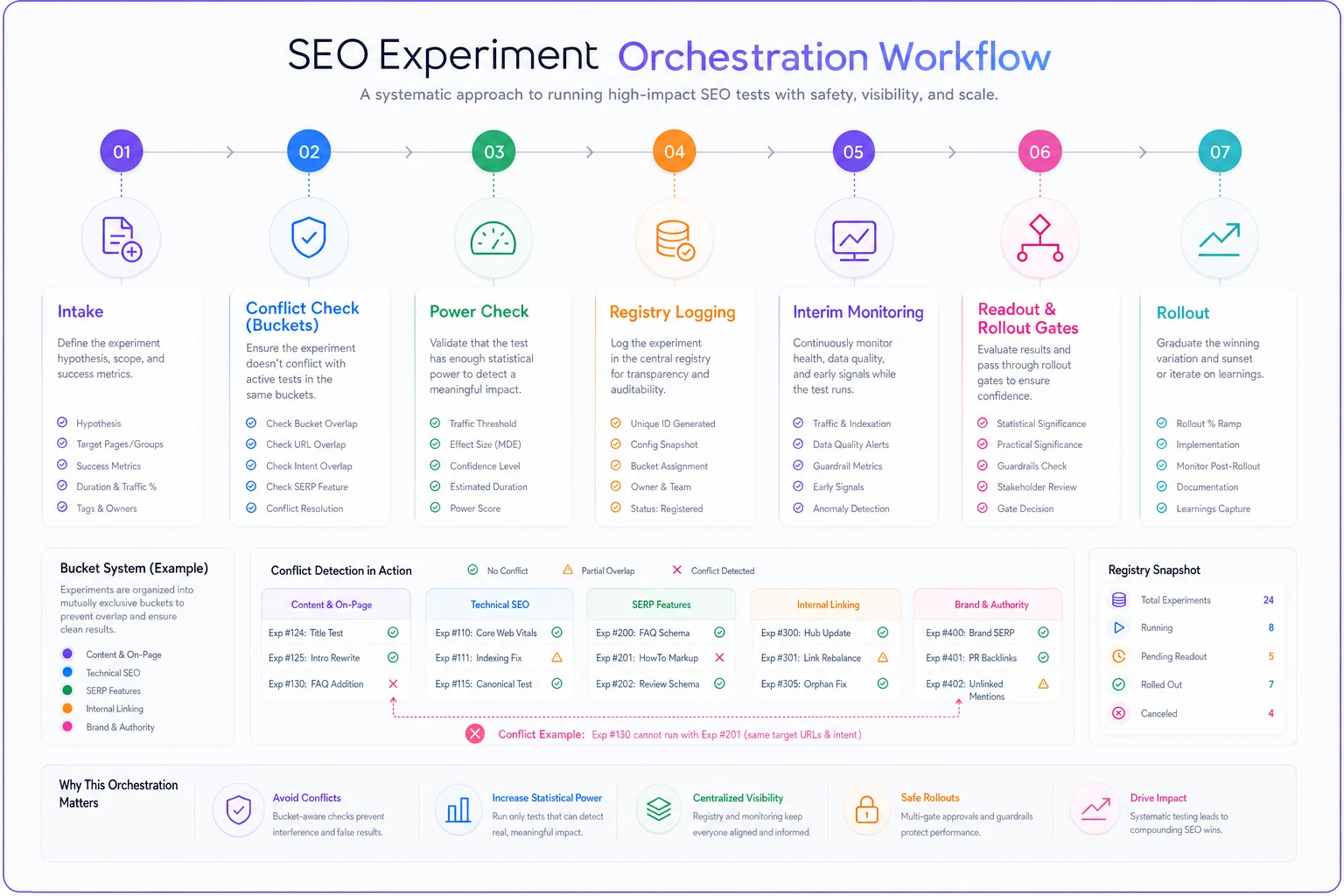
Make the power check a strict gate—reject low-traffic buckets early.
There's a good foundation for the CTR and head-tag side of this in our breakdown of how to design low-risk title and meta tests that move rankings and CTR — individual test design still matters even when you're running hundreds.
Statistics when you're running 40 tests at once
This is where enterprise programs get themselves into trouble intellectually. If you run 40 independent tests at a 95% confidence threshold, you'd expect roughly 2 of them to show a "significant" result purely by chance. Run that quarter after quarter and you'll accumulate a pile of false winners that you've rolled out sitewide, each one adding a little noise and a little risk.
-
Pre-register the metric. Decide before launch what "success" means. Sessions? Clicks? Conversions from organic on the test bucket? Pick one primary metric. Everything else is secondary and doesn't get to overturn the decision.
-
Correct for multiple comparisons. When you're evaluating a batch of tests, raise the bar. Treating a p-value of 0.049 as a clean win across 40 simultaneous tests is how you fool yourself. Tighten the threshold or require a larger effect size.
-
Use holdout buckets as your reality check. The never-touched control from your hashing scheme tells you what "no intervention" looked like this quarter. If your holdout also went up 6%, then the test that went up 7% did almost nothing.
-
Respect minimum runtime. SEO tests need to survive at least one full recrawl-and-reindex cycle, plus enough time for rankings to stabilize. Calling a test at two weeks because it looks great is how you promote seasonality.
The honest framing: you are not trying to prove each test with academic certainty. You're trying to make better decisions on average across hundreds of tests than you'd make with gut feel. A program that's right 70% of the time on well-powered tests, compounding over two years, is transformative. That's the whole game.
The measurement side connects directly to how you attribute value — we go deeper on tying tests back to dollars in how a business-aligned SEO measurement framework connects visibility, experiments and revenue.
A decision taxonomy for rollouts
The messiest part of most programs is the end of a test, not the beginning. A test finishes, the result is ambiguous, and now there's a Slack argument. A decision taxonomy removes the argument by deciding the rules in advance.
-
Clear win, roll out. Effect exceeds the threshold, holds across the runtime, holdout confirms it's real. Roll to 100% of the eligible bucket, log it, and free the bucket.
-
Clear win but risky mechanism. Result is good but the change touches crawl/indexation or something fragile. Roll out in stages — 25%, then 50%, then 100% — with monitoring gates between each.
-
Flat / inconclusive. No detectable effect. This is a result, not a failure. Revert to control (unless the change has non-SEO benefits like accessibility) and move on. Don't rerun it hoping for a different answer.
-
Negative. Metric dropped meaningfully. Revert immediately, document why, and add it to the "don't try this again" log so a future team doesn't waste a slot rediscovering it.
-
Broke something. Indexation or rankings cliff during the test. This isn't a decision — it's an incident. Roll back now, diagnose later.
Rollout readiness checklist
-
[ ] Result held for the full pre-committed runtime, not just the good weeks
-
[ ] Holdout bucket confirms the effect isn't market-wide movement
-
[ ] Primary metric moved (secondary metrics didn't get promoted to primary after the fact)
-
[ ] Effect size is worth the implementation and maintenance cost
-
[ ] The change doesn't conflict with anything currently queued
-
[ ] Someone owns the rollout and the post-rollout monitoring window
-
[ ] The decision is logged in the registry, win or loss
The thing most teams miss: flat results are the most valuable output of a mature program. A program that only ever reports wins is lying. When a third to half of your tests come back flat or negative, that's a sign the measurement is honest. Teams that report a 90% win rate are usually just measuring noise and calling it strategy.
A real scenario
A mid-large retailer — home goods, somewhere north of 200k indexable URLs — had an experimentation "program" that was really just three or four teams shipping changes whenever they felt like it. Over a year they'd shipped somewhere around 60 changes across the site. When leadership asked what those changes were worth, the SEO lead genuinely couldn't answer. Organic was up maybe 8% year over year, but so was the market, and there was no way to separate the two.
They rebuilt around bucketing and a registry. Nothing fancy — a few hundred hash-based buckets, a conflict-check rule, a permanent 5% global holdout, and a hard rule that crawl-level changes freeze the affected buckets. First quarter under the new system they ran about 22 tests instead of the usual scattershot pile, because half the previous ideas couldn't clear the power check.
Of those 22, roughly 7 were clear wins, about 9 came back flat, 4 were negative and got reverted, and 2 broke something and got rolled back inside a week. The interesting part wasn't the win count — it was that for the first time they could point to specific rolled-out changes and estimate they were driving somewhere in the range of $30k–$40k in incremental monthly organic revenue, separated cleanly from the market via the holdout. The flat and negative results saved them from shipping 13 changes that would have added risk for nothing.
The team's own words, roughly: the program felt slower but they finally trusted the numbers. That trust is what unlocked more experimentation budget, not the win rate.
When a formal program makes sense — and when it doesn't
This level of governance is genuinely overkill for a lot of sites. If you're running fewer than a handful of tests a year, a shared doc and some discipline will serve you better than a bucketing system nobody maintains.
-
You've got multiple teams touching the same templates and stepping on each other
-
Your site is large enough that traffic per template is high enough for tests to actually reach significance
-
Leadership is asking you to prove incremental value, not just report traffic
-
You're shipping enough changes that manual conflict-tracking has already broken down at least once
-
Small site where a single test can't get statistical power no matter how you slice it
-
One person owns all SEO changes, so interference basically can't happen
-
You're in the middle of a migration or major structural change — freeze experiments, don't add to the chaos
-
You don't yet have reliable revenue attribution wired up, because then you're governing tests you can't actually measure
Who should not do this: teams that haven't nailed basic measurement first. Governance on top of untrustworthy data just gives you organized wrong answers. Get attribution honest before you scale the test count.
Where the tooling actually earns its place
Manual coordination works up to maybe a dozen concurrent tests. Past that, the conflict-checking and registry maintenance become their own job — and it's exactly the kind of job that gets skipped under deadline pressure. An operational platform that tracks live experiments, enforces bucket assignments, and flags conflicts before launch stops being a nice-to-have pretty quickly.
The value isn't automation for its own sake. It's that the system refuses to let two conflicting tests land on the same bucket, so the contamination that quietly kills programs never happens in the first place. The same layer pulling recrawl cycles and ranking data together also makes the readout step fast enough that people actually do it instead of arguing about whose spreadsheet is current.
The point of the tooling is boring reliability: the conflict check runs every time, the registry is always current, and the holdout stays untouched. Humans are bad at that kind of consistency across hundreds of tests. Software isn't.
The real takeaway
Running thousands of tests safely isn't about running more tests. It's about building the layer underneath the tests — bucketing, conflict rules, honest statistics, and a decision taxonomy — so that every test produces a trustworthy answer instead of a contaminated one.
The teams that get this right end up running fewer tests than they used to, but they can defend every rollout with numbers, and they stop shipping changes that add risk for no measurable gain. That's the difference between an experimentation program and just a lot of people changing things and hoping. Build the governance first, and the volume takes care of itself.
Running thousands of tests safely isn't about running more tests. It's about building the layer underneath the tests — bucketing, conflict rules, honest statistics, and a decision taxonomy — so that every test produces a trustworthy answer instead of a contaminated one.
The teams that get this right end up running fewer tests than they used to, but they can defend every rollout with numbers, and they stop shipping changes that add risk for no measurable gain. That's the difference between an experimentation program and just a lot of people changing things and hoping. Build the governance first, and the volume takes care of itself.
Ready to elevate your search rankings?
Join 5,000+ businesses using GoSeofy to increase organic traffic, optimize content, and outperform competitors online.