


Most enterprise SEO plans fall apart at the same predictable point: month four. The audit is done, a few quick wins landed, leadership is happy — and then everything stalls because nobody planned for what the next stage actually requires. You built for the first quarter, not the first eighteen months. And when a VP asks why you need two more headcount and a six-figure tooling budget, the answer is usually some version of "trust me, it'll pay off." That answer doesn't survive contact with finance.
An SEO maturity model is really just a way to tie spend and hiring to the stage your program is actually in — not the stage you wish it were in. It forces you to answer boring but critical questions: what breaks if you don't hire this person now? What does the tooling stack need to look like before you run experiments, not after? What's the OKR that actually proves you've earned the next round of investment?
This is a prescriptive roadmap broken into three phases — months 0–6, 6–12, and 12–18 — with hiring templates, tooling checklists, sample OKRs, and budget phasing built for defensible planning. The whole thing runs on one idea most teams miss: each stage exists to earn the right to the next one. You don't hire a data engineer because it's on a list. You hire one because the program has hit the ceiling of what spreadsheets and manual joins can support.
Why enterprise SEO programs stall at predictable points
Before the roadmap, it's worth understanding why these stalls happen, because the maturity stages map almost exactly to the failure points.
The first stall is a data trust collapse. Early on, everyone believes the numbers. Then someone notices GSC and GA don't agree, a dashboard shows a traffic drop that turns out to be a tracking bug, and suddenly every meeting spends fifteen minutes arguing about whether the data is real. Programs that don't invest in measurement infrastructure early lose credibility right when they need it most.
The second stall is a coordination bottleneck. SEO fixes live in engineering's backlog, and engineering doesn't report to you. In the first six months you can get away with informal favors and Slack messages. By month eight, you've got forty tickets waiting, three of them revenue-critical, and no formal way to prioritize them against product roadmap work.
The third stall is scale outrunning process. What worked for 500 pages breaks at 50,000. Manual title tests, hand-checked schema, one person eyeballing crawl logs — none of it survives contact with a large catalog. The team keeps working harder while the site quietly accumulates soft 404s, index bloat, and canonical conflicts nobody has time to catch.
The maturity model exists to get ahead of each of these before they become fire drills.
The three-stage maturity model at a glance
Here's the shape of the whole thing before we go deep on each stage.
Stop losing visibility in search results.
GoSeofy helps you monitor, analyze, and improve your SEO performance with ease.
- Comprehensive keyword tracking
- Backlink quality monitoring
- Real-time SEO performance reports
No credit card required
| Stage | Months | Primary Goal | Core Team Additions | Budget Range (annualized) | The Question It Answers |
|---|---|---|---|---|---|
| Foundation | 0–6 | Establish trust in data + fix critical technical debt | SEO Lead, part-time analyst, contracted dev support | ~$180k–$260k | "Is the site even indexable and are we measuring it honestly?" |
| Systemization | 6–12 | Turn fixes into repeatable workflows + prove revenue impact | Technical SEO, content strategist, dedicated eng cycles | ~$400k–$600k | "Can we do this reliably without heroics?" |
| Scale & Compounding | 12–18 | Run experiments at volume, automate detection, own attribution | Data engineer, experimentation PM, content ops | ~$700k–$1M+ | "Can we compound gains and defend budget with revenue math?" |
The budget ranges are deliberately wide. A B2B SaaS company with 2,000 pages and an enterprise retailer with 800,000 SKUs will land at very different points inside those ranges. Treat them as shape, not gospel.
Stage 1 — Foundation (Months 0–6)
The whole point of this stage is earning trust — trust in the data, trust from engineering, and trust from leadership that this program isn't going to be another initiative that burns budget and quietly fades.
The mistake almost everyone makes here is going straight for content. New SEO leads want to show visible output, so they commission fifty articles before confirming the site is even being crawled properly. Then three months in, someone discovers half the category pages are noindexed by a stray robots directive left over from a migration two years ago, and all that content investment was pouring water into a bucket with a hole in it.
What actually matters in Stage 1:
-
Confirm the site is indexable and measurable. Full technical crawl, log-file review, GSC coverage audit. You're looking for the structural problems that cap everything else.
-
Build the measurement backbone. Before anyone trusts a report, the GSC/GA joins need documented lineage and ownership. If your dashboards can't survive the question "where did this number come from," you have no foundation.
-
Fix the revenue-critical technical debt first. Not everything — the handful of issues actually gating organic revenue. Deindexed money pages, broken canonicals on top categories, crawl waste on high-value paths.
-
Establish a triage process. Even a lightweight one. When something breaks, who's paged and what's the rollback criteria.
Stage 1 hiring template
-
SEO Lead / Manager (full-time) Owns strategy and cross-functional relationships. This person needs to be senior enough to sit in a room with engineering directors and hold their ground.
-
Analyst (part-time or shared) Someone who can build and defend the measurement layer. Often borrowed from an existing analytics team at this stage.
-
Contracted engineering support You don't need dedicated headcount yet. You need reliable access to dev hours for the critical fixes.
Resist the urge to buy heavy tooling in month one; focus initial spend on salary and contracted dev to fix revenue-critical issues.
Stage 1 tooling checklist
-
[ ] Crawler (Screaming Frog, Sitebulb, or an enterprise equivalent)
-
[ ] Log-file analysis capability
-
[ ] Rank tracking scoped to money keywords, not vanity terms
-
[ ] GSC + GA connected with documented join logic
-
[ ] A shared backlog/ticketing system SEO can actually see into
Sample Stage 1 OKRs
Objective: Establish a trustworthy technical and data foundation.
-
KR
100% of revenue-generating page templates confirmed indexable and correctly canonicalized.
-
KR
GSC/GA reporting reconciled to within an agreed variance and documented.
-
KR
Top 10 revenue-gating technical issues identified and 8 resolved.
Budget note: Most of your Stage 1 money goes to salary and contracted dev, not tools. Resist the urge to buy a $60k/year enterprise platform before you know what workflows you're actually running. Teams that buy heavy tooling in month one end up using maybe 20% of it and can't defend the line item at renewal.
Stage 2 — Systemization (Months 6–12)
If Stage 1 was about proving the site works, Stage 2 is about proving the team works — repeatably, without one person being the single point of failure for everything.
This is the stage where the coordination bottleneck usually bites. You've got more work than informal favors can cover, and engineering has stopped saying yes to Slack requests. The programs that get through this cleanly are the ones that formalize how SEO work enters and moves through the pipeline. If you haven't already, this is where an ops playbook with SLAs, ticket templates, and onboarding stops being a nice-to-have and becomes the thing preventing your program from drowning in one-off requests.
The other big shift in Stage 2 is moving from "we fixed things" to "we can prove those fixes moved revenue." Leadership tolerated Stage 1 on faith. They won't fund Stage 3 on faith.
What matters in Stage 2:
-
Formalize intake and prioritization. Every request scored the same way, so engineering trusts that what you send them is genuinely ranked — not just whoever shouted loudest.
-
Build repeatable workflows for the recurring work
schema deployment, content briefs, title testing, technical QA on releases.
-
Secure dedicated engineering cycles. Contracted hours don't cut it anymore. You need a committed allocation, even if it's just 15–20% of one team's sprint capacity.
-
Stand up revenue attribution so the next budget conversation is a math conversation, not a vibes conversation.
Here's a simple depiction of how SEO requests flow into engineering and return as deployed fixes.
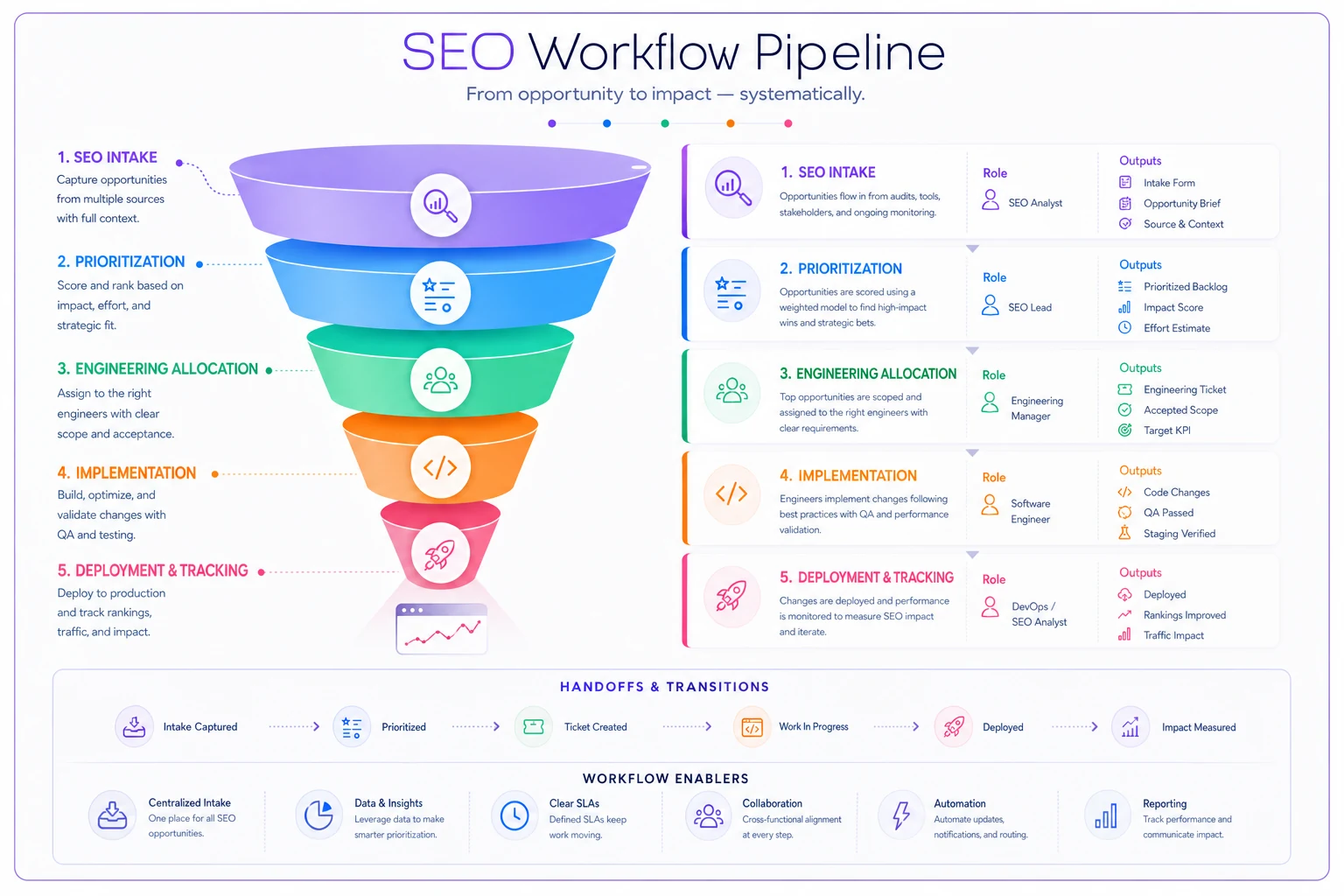
This shows roles, handoffs, and the prioritization loop so leadership and engineering share the same expectations.
Stage 2 hiring template
-
Technical SEO Specialist (full-time) Owns crawl health, rendering, schema, migration QA. The person who catches the faceted-nav disaster before it ships.
-
Content Strategist (full-time) Owns topic architecture and briefs. Not a writer — the person who decides what's worth writing and how it connects.
-
Dedicated engineering allocation Negotiated as a standing commitment, not favor-by-favor.
Stage 2 tooling checklist
-
[ ] Enterprise crawler with scheduled monitoring and change alerts
-
[ ] Content brief / topic mapping system
-
[ ] Schema validation and monitoring
-
[ ] A prioritization framework everyone actually uses
-
[ ] Attribution model connecting organic sessions to pipeline or revenue
Sample Stage 2 OKRs
-
KR
90% of SEO tickets scored through a shared prioritization framework.
-
KR
Median time-to-deploy for approved technical fixes under an agreed SLA.
-
KR
Organic revenue attribution model live and validated against two independent data sources.
-
KR
Repeatable workflows documented for the four highest-volume recurring tasks.
On prioritization specifically — this is where an ROI-driven matrix for allocating headcount, engineering cycles, and budget earns its keep. The teams that survive the Stage 2 crunch aren't the ones working the most hours; they're the ones who can point to a defensible ranking when engineering asks why this ticket over that one.
By Stage 2, the volume of recurring checks — schema validation across templates, flagging pages that drifted into soft-404 territory, catching canonical conflicts after a release — outpaces what one specialist can eyeball. Operational software with AI automation earns a spot in the stack here: not to replace the specialist, but to handle repetitive detection so they're spending time on judgment calls instead of manual scanning. Fewer things slip through. That's the goal.
Stage 3 — Scale & Compounding (Months 12–18)
By now the foundation is solid and the workflows are repeatable. Stage 3 is about compounding — running enough safe experiments, catching enough issues automatically, and owning enough of the attribution story that gains build on each other instead of producing one-off wins that fade.
The failure mode here is different from earlier stages. It's not that things break loudly — it's that they degrade quietly. At 50,000+ pages, you accumulate index bloat, stale schema, and crawl waste faster than any human can audit. A program that looked healthy at month twelve can be silently leaking traffic by month eighteen if detection isn't automated.
What matters in Stage 3:
-
Experimentation at volume. Not one title test at a time — a governed program running many safe tests with proper controls, so you're learning continuously and measuring incremental value rather than guessing.
-
Automated detection across the catalog. Anomaly alerts on crawl patterns, schema conflicts, indexation drift, ranking cliffs. The site tells you when something's wrong instead of you finding out from a traffic report three weeks late.
-
Full revenue ownership. The SEO org owns its attribution pipeline end to end and can defend it in a board deck.
-
Content operations at scale. Production, refresh, and pruning running as a managed system, not a series of one-off campaigns.
Stage 3 hiring template
-
SEO Data Engineer (full-time) Owns the attribution pipeline, log processing, and the data infrastructure feeding automated detection. This is the hire spreadsheets have been quietly demanding since around month nine.
-
Experimentation PM (full-time or shared) Runs the testing program, guards experiment integrity, and protects against blind tests that create risk.
-
Content Operations Lead (full-time) Turns content into a production system with clear throughput and quality gates.
Stage 3 tooling checklist
-
[ ] Data warehouse / pipeline for SEO + revenue data
-
[ ] Automated anomaly detection across crawl, index, and schema
-
[ ] Experimentation platform with proper statistical controls
-
[ ] Content ops workflow tooling
-
[ ] Executive dashboards tied to revenue, not just rankings
Sample Stage 3 OKRs
-
KR
Sustained experiment throughput of N safe tests per quarter with measured incremental lift.
-
KR
Automated detection covering 95%+ of revenue-critical page templates with alerting under an agreed latency.
-
KR
Organic revenue attribution owned end-to-end and reconciled monthly.
-
KR
Index bloat reduced and held under a defined threshold across the catalog.
Stage 3 is also where the maturity model pays its clearest dividend. Because each prior stage was documented and tied to outcomes, the budget conversation for this final phase isn't a pitch — it's a summary of what worked and what the next level of investment unlocks. That's a meaningfully different conversation to walk into.
When each stage actually makes sense — and when it doesn't
When to move faster: If you're an established enterprise with existing engineering capacity and clean data infrastructure, you might compress Stages 1 and 2. You're not building the measurement layer from scratch; you're pointing existing infrastructure at SEO.
When to move slower: If your data is a mess or engineering has zero available cycles, don't rush to Stage 2 hiring. Adding a content strategist when the site isn't reliably indexable is like hiring a sales team before the product works. You'll spend salary generating output that can't rank.
Who should not follow this model at all: If you're a small business with a few hundred pages and a single marketer, this is overkill. The maturity model assumes enterprise scale — meaningful catalog size, real engineering dependencies, and organic revenue large enough to justify six-figure investment. Below that threshold, you want a lean, focused operator, not a staged org build. Don't cargo-cult enterprise structure onto a small operation.
The most common expensive mistake: hiring Stage 3 roles at Stage 1 maturity. A data engineer with no data pipeline to build, or an experimentation PM with no reliable measurement to experiment against, is an expensive person waiting for the rest of the org to catch up. Hire to the stage you're in, plus a small lead into the next one — never two stages ahead.
A realistic scenario: how the phasing plays out
Consider a mid-market B2B SaaS company — roughly 3,000 indexable pages, organic driving maybe a quarter of pipeline. They came in with a familiar problem: leadership believed SEO mattered but couldn't get a straight answer on ROI, and every reporting meeting devolved into arguments about whether the numbers were real.
Stage 1 (months 0–6): They resisted the urge to commission content immediately. The technical crawl surfaced that a chunk of their highest-intent comparison pages had picked up a canonical pointing to the wrong template after a rebrand — quietly suppressing pages that should've been ranking. Fixing that, plus reconciling the GSC/GA reporting, took most of the first two quarters. Spend landed around $210k annualized, mostly the lead's salary plus contracted dev.
Stage 2 (months 6–12): They added a technical specialist and a content strategist, formalized intake so engineering stopped treating SEO as random requests, and stood up attribution. This is where the argument shifted. Instead of "we think SEO is working," they could show organic-sourced pipeline against a real model. Spend rose toward the $450k range.
Stage 3 (months 12–18): With trust established, they got budget for a data engineer and an experimentation program. Automated detection started catching schema drift and soft-404 patterns the specialist would've missed manually. The compounding showed up not as one big spike but as steadier, defensible growth — and a budget conversation that was finally just a math conversation.
The outcome that mattered wasn't a single traffic number. Eighteen months in, the program could defend every hire and every dollar with a line back to revenue.
Playbook artifacts to build as you go
You'll want a small set of reusable artifacts that live beyond any single person. Build these as you hit each stage:
-
A stage-assessment scorecard — honest criteria for which stage you're actually in, reviewed quarterly.
-
Role scorecards for each hire tied to the OKRs above, so hiring is defensible.
-
A tooling justification doc — what each tool does, which workflow it supports, and what breaks without it. This is your renewal-season armor.
-
A prioritization rubric everyone uses, so engineering trusts your queue.
-
A revenue attribution one-pager you can drop into any executive deck without re-explaining the methodology.
The point of writing these down isn't process for its own sake. Enterprise SEO programs lose people — leads leave, priorities shift, reorgs happen. The programs that survive leadership turnover are the ones where the system is documented, not stuck in one person's head.
Closing thought
Most enterprise SEO budgets don't get cut because of poor performance. They get cut because the team couldn't connect spend to stage and stage to outcome when it mattered. A maturity model fixes that by making every investment answer a specific question: what does this hire unlock, what does this tool make repeatable, and what revenue math does this stage prove?
Plan in stages, hire to the stage you're in, and make each phase earn the next. Do that consistently, and the budget meeting stops being a defense and starts being a straightforward request backed by eighteen months of evidence.
Ready to elevate your search rankings?
Join 5,000+ businesses using GoSeofy to increase organic traffic, optimize content, and outperform competitors online.