



Most enterprise SEO roadmaps aren't roadmaps. They're wishlists sorted by whoever complained loudest in the last quarterly planning meeting. Someone in merchandising wants faceted pages fixed. The content lead wants 40 new hub pages. A VP saw a competitor outranking them and now "site speed is a priority." Engineering has a backlog three sprints deep and no idea which of your 22 tickets actually moves revenue.
The problem isn't that teams don't care about SEO. It's that nobody has a defensible way to say this project is worth 3 engineering weeks and that one isn't. Prioritization defaults to politics, gut feel, or whatever's easiest to ship. And the highest-ROI work — the boring, cross-functional stuff that requires real engineering commitment — keeps sliding.
This is a systems piece, not a list of ranking factors. The goal is a reproducible way to score SEO work against expected revenue, phase it into engineering cycles without derailing the product roadmap, and get sign-off from people who don't care about crawl budgets. Build this scoring layer once and you stop re-litigating priorities every quarter.
Why prioritization breaks at scale (and it's not what you think)
At a small site, prioritization is easy because the causal chain is short. Fix a title tag, rankings move, you see it in a week. One person can hold the whole map in their head.
At enterprise scale, three things quietly break that model.
First, the feedback loop stretches. Ship a technical fix on 80,000 product pages and you might not see clean revenue signal for 8–12 weeks — crawl lag, seasonality, and the fact that Google re-evaluates templated changes slowly all pile on. When feedback takes a quarter, gut feel stops working. Nobody can intuitively connect a June deploy to a September revenue bump.
Second, ownership fragments. The person who knows a fix matters (SEO) rarely controls the resources to ship it (engineering, product, content ops). So the prioritization conversation isn't really about impact — it's a negotiation between teams with different scorecards. SEO is measured on organic traffic. Engineering is measured on velocity and uptime. Those incentives don't naturally align.
Third, the volume of "valid" work explodes. On a large site there are always dozens of legitimately worthwhile projects. Schema gaps, internal linking, dead pages, indexation waste, Core Web Vitals — all real, all defensible. Without a scoring model, "everything is important" becomes indistinguishable from "nothing is prioritized."
The teams who consistently win at this aren't the ones with the best SEO ideas. They're the ones who can translate SEO ideas into a currency the rest of the org already uses: expected revenue, effort, and confidence. That translation layer is the whole game.
The ROI scoring matrix (and the weights that actually matter)
The core artifact is a scoring spreadsheet. Every candidate SEO project gets scored on a fixed set of dimensions, each weighted, producing a single comparable number. The point isn't false precision — it's forcing consistent, explicit reasoning so two projects can be compared without calling a meeting.
Stop losing visibility in search results.
GoSeofy helps you monitor, analyze, and improve your SEO performance with ease.
- Comprehensive keyword tracking
- Backlink quality monitoring
- Real-time SEO performance reports
No credit card required
| Dimension | What it captures | Weight | Scale |
|---|---|---|---|
| Revenue impact | Estimated incremental organic revenue if it works | 35% | 1–10 |
| Confidence | How sure are we it'll actually work (evidence, precedent) | 20% | 1–10 |
| Effort (inverse) | Engineering + content cost; lower effort scores higher | 20% | 1–10 |
| Strategic leverage | Does it unlock or de-risk other work? | 15% | 1–10 |
| Time-to-impact | How fast revenue shows up | 10% | 1–10 |
Score = (Revenue × 0.35) + (Confidence × 0.20) + (Effort_inverse × 0.20) + (Leverage × 0.15) + (Speed × 0.10)
A few things about these weights, because they're not arbitrary.
Revenue gets the heaviest weight, but not a dominant one. If you weight revenue at 60%, every giant moonshot floats to the top and never ships because effort is enormous and confidence is low. Capping it at 35% keeps big-but-risky ideas from crowding out reliable wins.
Confidence is weighted almost as heavily as effort on purpose. The most common scoring mistake is teams inflating revenue estimates for projects they want to do, without discounting for uncertainty. A separate confidence score exposes that. A project scored 9 on revenue but 3 on confidence gives you a clear signal: run a cheap test to raise confidence before committing engineering cycles.
The effort inverse matters more than people expect. Two projects with identical revenue potential aren't equal if one is a two-day metadata change and the other is a two-quarter re-platform. Rewarding low effort surfaces quick wins that build political capital — which you need to fund the expensive work later.
Scoring revenue without pretending you know the future
estimated incremental revenue = affected sessions × expected traffic lift % × conversion rate × AOV
You won't be exact. You don't need to be. What you need is a consistent method so that when you score 15 projects, they're all wrong in the same direction and therefore still comparable. A project touching 200k monthly sessions with a plausible 8% lift scores higher than one touching 12k sessions with a hoped-for 30% lift — and now you can see that instead of arguing about it.
If your session-to-revenue mapping is shaky, that's an upstream problem worth fixing first. A scoring matrix is only as good as the attribution feeding it, which is why teams serious about this usually stand up a proper SEO data pipeline for revenue attribution before trusting the numbers coming out of the matrix. Bad revenue estimates make a beautiful spreadsheet dangerous.
From scores to a phased engineering plan
A ranked list isn't a plan. The top project by score might need three teams and a shared data model that doesn't exist yet. The second artifact is a phasing template that translates the ranked backlog into something engineering can actually slot into cycles.
-
Quick wins (fits in current sprint, single team). High-score, low-effort items that need no cross-team coordination. Metadata tests, canonical fixes, isolated schema additions. These ship continuously and build credibility.
-
Committed builds (1–3 sprints, cross-functional). Higher effort, high leverage. Faceted navigation rework, internal linking systems, template-level indexation fixes. These need to be scheduled into the roadmap, not squeezed around it — which means they go through normal product planning with a one-page ask attached.
-
Foundational bets (quarter+, platform-level). Re-platforms, rendering changes, data infrastructure. Rare, expensive, and only justified when strategic leverage is high and confidence has been raised through smaller precedent work.
The critical discipline: never let a foundational bet skip the quick-win phase. If a huge project depends on an assumption, find the smallest version that tests that assumption and run it first. A team wanting to rebuild rendering to fix indexation should first prove indexation is actually the revenue bottleneck on a 500-page subset. That subset test is a quick win that either kills the big project or makes it fundable.
Validate big assumptions with a small, measurable test before committing engineering cycles.
The workflow that keeps phasing honest
Every candidate project enters the matrix and gets scored by the SEO lead, with the revenue input sanity-checked against the attribution model.
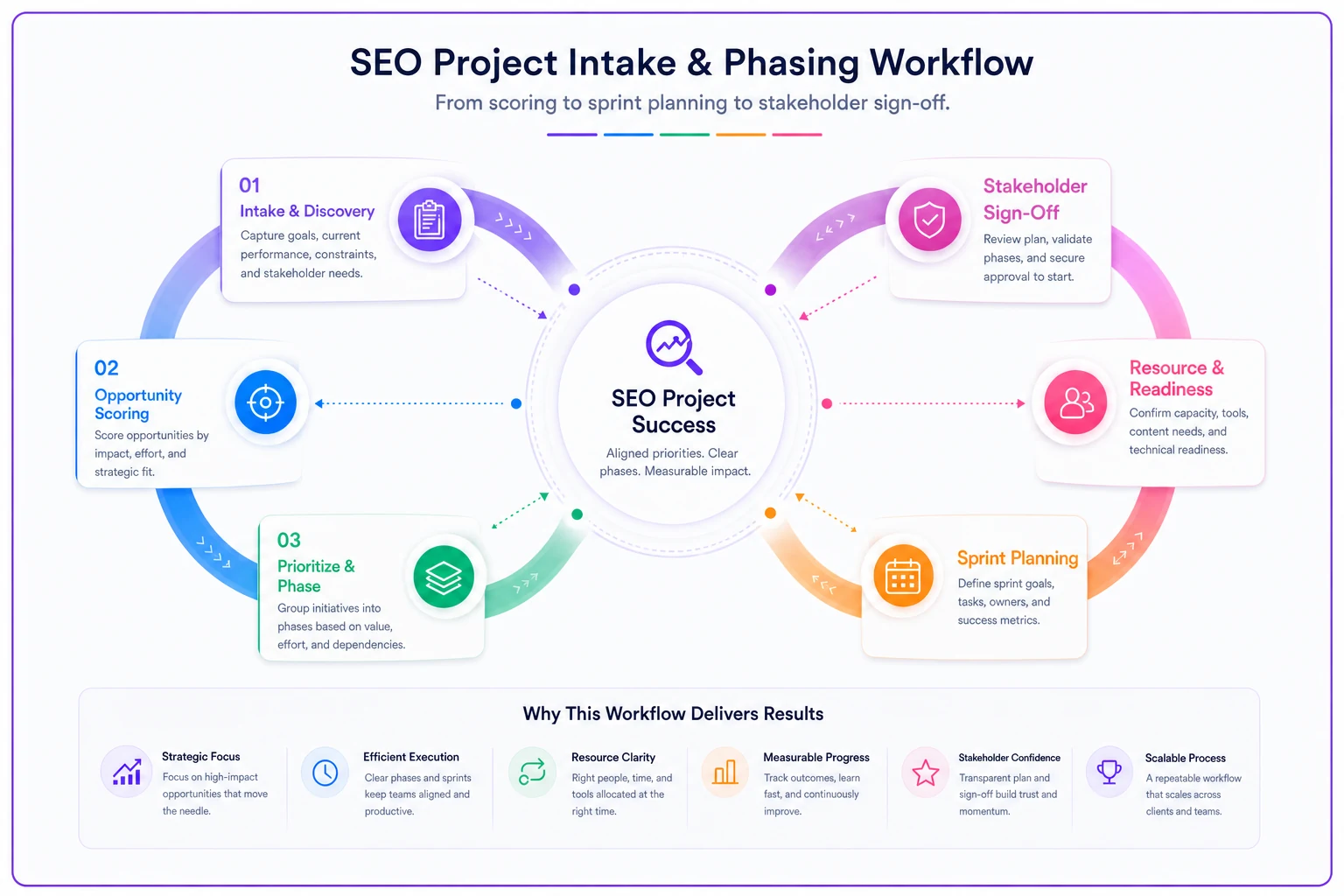
Anything above the quick-win threshold with effort under roughly three days goes straight into the SEO team's own queue and ships without engineering negotiation. Everything else gets sorted by score into the committed and foundational bands.
At the start of each planning cycle, the SEO lead brings the top committed items to product planning — not as "SEO requests" but as scored revenue projects with effort estimates and one-page asks attached. Product slots them against everything else competing for the same engineering time. Because they're already denominated in expected revenue, they compete on equal footing with feature work instead of losing by default.
Foundational bets don't enter planning until their prerequisite tests have run. This is the part most teams skip and later regret. Keeping intake, scoring, and hand-off consistent is really an operations problem — and if your team is drowning in ad-hoc requests, the underlying fix looks a lot like the SEO ops playbook with SLAs and ticket templates. The matrix sits on top of that structure; it doesn't replace it.
The one-page ask: getting non-SEO people to say yes
The third artifact is the stakeholder document, and it's where most SEO teams lose. A perfect matrix still gets nothing built if the ask lands as a wall of technical justification on a VP's desk.
-
The ask, in one sentence. "3 engineering weeks in Q3 to rebuild faceted navigation indexing."
-
Expected revenue impact, with the range. "Est. $180k–$260k annualized incremental organic revenue." Ranges read as honest; single numbers read as sales.
-
Confidence and why. "Medium-high. Precedent
similar fix on category pages recovered ~15% traffic in 90 days."
-
What happens if we don't. The opportunity cost, stated plainly.
-
Dependencies and risk. Who else is needed, what could go wrong, rollback plan.
The pattern to avoid: leading with the technical problem. Executives don't fund "soft 404s on 30k product URLs." They fund "recovering roughly $200k in organic revenue currently leaking from unindexable product pages." Same project. One gets approved.
That framing — connecting SEO work to money — is the same discipline behind a business-aligned SEO measurement framework. If you've already built that measurement language internally, your one-page asks basically write themselves.
A real scenario: how this changed a mid-market retailer's roadmap
A home-goods e-commerce operation, roughly 90k SKUs, had a backlog of around 30 SEO projects and a running argument between SEO and engineering about what mattered. Engineering was allocating maybe one sprint a quarter to SEO, and it kept going to whatever was freshest in someone's mind.
They scored the full backlog. What surfaced was uncomfortable: two projects engineering had already committed to scored in the bottom third — decent ideas, but low confidence and heavy effort. Meanwhile a template-level internal linking fix, which nobody had championed because it was "boring," scored near the top: large affected page count, high confidence, moderate effort.
They reshuffled. The internal linking work and a batch of metadata quick wins shipped over the following two quarters. The two low-scoring committed projects got demoted to "test first" — and one of those tests failed, which saved an estimated six weeks of engineering that would've produced nothing.
Organic revenue on the affected page templates came up somewhere in the 12–18% range over those two quarters. But the bigger win was procedural: prioritization arguments dropped off almost entirely because the matrix made the reasoning visible. Engineering stopped feeling like SEO requests were random. That trust compounded — the next quarter they got more allocated cycles, not fewer.
When this framework makes sense — and when it doesn't
It makes sense when you have more valid SEO work than capacity, multiple teams competing for the same engineering time, and a feedback loop long enough that gut feel has stopped working. That's most enterprise and mid-market sites.
It's overkill when you're a small team on a small site with fast feedback. If you can ship a change and see the result in a week, formal scoring is just bureaucracy. Fix things.
It's a bad idea when your attribution is broken and you don't know it. A scoring matrix built on fantasy revenue numbers produces confident, wrong priorities — which is worse than admitted guessing. Fix the data foundation first, then score.
Who should not do this: teams using it as a shield to avoid decisions. The matrix is a reasoning tool, not a decision machine. If a project scores 6.8 and another scores 6.9, that's a tie — use judgment. The value is in the top-versus-bottom separation and the forced consistency, not the second decimal place.
Keeping the matrix alive
The failure mode after month three is that the spreadsheet becomes a graveyard. Someone scores everything once, priorities get set, and nobody re-scores as reality changes. Confidence scores should move as tests come back. Revenue estimates should get corrected against actuals so next quarter's scores are calibrated better than last quarter's.
A matrix that never learns from its own predictions is just an elaborate opinion document. Treat it as a living record: score, ship, measure, feed the result back into how you score the next batch. Over a few quarters your revenue estimates get noticeably tighter, your confidence scores stop being wishful, and the whole thing starts predicting outcomes well enough that stakeholders stop second-guessing it.
The real payoff isn't a prettier roadmap. It's a prioritization process the rest of the organization actually trusts, funds, and stops fighting about. The SEO work that matters most is usually cross-functional, unglamorous, and easy to deprioritize — and a scoring layer that speaks in revenue is how that work finally gets built.
Ready to elevate your search rankings?
Join 5,000+ businesses using GoSeofy to increase organic traffic, optimize content, and outperform competitors online.