



Most indexing disasters on e-commerce sites don't come from a bad migration or a broken redirect. They come from filters. Color, size, price range, brand, availability — each one looks harmless on its own. Then someone stacks four of them together and your /shoes category quietly spawns 40,000 crawlable URLs, most of which are near-duplicates of each other.
The frustrating thing is that faceted navigation is good for users. The implementation is what goes sideways, usually because the marketing team and the engineering team never actually agreed on which URLs are supposed to exist in Google's index and which ones are just there to help someone find a size 9 running shoe.
This post is narrow on purpose. It covers the exact page-type mapping, canonical rules, and server-side vs JS patterns that keep faceted URLs from breaking your indexing — plus the regression queries and product-variant checklists your engineers can actually use without guessing.
Why faceted navigation breaks indexing in the first place
The math is the whole problem. If you have a category with six filter dimensions and each has a handful of values, the number of possible URL combinations isn't additive — it's multiplicative. A category showing 200 products can generate tens of thousands of unique filter-state URLs, and Googlebot will happily try to crawl a big chunk of them.
-
Crawl waste. Bots burn time on
?color=blue&size=9&sort=price_ascinstead of your actual product and category pages. If you've ever dug into log files and wondered why 60% of Googlebot hits land on parameter URLs, this is why. There's a whole workflow for attacking this in the piece on crawl budget triage for large e-commerce sites. -
Duplicate/thin signals. Most filter combinations return the same products in a slightly different order, or a subset. Google sees a wall of near-identical pages and starts making its own decisions about what to index — and those decisions rarely match yours.
-
Canonical confusion. When self-referencing canonicals get applied to filtered URLs automatically, you're telling Google every filter state is its own canonical page. That's the most common mistake, and it's almost always a templating default nobody set intentionally.
The core issue is that "should this URL rank?" and "should a user be able to reach this state?" are two different questions. Faceted nav collapses them into one URL structure, and unless you deliberately separate them, engineering defaults decide the answer for you.
First, map every page type before touching a single rule
You can't write canonical logic until you know what kinds of pages you actually have. The mistake teams make is jumping straight to "let's noindex the filters" without defining what a filter even is on their own site. Some filters are commercially valuable — people search "waterproof hiking boots." Some are pure utility — sort by price. Treating them identically is how you either bloat the index or accidentally kill pages that were driving revenue.
Stop losing visibility in search results.
GoSeofy helps you monitor, analyze, and improve your SEO performance with ease.
- Comprehensive keyword tracking
- Backlink quality monitoring
- Real-time SEO performance reports
No credit card required
Here's the mapping worth getting SEO and engineering to agree on in writing before implementation:
| Page type | Example URL | Index? | Canonical target | Notes |
|---|---|---|---|---|
| Root category | /hiking-boots | Index | Self | Primary ranking page |
| Single high-value facet | /hiking-boots/waterproof | Index | Self | Only if it has search demand + unique content |
| Single low-value facet | /hiking-boots?color=brown | Noindex, follow | Root category | Useful for users, not for ranking |
| Multi-facet combination | /hiking-boots?color=brown&size=10 | Noindex, follow | Root category | Almost never worth indexing |
| Sort / view params | ?sort=price&view=grid | Noindex, follow | Base URL without param | Pure UX state |
| Pagination | /hiking-boots?page=3 | Index | Self | Do NOT canonical to page 1 |
The subtlety most people miss: noindex and canonical are not interchangeable, and stacking them causes problems. A page that's noindex and canonicalized to another URL sends mixed signals — Google may eventually drop the canonical because the noindex tells it not to process the page at all, which weakens the signal consolidation you were after. Pick the right tool per page type. For pure UX states, noindex, follow is usually cleaner than a canonical.
Notice the row about high-value facets pointing to self. This is where real revenue lives and where over-aggressive noindex rules quietly destroy traffic. If "waterproof hiking boots" gets searched a few thousand times a month and you noindex that facet page along with everything else, you just handed that ranking to a competitor. Promote a small number of facet pages to proper indexable pages with unique intros and titles. Keep the rest out.
Promote a small number of facet pages to proper indexable pages with unique intros and titles.
Keep the rest out.
The index/noindex + canonical decision, as a rule set engineers can code
Turn the table above into deterministic logic. Ambiguous rules are how you end up with edge cases that behave randomly. A workable rule set looks like this:
-
If the URL matches a whitelisted "promoted facet" pattern → serve
index, follow, self-canonical, unique title/meta/H1, and a short unique description block. -
If the URL contains exactly one filter parameter not on the whitelist → serve
noindex, follow, no conflicting canonical, keep internal links crawlable. -
If the URL contains two or more filter parameters → serve
noindex, follow, and consider blocking the deepest combinations at the crawl level once you confirm bots are wasting time there. -
If the URL contains only sort/view/session parameters →
noindex, follow, and canonical to the parameter-stripped base URL (this one's safe because the base is genuinely the same content). -
Everything else (root categories, products, pagination) →
index, follow, self-canonical.
The whitelist is the important, human part. It should be a maintained list owned by SEO, not a regex someone wrote once and forgot. When a new commercially valuable filter emerges — say a "vegan leather" attribute starts trending — someone adds it to the whitelist and it graduates to an indexable page. Without that ownership, the list rots and you're back to noindexing everything.
When aggressive noindex is actually the right call
If your category depth is shallow, your filters are almost entirely utility (sort, view, in-stock toggle), and you have no keyword data showing demand for filter combinations, then blanket-noindexing every parameter URL is genuinely fine. Simpler is better. Don't build a whitelist for filters nobody searches.
When it's a bad idea
If you're a large catalog retailer with real long-tail demand — attributes like brand, material, use-case, or capacity that people search directly — blanket noindex is throwing money away. The teams that get burned worst are the ones who "cleaned up" faceted URLs in a single sweep and watched long-tail category traffic quietly disappear over the following weeks, with no obvious culprit because nothing actually broke. It just stopped being indexable.
Here's a simple workflow to implement those rules:
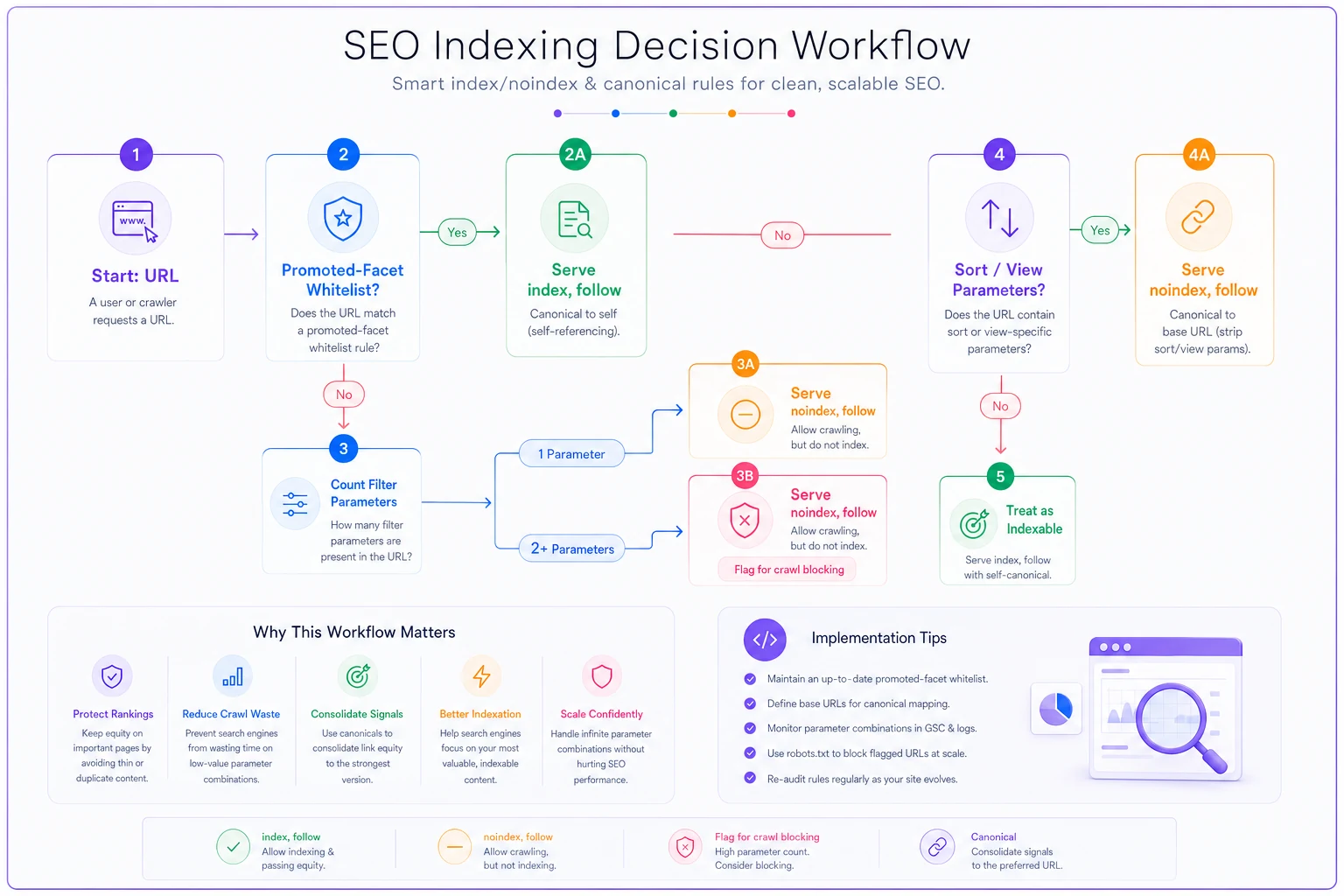
Use this workflow in CI checks and deploys.
Server-side vs JS: where implementation quietly fails
This is the part engineers care about and where a lot of well-intentioned SEO rules die silently. You can define perfect canonical logic and still have it fail because it's applied client-side after Googlebot has already made a decision.
The difference in practice:
-
Server-side rendering of directives. The
robotsmeta tag, canonical, and response headers are present in the initial HTML response. Googlebot sees them immediately, on the first pass, without waiting for rendering. This is what you want for anything indexing-related. -
Client-side (JS) injection of directives. The page loads, then JavaScript sets the canonical or swaps a
noindextag. Google can render JS, but rendering is deferred and not guaranteed on schedule — especially at scale. During that gap, the raw HTML might sayindexwhile your JS intendednoindex.
The failure pattern that shows up most often on modern SPA-style stores: the default HTML ships with a self-referencing canonical and no robots tag, and a client-side router injects the correct noindex after hydration. In a browser it looks perfect. In Google's initial fetch it looks like every filter combination is an indexable, self-canonical page. By the time JS rendering catches up, thousands of junk URLs are already queued.
The rule is simple and worth enforcing hard: anything that controls indexing must be in the server response, not injected by JavaScript. Titles and descriptions can tolerate some rendering delay. robots and canonical cannot.
A quick comparison of what's safe to render where:
| Element | Safe client-side? | Recommendation |
|---|---|---|
robots meta (index/noindex) | No | Server-side only |
| Canonical tag | No | Server-side only |
X-Robots-Tag header | N/A (header) | Server-side, great for non-HTML |
| Title / meta description | Risky | Prefer server-side |
| Structured data | Tolerable | Either, but SSR is safer |
| Internal links for crawl paths | No | Must be real <a href> in HTML |
That last row matters more than people expect. If your filter links are onClick handlers instead of real anchor tags, Googlebot may never discover — or crawl-signal — the promoted facet pages you do want indexed. Real hrefs for the pages that matter, plain and simple.
Regression monitoring: the queries that catch this before it costs you
Faceted indexing problems are damaging partly because they're invisible day-to-day. Nothing errors. Nothing 404s. The page renders fine. You only find out when a rankings report looks off weeks later. So you monitor the directive itself, not just the traffic.
-
Weekly parameter-URL index count. Pull the count of indexed URLs containing filter parameters from Search Console's coverage/pages report or an index-status crawl. A steadily climbing number of indexed
?color=URLs means a rule regressed somewhere. -
Daily log sampling of bot hits on parameter URLs. From your server logs, calculate the share of Googlebot requests landing on parameter URLs vs clean category/product URLs. If parameter share jumps, something started letting bots in. This ties directly into the workflow in the guide on finding indexation blind spots with log-file analysis.
-
Directive diff on deploy. Every release, re-fetch a fixed sample of roughly 30 known URLs (a few of each page type) and compare the rendered vs raw HTML robots and canonical values. If raw HTML says
indexand rendered saysnoindex, you've reintroduced the JS-injection bug. -
Whitelist drift check. Cross-reference your promoted-facet whitelist against actual indexable facet pages. Any indexable facet page not on the whitelist is an accidental indexation. Any whitelisted page returning
noindexis a lost ranking opportunity.
The highest-value alert here is number 3. The raw-vs-rendered diff catches the exact class of failure that ships silently and generates thousands of junk URLs before anyone notices. Wire it into CI if you can — fail the build when a known-noindex URL ships as index in raw HTML.
A short real scenario
A mid-sized outdoor gear retailer — roughly 8,000 SKUs — rolled out a new front-end framework and moved their category filtering to a client-side router. Everything looked clean in QA. Within about six weeks, Search Console's indexed page count climbed from around 22k to over 90k, almost all of it filter-combination URLs with self-referencing canonicals baked into the shipped HTML.
Traffic didn't crater immediately, which is what made it dangerous — it eroded. Long-tail category rankings slipped as Google spread its crawl thin across tens of thousands of near-duplicate URLs and started deprioritizing some of the real category pages. The team estimated the drift had cost them somewhere in the low-thousands of dollars in monthly organic revenue by the time they caught it.
The fix wasn't complicated once diagnosed: move robots and canonical back into the server response, apply the multi-facet noindex, follow rule, whitelist about a dozen genuinely-searched facet pages back to indexable, and add the raw-vs-rendered directive diff to their deploy checks. Indexed count settled back toward the low-20k range over the following two months, and the previously-slipping long-tail category pages recovered. Nothing exotic — just directives Google could actually see on first fetch.
The engineering checklist to hand off
Give this directly to whoever ships the code.
-
Page-type map agreed and documented (root, promoted facet, single facet, multi-facet, sort/view, pagination)
-
Promoted-facet whitelist created and assigned an owner
-
robotsmeta and canonical rendered server-side in the initial HTML response -
No JS injection or swapping of
robotsorcanonicalafter load -
Multi-facet combinations set to
noindex, followwith no conflicting canonical -
Sort/view/session params canonical to parameter-stripped base URL
-
Pagination pages self-canonical and indexable — not canonicaled to page 1
-
Promoted facet pages have unique title, H1, and a short unique content block
-
Filter links that matter for crawl use real
<a href>anchors, not JS handlers -
noindexandcanonicalnever stacked on the same URL toward a different target -
Raw-vs-rendered directive diff added to deploy/CI checks
-
Weekly indexed-parameter-URL count monitored with an alert threshold
-
Log-based bot-hit share on parameter URLs tracked
Give this directly to whoever ships the code.
Where teams should focus their attention
If you only fix two things, make them these: get indexing directives into the server response, and put one person in charge of the promoted-facet whitelist. The first prevents catastrophic silent bloat. The second prevents the slow bleed of noindexing pages that were quietly making money.
Faceted navigation SEO rules aren't really about SEO cleverness — they're about making sure marketing intent and engineering implementation describe the same set of pages. Most failures come from both teams assuming the other one handled it. Write the page-type map down, code it deterministically, and monitor the directive rather than waiting for traffic to tell you something went wrong. By the time traffic tells you, you've already lost a couple of months of rankings you didn't need to lose.
If you only fix two things, make them these: get indexing directives into the server response, and put one person in charge of the promoted-facet whitelist. The first prevents catastrophic silent bloat. The second prevents the slow bleed of noindexing pages that were quietly making money.
Faceted navigation SEO rules aren't really about SEO cleverness — they're about making sure marketing intent and engineering implementation describe the same set of pages. Most failures come from both teams assuming the other one handled it. Write the page-type map down, code it deterministically, and monitor the directive rather than waiting for traffic to tell you something went wrong. By the time traffic tells you, you've already lost a couple of months of rankings you didn't need to lose.
Ready to elevate your search rankings?
Join 5,000+ businesses using GoSeofy to increase organic traffic, optimize content, and outperform competitors online.