



Most SEO programs don't stall because the team ran out of tactics. They stall because nobody decided who owns what, when, or how decisions actually move between SEO, product, and engineering. You can have the smartest technical SEO in the building, and it won't matter if their fixes sit in a backlog for six weeks with no SLA, no ticket owner, and no escalation path.
SEO organizational design is usually the last thing anyone invests in, and the first thing that breaks. Teams buy tools, hire specialists, publish playbooks — and then watch all of it get bottlenecked because a canonical tag change requires three Slack threads and a prayer to get shipped.
This post is about the org itself. Not the tactics. How you staff it, how roles evolve as you scale, what the career ladder looks like so people don't leave, and — the part everyone skips — how work actually hands off between teams without turning into a political negotiation every single time.
Why SEO orgs break differently than other orgs
The structural problem that makes SEO uniquely painful to organize: SEO doesn't own its own production environment.
A content team can publish content. A paid team can launch and kill campaigns inside their own platform. But SEO? The actual levers — rendering, URL structure, internal linking logic, status codes, schema injection, page speed — all live inside systems owned by engineering and product. SEO is a function that depends almost entirely on other teams executing its recommendations.
That dependency is the root of nearly every scaling failure. When the team is small, you paper over it with relationships. The SEO lead knows a friendly engineer, they grab coffee, things get done informally. That works at five people. It completely falls apart at fifty.
What you see across a lot of growing programs is that the breaking point isn't headcount — it's the number of handoffs per week. Once SEO is generating more requests than informal relationships can absorb, everything grinds. Requests get lost. Priorities get argued in meetings instead of decided by a system. The best people burn out from constantly chasing status updates instead of doing actual work.
So organizational design for SEO isn't really about org charts. It's about designing the interfaces between SEO and the teams it depends on.
The four maturity stages (and what actually changes at each one)
Growth isn't linear, and the org shouldn't be either. The mistake people make is hiring for the stage they want to be at instead of the one they're in. You end up with a Director of SEO managing two people, or a lone generalist drowning in work that needs four specialists.
Stop losing visibility in search results.
GoSeofy helps you monitor, analyze, and improve your SEO performance with ease.
- Comprehensive keyword tracking
- Backlink quality monitoring
- Real-time SEO performance reports
No credit card required
| Stage | Team shape | Primary bottleneck | What you're actually buying with each hire |
|---|---|---|---|
| 1. Founder-led / Scrappy | 1 generalist (often part-time or shared) | Everything is on one person | Coverage — just getting SEO looked at |
| 2. First real team | 2–4 people: a lead + content + a technical leaning hire | Engineering access | Reliable execution on a few priorities |
| 3. Specialized | 6–12 people: technical, content, analytics, maybe local/international | Coordination between specialists | Depth and parallel workstreams |
| 4. Platform / Enterprise | 15+ with sub-teams, PM-for-SEO, dedicated eng pod | Governance and conflict resolution across many teams | Scale without chaos — process over heroics |
Worth noticing: the bottleneck moves. At Stage 2 it's getting engineers to ship anything. By Stage 4, engineering access is a solved problem — you have a dedicated pod — and the new enemy is coordination. Specialists stepping on each other, duplicate requests, nobody sure who owns the staging environment's SEO config.
Design your org for the wrong bottleneck and you waste money. Hiring a second content writer when your actual problem is "engineering won't touch our tickets" is a classic Stage 2 mistake.
A phased hiring plan that matches the bottleneck
Instead of a generic "hire these roles in this order" list, tie each hire to the problem it solves. Here's a sequence that holds up across most B2B and e-commerce programs.
-
First hire — the SEO Generalist/Lead. This person does everything and, more importantly, figures out where the leverage is. Don't hire a pure specialist first. You need someone who can diagnose whether your biggest problem is technical, content, or authority. Their real job in year one is building the case for the next hires.
-
Second hire — depends entirely on the diagnosis. If the site has deep technical rot (indexing issues, crawl waste, rendering problems), hire a Technical SEO. If the site is technically clean but thin on content, hire a Content Strategist. Don't hire based on what's trendy. Hire based on where traffic is actually being left on the table.
-
Third hire — the opposite of hire #2. Now you balance the team. You've got technical covered, so you add content depth, or vice versa.
-
Fourth hire — Analytics / SEO Data. This one gets delayed more often than it should. Once you have multiple people shipping changes, you need someone who can tell you what's working. Without this role, your team argues about attribution in meetings forever.
-
Fifth-plus — this is where you add the connective tissue a Technical Program Manager or SEO PM whose entire job is moving work through product and engineering. More on why this role is non-negotiable at scale below.
A practical note on budget sequencing: the enterprise SEO prioritization framework is worth running before you lock in a hiring plan, because it tells you where the ROI actually is — and headcount should follow ROI, not the other way around.
The role nobody hires early enough: SEO Program Manager
This is the single highest-leverage structural decision most teams get wrong, so it's worth spending real time on.
Around Stage 3, your SEO specialists start spending 30–40% of their time on coordination instead of work. Writing tickets, chasing engineers, sitting in prioritization meetings, re-explaining why a soft 404 matters to a PM who doesn't care. That's expensive. You're paying specialist salaries for project-management labor.
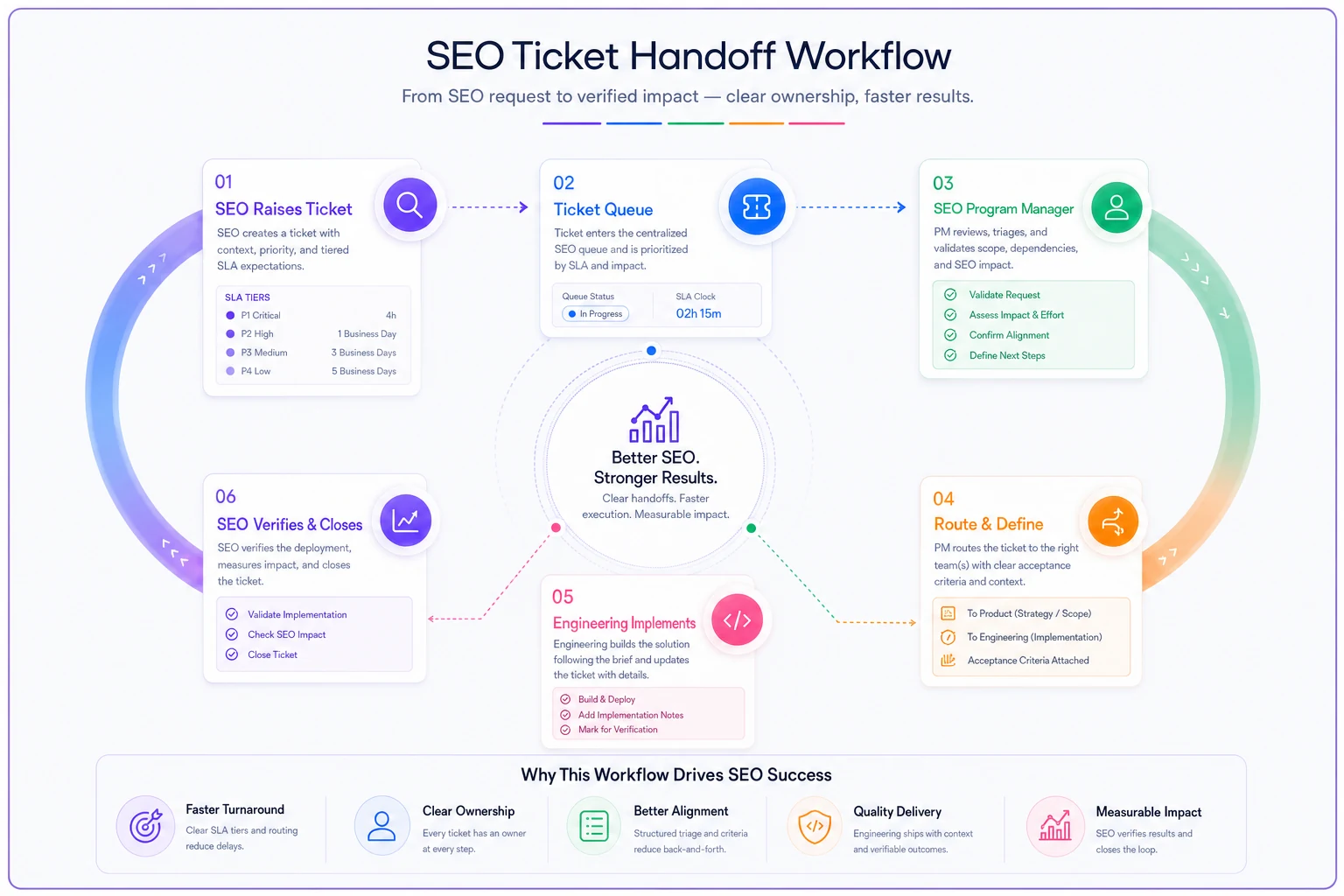
The SEO Program Manager (or TPM embedded with SEO) exists to absorb all of that. They own the ticket pipeline, the SLAs, the handoff templates, the standup with engineering. They translate "we have canonical conflicts on 12,000 product pages" into an engineering ticket with acceptance criteria, a priority score, and a rollback plan.
A common pattern: a program that adds this role sees its technical SEOs get back a full day or more per week of actual technical work. The role pays for itself not in salary math but in unblocked execution. Fixes that used to sit for a month ship in a week.
This is also the role that makes the ops side real. The mechanics of ticket templates, SLAs, and onboarding are covered in depth in the guide on scaling SEO operations without chaos — the Program Manager is the human who actually runs that system day to day.
Copy-ready job descriptions (trim to taste)
Technical SEO Specialist > You'll own the technical health of our site: crawlability, indexation, rendering, site architecture, and page experience. You'll diagnose issues using log files and Search Console, write engineering-ready specs with acceptance criteria, and partner with our dev team to ship fixes. Success looks like: fewer wasted crawl cycles, clean indexation of revenue pages, and technical issues resolved within SLA. You should be comfortable reading a server log, arguing about canonicals, and explaining why any of it matters to someone who isn't an SEO.
Content Strategist (SEO) > You'll own what we rank for and why. You'll build topic clusters, define intent targets, brief writers, and measure whether our content actually earns and keeps rankings. You'll work with the technical team on internal linking and with analytics on content performance. Success looks like: topical authority in our priority areas and content that converts, not just ranks.
SEO Analyst / Data > You'll be the source of truth for whether our SEO work is paying off. You'll build and maintain reporting, connect organic performance to revenue, flag anomalies, and design the measurement for our experiments. You'll work across SEO, product, and data engineering to keep our numbers trustworthy. Success looks like: nobody argues about attribution anymore because the data settles it.
SEO Program Manager / TPM > You'll run the pipeline that turns SEO recommendations into shipped changes. You'll own our ticketing process, SLAs, and the handoffs between SEO, product, and engineering. You'll run prioritization and keep work moving. Success looks like: fixes ship predictably, nothing gets lost, and specialists spend their time on specialist work instead of chasing status.
Career ladder rubrics (so your best people don't leave)
SEO has brutal retention problems partly because there's no obvious ladder. A great technical SEO at a company with no senior path just leaves for a company that has one. Build the ladder before you need it.
-
Scope — Do they own a task, a project, a workstream, or a strategy? A junior executes briefs. A senior defines what the briefs should be. A lead decides which workstreams exist at all.
-
Autonomy — How much supervision? Junior
work is checked. Mid: trusted on execution. Senior: trusted on judgment. Lead: sets the standard others are judged against.
-
Influence — Who do they move? Junior
their own work. Mid: their immediate function. Senior: cross-functional, gets engineering to reprioritize. Lead: influences company roadmap.
-
Ambiguity — How undefined a problem can they handle? Junior
clear problems. Senior: "traffic dropped 15% and we don't know why" — and they figure it out.
People get promoted when they're already operating at the next level, not as a reward for tenure. If your mid-level technical SEO is already resolving cross-team conflicts and setting standards, they're doing senior work and should be paid for it — or they'll find someone who will.
The handoff problem: where SEO work actually dies
You can have perfect roles, a clean ladder, and great hires, and still fail completely if the handoff between SEO, product, and engineering is undefined.
In practice, SEO work usually dies in one of these spots:
-
The silent backlog. SEO files a ticket. It enters engineering's backlog. It's never prioritized against product work because SEO has no seat at that prioritization table. It sits forever.
-
The spec that isn't a spec. "Fix the canonicals" is not a ticket. Engineering can't act on it, so they don't, and SEO thinks engineering is ignoring them.
-
The invisible dependency. Product ships a redesign. Nobody told SEO. It breaks internal linking and tanks a category. Now SEO is doing recovery work that a single review step would have prevented.
-
The no-owner limbo. A fix spans SEO (what), engineering (how), and product (whether it conflicts with roadmap). When all three partially own it, nobody fully owns it.
The fix is not "better communication." It's a defined interface — an SLA and a ticket contract that both sides agree to.
SLA tiers that actually get respected
The trick is tying urgency to revenue impact, not to how loudly the SEO is complaining. Three tiers is enough:
| Tier | Trigger | Response SLA | Example |
|---|---|---|---|
| P1 — Revenue bleeding | Live indexing/ranking loss on revenue pages | Same day, pulled into current sprint | Category pages deindexed; noindex accidentally shipped to templates |
| P2 — Degrading | Issue causing gradual loss or blocking a launch | Within current or next sprint | Soft 404s spreading across product pages; broken canonicals |
| P3 — Improvement | Optimization, no active loss | Groomed into roadmap, scheduled | New schema rollout; internal linking enhancement |
The reason this works is that it moves the fight. Instead of arguing every ticket's priority in a meeting, the team argues once about which tier something belongs in — and the SLA follows automatically.
The ticket contract
Every SEO-to-engineering ticket should carry, at minimum:
-
The problem in business terms (what revenue/pages are affected)
-
The technical change requested, specifically
-
Acceptance criteria — how we'll know it's done and correct
-
A verification step — who checks it post-deploy and how
-
A rollback condition — what signals mean "undo this"
Tickets without acceptance criteria are the number-one cause of "I fixed it" / "no you didn't" cycles. The verification step is what closes the loop so SEO isn't manually auditing every deploy.
The reverse handoff everyone forgets
The one that causes the most quiet damage: product and engineering need to hand off to SEO too. Any change touching URLs, templates, rendering, or navigation should trigger an SEO review before it ships. One lightweight gate — an "SEO impact" checkbox on relevant PRs or tickets that routes to the SEO queue — prevents the migration disasters that take months to recover from.
Add an 'SEO impact' checkbox to PR templates so SEO reviews run automatically.
This isn't bureaucracy for its own sake. It's a one-step gate that takes thirty seconds to add to a PR template and has saved more than a few programs from a painful quarter of recovery work.
When heavy org structure is a bad idea
Not every team needs this. If you're a Stage 1 or early Stage 2 program, installing SLA tiers and ticket contracts and a career ladder is overhead you can't afford. You'll spend more time maintaining the process than doing SEO.
-
You have fewer than around four people and informal relationships still move work
-
Your request volume is low enough that nothing is actually getting lost
-
You're pre-product-market-fit and priorities change weekly anyway
Build it immediately when:
-
You're consistently losing track of SEO requests
-
Specialists are spending more time coordinating than executing
-
You've been burned by a product change that broke SEO because nobody reviewed it
-
Prioritization has become a political fight instead of a decision
The warning sign to watch for is simple: the first time a serious SEO fix sits unshipped for a month and a product change silently broke organic traffic in the same quarter, you've outgrown informal coordination. That's when you build the interfaces.
A real scenario
A mid-market e-commerce company — roughly 40 people total, maybe six in marketing — had a solid technical SEO and a content person. Organic was flat despite real effort. When they mapped where work went, the picture was ugly: the technical SEO had around 30 open tickets with engineering, most older than a month, none prioritized against the product roadmap. No tier system, no acceptance criteria, half the tickets were one-liners engineering couldn't act on.
They didn't hire more SEOs. They added a program manager — promoted from an existing ops person, actually — and installed a three-tier SLA plus a ticket contract. Within a quarter, the backlog of stale tickets dropped from the low 30s to single digits. The technical SEO got roughly a day a week back. And a planned site redesign that would've nuked their internal linking got caught in the new review gate before launch — probably the biggest single save, since that kind of migration damage can take months to claw back.
Nothing exotic. They just gave the work a path to travel.
The takeaway
Scaling SEO is less about hiring brilliant individuals and more about designing the connections between them — and between SEO and the teams it depends on. The roles matter. The ladder matters. But the interfaces, the SLAs, the ticket contracts, and the reverse handoff from product are what separate a program that scales from one that stalls at a dozen people. Get the org design right and your specialists spend their time being specialists. Get it wrong and you'll pay senior salaries to watch smart people chase status updates. Design the system for the bottleneck you actually have, not the one you read about — and move it forward as the team matures.
Ready to elevate your search rankings?
Join 5,000+ businesses using GoSeofy to increase organic traffic, optimize content, and outperform competitors online.