
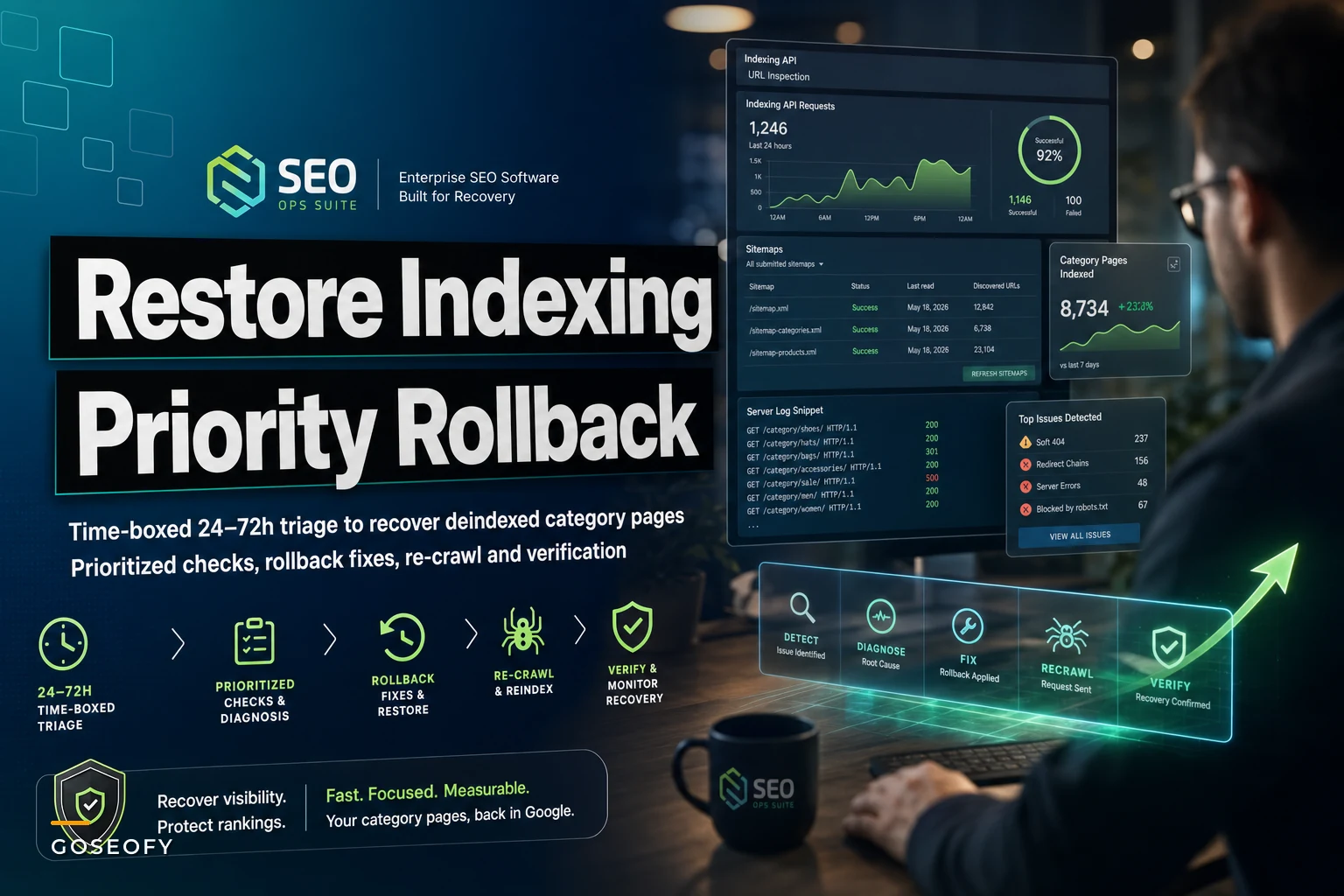

When a batch of category pages drops out of the index, you don't have time for a leisurely audit. Category pages sit near the top of the revenue funnel — they collect internal links, absorb head-term rankings, and funnel people toward products. When they vanish, the loss shows up in checkout, not just in Search Console. So the whole game in the first three days is about sequencing: doing the highest-signal checks first, ruling out the most damaging causes fast, and rolling back anything reversible in minutes before you start guessing.
This playbook runs on a clock. Hour 0 to 72. Each window has a job. The goal isn't to fix everything — it's to stop the bleeding and get Google re-crawling the important URLs before rankings decay past the point where recovery takes months.
First, define "deindexed" precisely — most teams waste the first 6 hours here
Half the panic around deindexing comes from misreading the symptom. Before touching anything, separate three things that look identical from the outside:
-
Dropped from index — the URL returns "Excluded" or "Crawled – currently not indexed" in the URL Inspection tool.
-
Ranking collapse but still indexed — the page is fine in the index, it just fell off page one. Different problem, different fix.
-
Serving a different page than you think — the URL 200s in your browser but Googlebot gets a 404, a redirect, or a soft 404. This is the sneaky one.
Teams frequently declare "we got deindexed" when they actually got reranked. That distinction matters because a rollback playbook does nothing for a relevance problem, and you'll burn a day chasing the wrong ghost. Pull the exact URLs from GSC's Pages report, filter for the category directory (say /collections/ or /c/), and confirm they're genuinely excluded — not just underperforming.
Hour 0–4: The rollback-first checks
The instinct is to diagnose. Resist it. In the first four hours you're looking for anything recently changed and instantly reversible. If a deploy went out in the last week, that's your prime suspect, and rolling it back is faster than understanding it.
Stop losing visibility in search results.
GoSeofy helps you monitor, analyze, and improve your SEO performance with ease.
- Comprehensive keyword tracking
- Backlink quality monitoring
- Real-time SEO performance reports
No credit card required
The order that tends to catch the most damage quickest:
-
robots.txt — Fetch the live file. Look for a
Disallowline that swallowed your category path. A singleDisallow: /c/shipped by mistake can nuke thousands of URLs overnight. This is the single most common "everything's gone" cause, and it's a one-line revert. -
Meta robots / X-Robots-Tag — Inspect a handful of affected category URLs and check the response headers and the rendered
<head>. Anoindexinjected by a template change or a CDN rule is the second-most-common culprit. Watch fornoindexdelivered via HTTP header — it's invisible in the HTML source, so people miss it constantly. -
HTTP status — Are the category URLs actually returning 200? A recent migration or faceted-nav change can flip live pages into 404s or 301s pointing somewhere useless.
-
Canonical tags — Check whether category pages are suddenly canonicalizing to the homepage, a parent category, or a filtered version of themselves. A bad canonical rule quietly tells Google "this page doesn't deserve its own index entry."
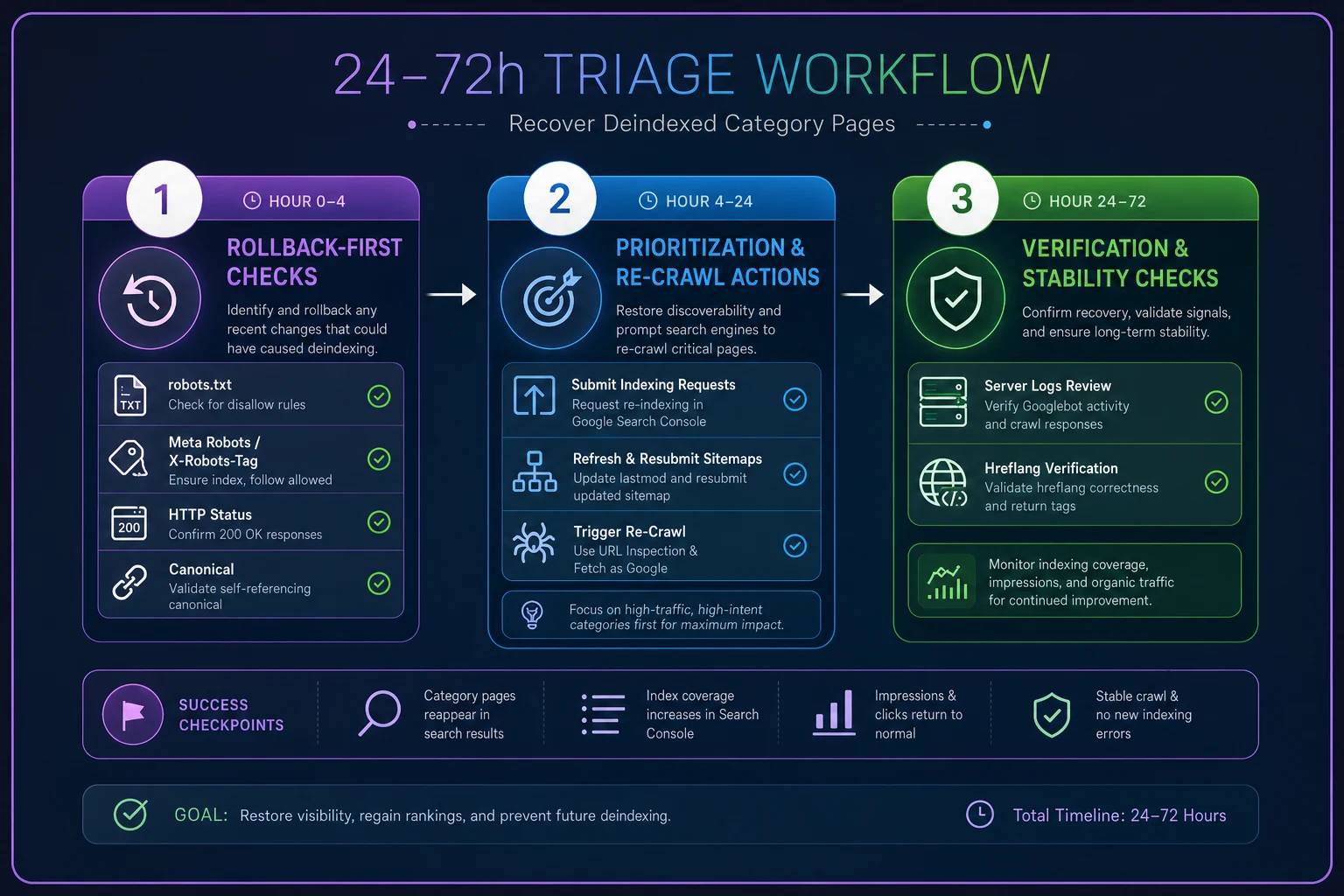
If any of these turns up a recent, reversible change, roll it back now and move on. Don't wait to confirm it's the cause. Reverting a bad robots directive costs nothing if you're wrong and saves days if you're right. This mindset — reversible actions first, root-cause later — is the same discipline that keeps launches from turning into disasters, and it's covered in more depth in the technical SEO migration playbook with rollback criteria.
This mindset — reversible actions first, root-cause later — is the same discipline that keeps launches from turning into disasters, and it's covered in more depth in the technical SEO migration playbook with rollback criteria.
A quick reference for the four prime suspects
The table below isn't exhaustive, but these four causes account for the vast majority of mass category deindexing events. If you're in hour one and don't know where to start, start here.
| Cause | Where to check | Rollback time | How often it's the culprit |
|---|---|---|---|
| Blanket robots.txt Disallow | Live /robots.txt | Minutes | Very common |
noindex via header or meta | Response headers + rendered <head> | Minutes to hours | Common |
| Wrong canonical target | Rendered <head> on category URLs | Hours | Common |
| Broken status (404/301) | curl / crawler on sample URLs | Hours to a day | Situational |
Notice that the two fastest fixes are also the two most likely causes. That's not a coincidence. The changes that cause mass deindexing tend to be global config changes — robots and template-level directives — because they apply everywhere at once. Individual page problems rarely take down a whole category tree.
Hour 4–24: Confirm scope and force re-crawl on what earns the most
Once you've addressed the obvious reversible causes, the next job is understanding how big the problem is and which URLs to save first. Not all category pages are equal. A "New Arrivals" hub driving a fifth of your organic revenue deserves attention before a long-tail sub-sub-category getting 40 visits a month.
Prioritize by revenue impact, not URL count. Pull last quarter's organic-assisted revenue per category page (or use organic entrances × conversion rate as a proxy if clean revenue data isn't available). Rank the deindexed URLs by that number. Now you have a triage list instead of a spreadsheet of 3,000 undifferentiated URLs.
A rough prioritization tier:
-
Tier 1 — Revenue-critical Top 10–15% of category pages by organic revenue. Submit these individually via the URL Inspection tool's "Request Indexing," and if you have Indexing API access, push them programmatically. Check these hourly.
-
Tier 2 — Meaningful but not urgent The middle band. Make sure they're in an updated, clean XML sitemap and let scheduled crawling pick them up.
-
Tier 3 — Long tail Fix the root cause and let normal crawling recover them over the following weeks. Don't spend manual effort here.
On the Indexing API: it's officially scoped for JobPosting and BroadcastEvent, but many teams use it to nudge Google toward high-value URLs after an incident and see faster pickup in practice. Treat it as an accelerant for Tier 1, not a substitute for fixing the underlying config.
While you're at it, refresh your sitemaps. After an incident, sitemaps often still list the broken state — or worse, auto-generate to exclude the affected URLs entirely. Confirm your category URLs are present, return 200, and carry lastmod dates that reflect the fix. Google leans on lastmod more than most people assume when deciding what to recrawl.
Hour 24–72: hreflang, log verification, and catching the second-order damage
By day two the fires should be out. Now you verify the fix actually reached Googlebot and hunt for collateral damage that surfaces late.
Verify with logs, not hope. The URL Inspection tool tells you what Google thinks right now, but server logs tell you whether Googlebot is actually coming back and what it's receiving. After a rollback, you want to see crawl activity returning to Tier 1 URLs with clean 200s. If Googlebot is still hitting the old broken response, the fix didn't propagate — CDN cache, stale edge config, or a deploy that didn't hit all servers are the usual suspects. Log analysis is the difference between "we fixed it" and "we think we fixed it," and it's the surest way to find URLs that are still quietly excluded. There's a full breakdown of this in finding indexation blind spots with log-file analysis.
hreflang, if you're international. For multi-region category pages, a deindexing event often exposes broken hreflang clusters. Check that each language/region version references the others correctly and that none carry a noindex that poisons the whole cluster. A common failure: the fix goes out on the /us/ category pages but the /uk/ and /de/ equivalents still point their canonical or hreflang at the broken versions. Those markets stay deindexed while the primary market recovers. Easy to miss because you're watching your home market's numbers rebound and assume everything else followed.
Watch for soft 404s creeping back in. Sometimes a rollback restores a 200 status but the page renders thin — an empty category with no products because a filter default changed. Google reads that as a soft 404 and re-excludes it within days. Spot-check that recovered category pages actually render their product grids to Googlebot, not an empty shell.
A real scenario: a mid-size outdoor gear retailer
An outdoor and camping retailer running roughly 1,200 category and sub-category URLs pushed a routine faceted-navigation update on a Thursday. The change added a canonical rule meant to consolidate filtered views — but a logic error made every base category page canonicalize to the site's top-level /shop/ page.
Nothing broke visibly. Pages loaded fine. But over the next eight days, Google quietly dropped around 400 category URLs from the index, and organic entrances to category pages fell by roughly 55–60%. Because it wasn't a hard error, no alert fired. They noticed when weekend organic revenue came in about $4k–$5k under a normal weekend and someone finally checked GSC.
Triage went roughly like this: within the first few hours they inspected a sample of category URLs, saw the canonical pointing at /shop/, and traced it to the Thursday deploy. Rolling back that one rule took under an hour. They ranked the 400 URLs by organic revenue, hand-submitted the top 60 or so through URL Inspection, and pushed the same set via the Indexing API. Sitemaps were regenerated with fresh lastmod dates.
Logs confirmed Googlebot returning to the priority URLs within about two days. The bulk of the deindexed pages came back over roughly three weeks, with the revenue-critical ones recovering first — which was the entire point of prioritizing by revenue instead of alphabetically. Total quantifiable loss landed somewhere in the low five figures, mostly concentrated in that first slow week before anyone noticed. Had it been caught in 24 hours instead of eight days, most of that would've been avoided.
The technical fix took an hour. The eight-day detection delay caused 90% of the damage. Which is why the real leverage isn't a faster rollback — it's noticing sooner.
When aggressive re-submission makes sense — and when it doesn't
Manually requesting indexing and hitting the Indexing API feels productive, so people overdo it. A few honest guardrails:
-
It makes sense when you've genuinely fixed the root cause and you're accelerating recovery on a small set of high-value URLs. Google recrawls fixed important pages faster when nudged.
-
It's a waste when the underlying problem is still live. Re-submitting a URL that still serves
noindexor a bad canonical just burns quota and teaches you nothing. Fix first, submit second. -
Don't bulk-submit thousands of URLs hoping volume solves it. It doesn't. It muddies your signal and you lose track of which fixes actually worked.
The teams that recover cleanly are the ones who resist the urge to do everything and instead do the right few things in order.
The 72-hour checklist
Keep this somewhere you can grab it at 9pm when category pages start disappearing:
-
- [ ] Confirm it's true deindexing, not a ranking drop or a Googlebot-only broken response
-
- [ ] Fetch live robots.txt — check for a category-level Disallow
-
- [ ] Inspect meta robots and X-Robots-Tag headers on sample URLs
-
- [ ] Verify category URLs return 200, not 404/301
-
- [ ] Check canonical targets on affected pages
-
- [ ] Roll back any recent reversible change immediately — don't wait to confirm causation
-
- [ ] Rank deindexed URLs by organic revenue; build Tier 1/2/3 list
-
- [ ] Request indexing on Tier 1; push via Indexing API if available
-
- [ ] Regenerate sitemaps with correct URLs and fresh lastmod
-
- [ ] Verify hreflang clusters on international category pages
-
- [ ] Confirm recrawl and clean 200s in server logs — not just in URL Inspection
-
- [ ] Spot-check recovered pages for thin/empty rendering (soft-404 risk)
Running through this list won't guarantee overnight recovery, but it makes sure you're not spending three days fixing the wrong thing while the actual problem keeps running.
The part nobody wants to hear
Most category-page deindexing isn't a mystery — it's a config change that shipped without anyone watching the right dashboard. The triage above works, but it's a cleanup crew. The teams that stop losing revenue to this don't just get faster at rollbacks; they get faster at detection, so the gap between "something broke" and "someone noticed" shrinks from eight days to eight hours.
Set up an alert on indexed-URL counts for your category directories. Watch canonical and robots directives after every deploy. Keep a known-good snapshot of your robots.txt and template <head> so a rollback is a diff, not a debate. The 72-hour playbook saves you when things break — but the real win is making the incidents smaller and rarer, because the pages that quietly disappear are almost always the ones that were paying the bills.
Set up an alert on indexed-URL counts for your category directories. Watch canonical and robots directives after every deploy. Keep a known-good snapshot of your robots.txt and template <head> so a rollback is a diff, not a debate. The 72-hour playbook saves you when things break — but the real win is making the incidents smaller and rarer, because the pages that quietly disappear are almost always the ones that were paying the bills.
Ready to elevate your search rankings?
Join 5,000+ businesses using GoSeofy to increase organic traffic, optimize content, and outperform competitors online.