

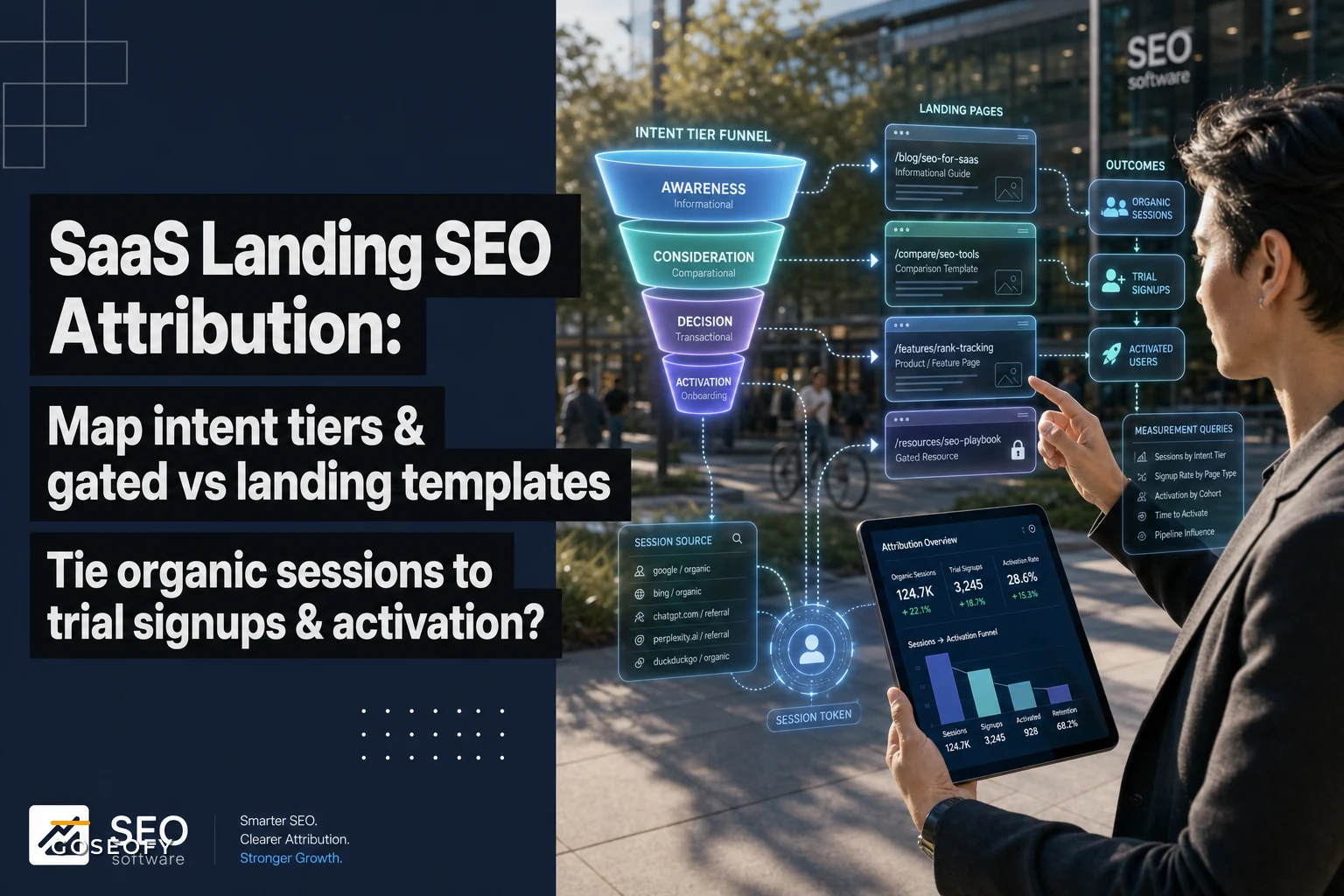

Most SaaS teams have the same broken assumption baked into their SEO: that ranking for a keyword automatically moves someone toward a trial. It doesn't. A page can rank on page one, pull thousands of clicks a month, and produce almost zero activated users — not because the content is bad, but because the intent behind the query never matched what the page was asking the visitor to do.
This is the specific problem worth solving: the mismatch between the intent tier of a query, the type of page you serve for it, and the conversion action you attach to that page. Get that mapping wrong and you either gate content too early (killing top-of-funnel discovery) or leave high-intent traffic sitting on a soft educational page with no path to trial. Get it right and the same traffic volume produces noticeably more signups.
Below is how the mismatch happens, how to map intent tiers to page templates, and how to actually tie it back to trials and activation.
The mismatch, in practice
A pattern that shows up constantly: a team builds a comparison page — "Tool X vs Tool Y" — which is a genuinely high-intent query. Someone searching that is close to a buying decision. But the page gets treated like blog content: long, informational, ending with a soft "learn more" link buried at the bottom. No pricing, no side-by-side that flatters your product, no obvious trial CTA above the fold.
Meanwhile, a top-of-funnel article — "what is workflow automation" — gets a gated ebook slapped on it. The visitor barely knows the category exists, and you're asking for their work email before they've formed any intent at all. Bounce.
Both pages might "convert" in a dashboard somewhere. But the comparison page is leaking the exact buyers you spent budget to attract, and the informational page is gating discovery that should be feeding your funnel wide open.
The root cause is almost always that pages are built by content type — blog, landing, resource — instead of by intent tier. Nobody decided, per query, what the visitor is actually ready to do next.
Intent tiers for SaaS, defined by readiness — not keywords
Forget the generic TOFU/MOFU/BOFU labels for a moment. For SaaS landing page SEO, the more useful framing is what conversion action is realistic for this visitor right now. That maps much cleaner onto page templates.
Stop losing visibility in search results.
GoSeofy helps you monitor, analyze, and improve your SEO performance with ease.
- Comprehensive keyword tracking
- Backlink quality monitoring
- Real-time SEO performance reports
No credit card required
A workable four-tier model:
| Intent tier | Example query | Realistic next action | Page template | Gate? |
|---|---|---|---|---|
| Category-unaware | "how to stop double-booking clients" | Read, maybe email capture | Educational article | No gate. Soft newsletter opt-in only |
| Solution-aware | "appointment scheduling software" | Compare options, understand fit | Solution landing page | No gate. Trial CTA present but not forced |
| Product-aware | "[Competitor] alternative" / "X vs Y" | Evaluate your product specifically | Comparison / alternative page | No gate. Strong trial + pricing visibility |
| Purchase-ready | "[Your brand] pricing" / "start free trial" | Sign up | Pricing / trial page | Signup form is the page |
The thing most teams miss: gating belongs almost nowhere near high intent. You gate to trade value for a lead when someone isn't ready to buy but is willing to give an email for something concrete — a template pack, a benchmark report, a calculator. That's a solution-aware move at best. Purchase-ready visitors shouldn't hit a gate; they should hit a signup form, which is a different thing entirely.
If you've already done proper keyword grouping, this maps directly onto the canonical target work — it's essentially the conversion layer that sits on top of a keyword architecture built around intent tiers and canonical targets.
Landing vs gated: a template decision, not a preference
The landing-vs-gated debate gets treated like a philosophy question. It's not. It's a template decision driven by tier.
-
Landing page template (ungated) works when
-
The query has commercial or navigational intent
-
The visitor benefits from seeing the product immediately
-
You want the page indexable and fully crawlable for ranking value
-
The conversion is "start trial" or "see pricing"
Gated content template works when:
-
The query is informational but adjacent to a real problem you solve
-
The asset delivers standalone value — a real template, a real dataset, not a rehashed blog post
-
You're okay trading some organic reach for a qualified email
-
The visitor isn't ready to trial, so a lower-commitment ask fits
A mistake that quietly costs a lot: gating the content that Google actually ranks. If the ranking asset lives behind a form, crawlers see a thin teaser page. Rankings drop. The fix is a hybrid — the substantive, indexable content stays open on the page, and the bonus (the downloadable version, the extended dataset, the Notion template) sits behind the gate. You keep the SEO value and still capture leads from people who want the packaged version.
A quick template checklist before you publish
-
Have you assigned the page a single intent tier? (Not two.)
-
Does the primary CTA match the realistic next action for that tier?
-
If gated, is the indexable content still substantial enough to rank on its own?
-
Is there exactly one primary conversion goal per page?
-
Does the page URL and internal linking reflect its tier — educational hub vs product cluster?
-
Have you tagged the page with its tier in your analytics so attribution can group by it later?
Tagging the tier at publish time (not retro) saves hours of messy joins later — make it part of your CMS checklist.
That last point is where most teams fall apart. The tagging almost never happens at publish time, which means you're stitching it together retroactively from URLs — and that only works if your URL structure was already clean.
The attribution gap: ranking data and trial data live in separate worlds
Your SEO data lives in Search Console and your rank tracker. Your trial and activation data lives in your product database or something like Amplitude. Your CRM has the leads. These three rarely talk to each other cleanly, which means nobody can answer the one question that matters: which organic pages actually produce activated users?
What ends up happening is teams optimize for the metric they can see. SEO reports on sessions and rankings. Product reports on activation. Nobody owns the join between "landed from organic on this tier of page" and "activated 9 days later." So you get a comparison page celebrated for its traffic while it silently underperforms on trials, and a gated asset dismissed as low-traffic while it quietly produces your best-activating users.
To close this gap, you need three things stitched together: the landing page and its intent tier, the signup event, and the activation milestone. This is the same principle behind connecting visibility, experiments and revenue in one measurement framework — the tier tag is what makes the join meaningful instead of just "organic → signup."
Here's a simple visual that captures the flow you need to build and instrument.
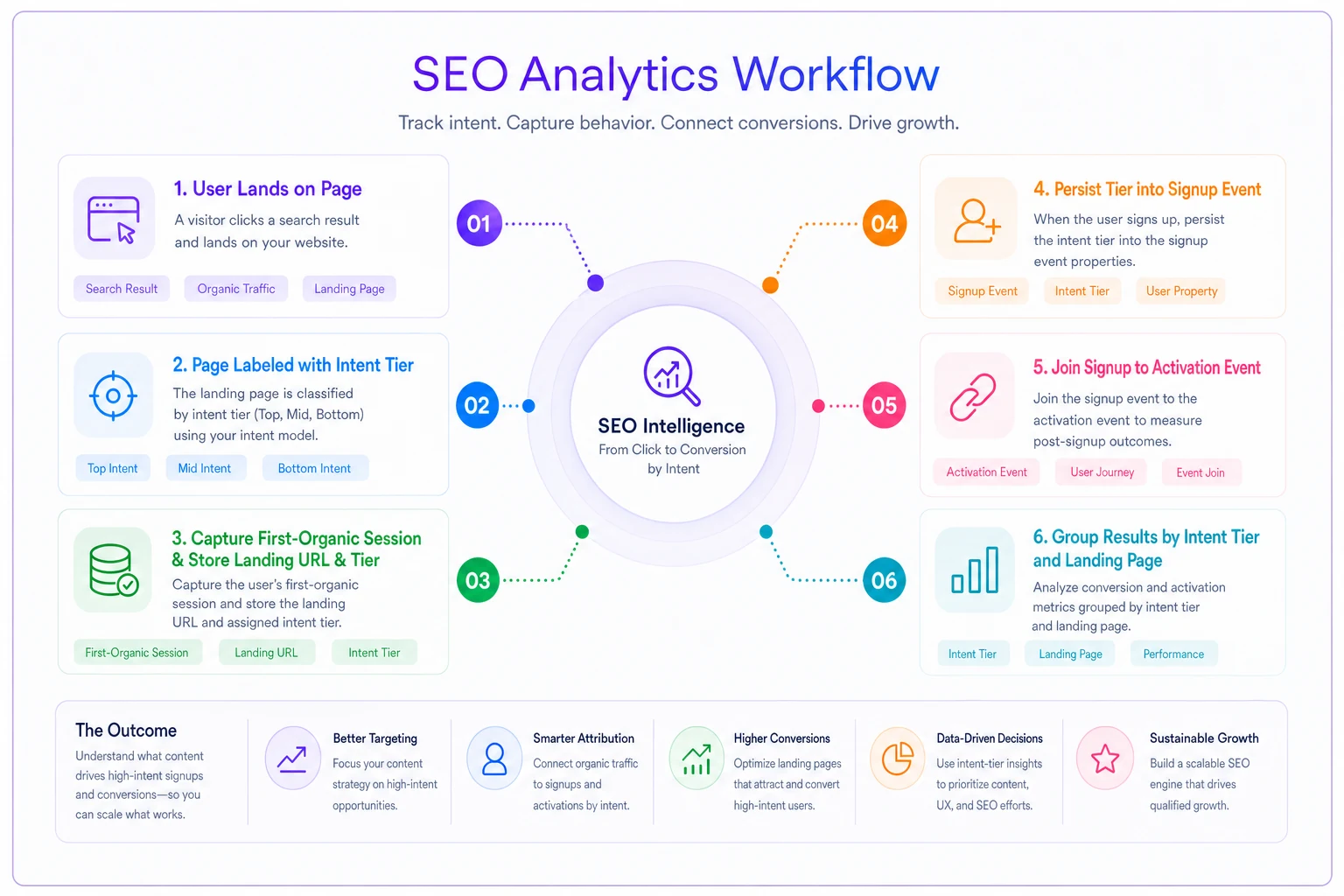
The diagram above shows the lightweight join: landing page + tier -> signup property -> activation join -> grouped reporting.
A simple attribution model that actually works
-
On first organic session, capture the landing page URL and its assigned intent tier into a first-touch cookie or param.
-
Persist that into the signup event as a property — something like
firstorganictier = product_aware. -
Define your activation milestone clearly
created first project, invited a teammate, connected an integration — whatever "aha" means for your product.
-
Join signups to activation events by user ID.
-
Group everything by intent tier and by landing page.
Now you can ask the questions that actually change your roadmap.
Measurement queries that tie organic to trials and activation
Signups and activation rate by intent tier: SELECT s.firstorganictier AS tier, COUNT(DISTINCT s.userid) AS signups, COUNT(DISTINCT a.userid) AS activated, ROUND(COUNT(DISTINCT a.userid) * 1.0 / NULLIF(COUNT(DISTINCT s.userid), 0), 3) AS activationrate FROM signups s LEFT JOIN activations a ON s.userid = a.userid AND a.activatedat BETWEEN s.signedupat AND s.signedupat + INTERVAL '14 days' WHERE s.channel = 'organic' GROUP BY 1 ORDER BY activation_rate DESC;
Top landing pages by activated users (not just signups): SELECT s.firstorganiclandingurl AS landingpage, s.firstorganictier AS tier, COUNT(DISTINCT s.userid) AS signups, COUNT(DISTINCT a.userid) AS activated FROM signups s LEFT JOIN activations a ON s.userid = a.userid WHERE s.channel = 'organic' GROUP BY 1, 2 HAVING COUNT(DISTINCT s.user_id) >= 20 ORDER BY activated DESC LIMIT 50;
The second query is the one that reorders priorities. A page ranked #40 in your traffic report might rank #3 by activated users. That's where you invest next.
A real scenario: the comparison page that leaked buyers
A B2B scheduling SaaS — small team, product-led, free trial funnel — had a "[Competitor] alternative" page pulling around 2,800 organic sessions a month. Everyone loved it in the traffic dashboard. Top five by clicks.
When they finally stamped intent tiers onto signups and ran the activation join, the picture flipped. That page was converting to trial at roughly 0.6% — well below their solution landing pages. The reason was obvious once someone actually looked: the page was structured like a blog post. Long intro, feature paragraphs, trial CTA sitting below a 1,400-word wall. Purchase-adjacent visitors were reading, nodding, and leaving.
They didn't rewrite the ranking content. They restructured it as a product-aware template: comparison table near the top, a clear "why teams switch" block, pricing visibility, and a persistent trial CTA. Nothing gated.
Over the next couple of months, trial conversion on that page moved into the 1.8–2.2% range. Same traffic, roughly three times the trials from a page that was already ranking. More importantly, those trials activated at a healthy rate because the intent was there all along — the page just hadn't been asking for the right action.
The gated ebook they'd been pushing on their "what is scheduling automation" article got stripped and replaced with a lightweight newsletter opt-in and internal links into the solution cluster. Discovery traffic stopped bouncing on a premature email gate. Two changes, neither of which touched rankings, both of which meaningfully moved the metric that actually mattered.
Experiments worth running — and how to keep them clean
Once tiers are tagged, you can test the mapping instead of guessing. A few experiments that consistently earn their keep:
-
CTA-by-tier test on product-aware pages, test "Start free trial" vs "See it in action" — demo or interactive tour. High-intent visitors often prefer immediacy over a scheduled call.
-
Gate depth test on a solution-aware asset, test full-open vs hybrid-gate (open content, gated bonus). Measure downstream activated users, not just leads captured — gated leads often activate worse.
-
Above-fold conversion element test on comparison pages, test surfacing the comparison table and pricing above the fold vs the traditional narrative-first layout.
Keep them clean by holding intent tier constant within a test and measuring on activation, not signups. A gate that triples email captures but halves activation is a loss dressed as a win — you only see that if activation is the outcome metric.
When gating is the right call — and when it quietly hurts you
Gating makes sense when:
-
The asset has real standalone value people would genuinely trade an email for
-
The traffic is informational and not close to a purchase decision
-
Your funnel actually nurtures leads — if leads just rot in a CRM, you gained nothing
Gating is a bad idea when:
-
The gated asset is the thing that ranks — you'll lose the traffic
-
The query has commercial or navigational intent — you're blocking buyers
-
Sales or lifecycle has no process to work the captured leads
Who should skip gating almost entirely: early-stage product-led SaaS with a self-serve trial and no sales team to work MQLs. For that model, every gate is friction between a searcher and a signup, and the lead sitting in a spreadsheet does nothing. Keep it open, get people into the product, and let activation data tell you which pages are actually pulling their weight.
Bringing it together
The core fix isn't more content or more traffic. It's aligning three things that usually drift apart: the intent behind a query, the template and CTA on the page that serves it, and a measurement layer that stamps the intent tier onto signups so you can finally see which organic pages produce activated users.
Once that's in place, the landing-vs-gated decision mostly stops being a debate — it falls out of the tier. The page type, the CTA, even the gate depth all become logical outputs of where the visitor sits in their buying process rather than judgment calls made at publish time with no data behind them.
And the pages you've been over-crediting for traffic, or ignoring for low volume, get re-ranked by the only metric that actually matters: real users getting real value out of your product.
Ready to elevate your search rankings?
Join 5,000+ businesses using GoSeofy to increase organic traffic, optimize content, and outperform competitors online.