



Most enterprise SEO teams discover keyword cannibalization the hard way. Their CEO searches for their main money term, finds three different pages ranking on page 2, and asks why none of them are on page 1. By that point, you've usually got 200+ pages fighting for variations of the same intent, product teams launching landing pages that compete with category pages, and blog content that accidentally targets commercial keywords better than your actual product pages.
The real mess happens at scale. Regional teams create location pages, product marketing spins up campaign microsites, content teams publish buyer guides, and the main site's category structure all target overlapping keyword clusters. Nobody owns the problem because everybody owns a piece of it.
What makes enterprise keyword architecture particularly brutal is that fixing it after the fact means political battles. Tell the VP of Product Marketing that their shiny new campaign site is cannibalizing the main domain's rankings and watch how fast that meeting goes sideways. Try to get the content team to stop targeting high-intent commercial keywords with their blog posts when their KPIs are based on organic traffic. That's not a fun conversation.
The Intent Tier System Nobody Actually Implements
Every SEO knows about search intent in theory. Informational, navigational, commercial, transactional — we've all seen the pyramid. But when you're dealing with 50,000+ URLs across multiple properties, that basic framework falls apart pretty fast.
What an actual enterprise intent taxonomy looks like when it works:
Tier 1: Direct Revenue Intent Your "buy now" keywords. Product names, model numbers, "pricing" modifiers. The stuff that converts at 8-12% when you rank positions 1-3. These keywords get protected status — only designated landing pages can target them.
Tier 2: Evaluation Intent Comparison keywords, alternative searches, "vs" queries, review-focused terms. These sit between research and purchase. Conversion rates hover around 2-4%. Multiple teams usually want these, which is where conflicts start.
Tier 3: Problem-Aware Intent The "how to fix" and "solutions for" keywords. Users know they have a problem but haven't decided on a solution yet. Blog content lives here, but so do solution pages and some category pages. This tier generates the most internal conflicts by a wide margin.
Tier 4: Educational Intent Pure research queries. "What is" keywords, definitional content, market education. Low conversion but high volume. Usually safe territory for content teams, but watch out for definition-style featured snippets that accidentally rank for Tier 1 terms.
Tier 5: Brand-Adjacent Intent Industry news, company updates, career pages, investor relations content. Not directly commercial but needs to exist. Often accidentally ranks for important terms because of domain authority.
The taxonomy isn't the hard part. Getting 15 different teams across 4 time zones to actually follow it — that's the hard part.
Canonical Target Mapping (Or: Who Gets to Rank for "Enterprise Software Solutions")
A scenario that plays out every quarter: marketing launches a new campaign page targeting "enterprise software solutions." The main site already has a category page for this. The blog has three articles about it. Regional sites have localized versions. Sales enablement created a landing page for a webinar using the same keyword.
Stop losing visibility in search results.
GoSeofy helps you monitor, analyze, and improve your SEO performance with ease.
- Comprehensive keyword tracking
- Backlink quality monitoring
- Real-time SEO performance reports
No credit card required
Google's response? Rank none of them on page 1.
Canonical target mapping means declaring a single URL as the primary target for each keyword cluster. Not keyword — keyword cluster. If you map individual keywords, you'll spend the next six months in spreadsheet hell.
The mapping process typically looks like this:
-
Cluster Formation Group keywords by actual SERP overlap, not semantic similarity. If two keywords show 7+ of the same URLs in positions 1-10, they belong in the same cluster.
-
Primary Assignment Each cluster gets ONE primary URL. Not two. Not "it depends." One. This URL gets the full keyword in the title, the optimal URL structure, and priority in internal linking.
-
Secondary Designation Other pages targeting similar intent get marked as secondary. They can mention the keywords, but they don't optimize for them. Their titles focus on different angles, their content serves different user needs.
-
Enforcement Rules New content must check against the canonical map before publication. Without this step, marketing teams will launch pages that tank rankings for your money terms within a couple of weeks.
A medium-sized enterprise site (15,000-30,000 pages) typically needs somewhere around 500-800 canonical targets mapped. Sounds manageable until you realize each one requires sign-off from whoever owns that page type.
The Ownership Matrix That Actually Gets Followed
Ownership matrices fail for the same reason most governance docs fail — they're theoretical exercises that nobody references after the meeting ends. The ones that work are embedded into actual workflows.
| Keyword Tier | Primary Owner | Secondary Stakeholder | Veto Rights | Update Frequency |
|---|---|---|---|---|
| Tier 1 (Direct Revenue) | Product/Ecommerce Team | SEO Team | CMO | Quarterly |
| Tier 2 (Evaluation) | Product Marketing | Content Team | VP Product | Quarterly |
| Tier 3 (Problem-Aware) | Content Team | Product Marketing | Head of Content | Monthly |
| Tier 4 (Educational) | Content Team | None | Head of Content | As Needed |
| Tier 5 (Brand-Adjacent) | Corporate Comms | HR/IR Teams | CMO | As Needed |
Use the CMS publish dropdown to force a tier selection and block Tier 1/2 publishes until an owner approves.
Ownership without enforcement is just a suggestion. Real implementation needs teeth.
Publishing Gatekeepers CMS workflows that require ownership verification before publication. A simple dropdown: "Which keyword tier does this target?" If it's Tier 1 or 2, it triggers additional approval.
Conflict Resolution Path When the product team wants to create a page targeting Tier 1 keywords that the ecommerce team owns, there's a documented escalation path. Usually: SEO team makes recommendation → Department heads review → CMO decides if needed.
Audit Triggers Quarterly reviews of top-performing content by tier. If a Tier 4 blog post starts ranking for Tier 1 keywords, it triggers a content revision or canonical adjustment. Blog posts accidentally outranking product pages for buyer keywords can cost serious money — in some cases around $30k monthly in lost revenue.
The Steady-State Reconciliation Process
Think of reconciliation like git merge conflicts for SEO. Multiple teams publish content, rankings shift, and suddenly you've got conflicts everywhere. Without a process, these compound until you're spending more time fixing cannibalization than creating new content.
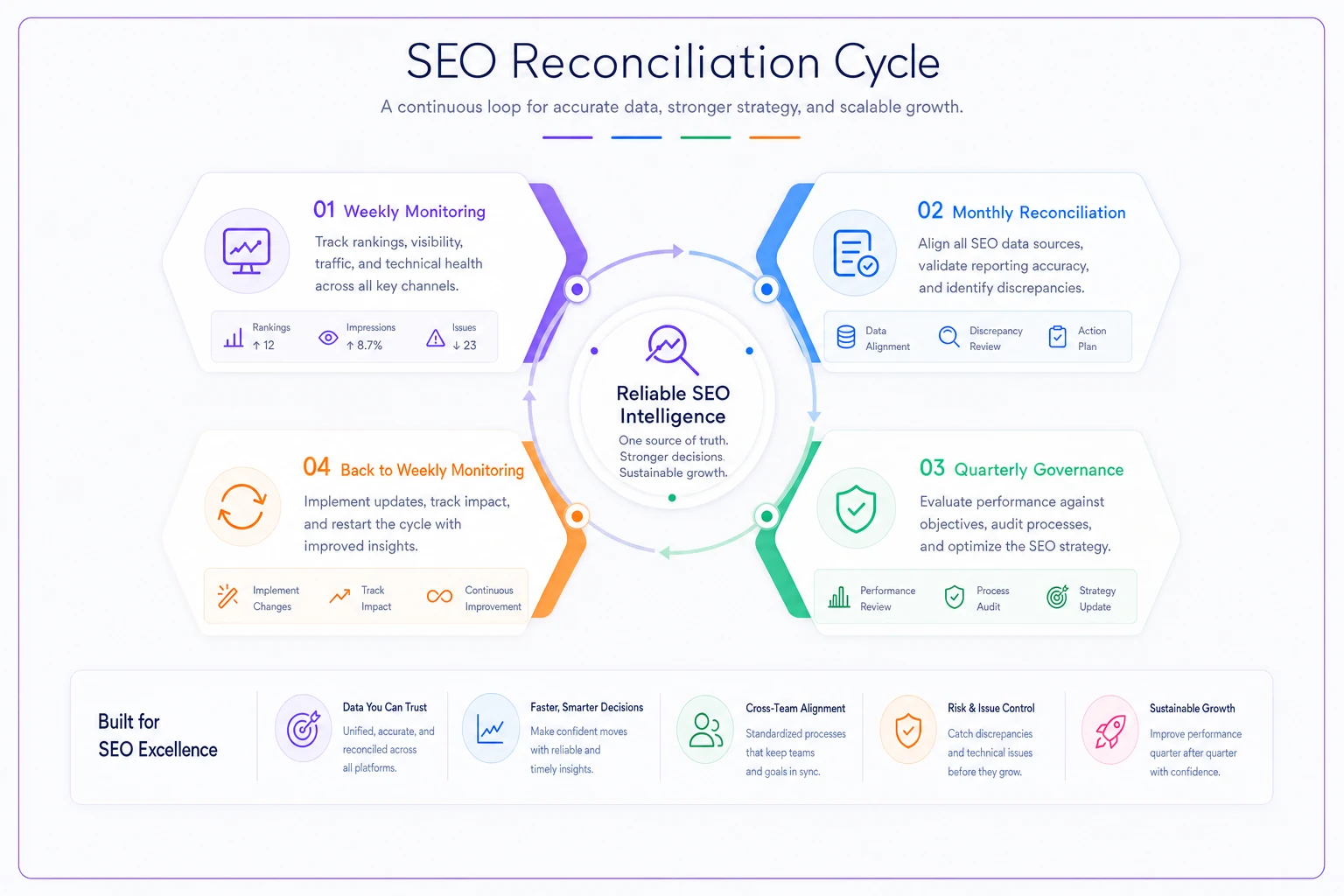
The steady-state process runs in cycles:
-
Weekly Monitoring Track ranking URLs for top 500 keyword clusters Flag any cluster where 2+ internal URLs appear in top 20 Identify sudden ranking drops for canonical targets
-
Monthly Reconciliation Review all flagged conflicts Check new content against canonical map Audit internal linking for proper target support Adjust content or consolidate as needed
-
Quarterly Governance Full intent tier audit Ownership matrix updates Canonical target performance review Major consolidation or restructuring projects
The spreadsheet workflow usually includes a master keyword cluster list with assigned canonical URLs, a conflict log tracking multiple URLs ranking for the same cluster, resolution tracking with action items and owners, and performance tracking pre/post reconciliation.
Real example: a B2B software company discovered 47 pages targeting variations of "workflow automation software." After consolidating down to 3 canonical targets (product page, comparison guide, educational overview), organic traffic to these terms increased roughly 40% over 3 months, and conversion rate jumped from 1.2% to 3.8%.
Common Conflict Patterns at Scale
The same conflicts tend to emerge across enterprises.
The Regional Multiplication Problem Company has 50 locations. Each creates a page for "software solution [city]." Meanwhile, the main site targets "software solution" nationally. Google can't figure out which to rank, so local pages outrank the main site for branded terms while neither ranks well for the actual local searches.
The Feature vs. Product Confusion Product pages for your main offering compete with feature pages that mention the product. Classic example: your "enterprise CRM" page fights with individual feature pages about "sales pipeline," "contact management," and "reporting." Each feature page accidentally optimizes for the main product term.
The Blog Authority Problem Your blog builds so much authority that it starts outranking product pages. Sounds good until you realize blog conversion rates are around 0.5% while product pages convert at 5%. That helpful "What is Enterprise Software?" post just pulled qualified traffic away from your actual enterprise software page.
The Campaign Microsite Disaster Marketing launches a beautiful microsite for a campaign. Six months later, it's ranking for your core brand terms while your main site dropped to page 2. The microsite converts at 1%, your main site converts at 4%. Nobody notices until the quarterly review shows a revenue drop.
Building the Conflict Resolution Rules
Generic rules like "product pages always win" don't work at scale. You need nuanced conflict resolution based on actual performance data.
-
Performance-Based Resolution Higher converting page wins, unless the conversion difference is less than 20%. If Blog Page A converts at 0.8% and Product Page B converts at 0.9%, the marginal difference doesn't justify the disruption.
-
Intent Alignment Override Even if performance is similar, intent alignment trumps metrics. A Tier 1 keyword goes to a Tier 1 page, full stop. There's a documented case of a company losing around $200k in quarterly revenue because their blog post about "buying enterprise software" outranked their actual purchase page.
-
Authority Preservation If a page has 100+ referring domains and ranks for 500+ keywords, you don't just redirect it. You revise content to focus on appropriate tier keywords while preserving the authority signals.
-
Time-Based Grandfathering Pages published before the governance framework get 6 months to align. Immediate forced changes cause ranking volatility that takes months to recover from.
The actual resolution actions available are content revision (adjust focus to target appropriate tier keywords), canonical tags (point duplicative content to the designated target), internal link adjustment (shift link equity to the correct page), consolidation (merge similar pages when revision isn't enough), and deletion (remove truly redundant pages that add no value).
The Political Reality of Enterprise Keyword Governance
The technical implementation is maybe 30% of the challenge. The other 70% is organizational psychology.
Product teams measure success by feature page traffic. Content teams get bonused on blog performance. Regional managers want their local pages to rank. Campaign managers need to justify their microsite budget. Everyone has metrics that directly conflict with centralized keyword governance.
Shared Revenue Attribution Instead of traffic-based KPIs, tie everyone to revenue contribution. When the blog team sees that their post ranking for buyer keywords actually hurts overall revenue, they're more willing to adjust. Connect this to your broader measurement framework to align stakeholder incentives.
Governance Champions Each department needs someone who understands and enforces the framework. Not SEO police — allies who get why this matters for their team's success too.
Small Wins First Start with the most obvious conflicts that everyone agrees are problems. Fix the three blog posts ranking for your #1 product term. Show the revenue impact. Then expand the program.
Transparent Reporting Monthly cannibalization reports that show exactly which pages conflict and the estimated revenue impact. Make it visible to leadership. Sunlight is the best disinfectant.
The Spreadsheet Stack That Makes This Work
The governance framework needs operational infrastructure. These are the actual spreadsheets that keep the system running:
Master Keyword Cluster Database
-
Columns
Cluster ID, Primary Keyword, Search Volume, Intent Tier, Canonical URL, Owner, Last Updated
-
Updated
Monthly
-
Rows
500-1,000 for most enterprises
Conflict Tracking Log
-
Columns
Date Identified, Keyword Cluster, Conflicting URLs, Impact (traffic/revenue), Resolution Action, Owner, Status
-
Updated
Weekly
-
Rows
Usually 20-50 active conflicts at any time
Content Publishing Checklist
-
Pre-publish verification against canonical map
-
Intent tier classification
-
Ownership confirmation
-
Conflict check against existing content
Performance Reconciliation Report
-
Pre/post metrics for resolved conflicts
-
Revenue impact calculations
-
Time to resolution tracking
-
Conflict recurrence monitoring
These aren't complex systems, but they need consistent maintenance. Skip two weeks of conflict tracking and you'll spend a month cleaning up the mess.
When This Framework Breaks Down
No governance framework survives contact with reality perfectly. The failure modes worth watching for:
The Acquisition Integration Problem Company acquires another company with their own site. Now you've got two domains with complete keyword overlap. The framework doesn't account for multi-domain governance. Resolution: treat domains as regions initially, then gradually consolidate based on performance.
The International Expansion Chaos Launching in 5 new countries means 5x the potential conflicts. Each country team wants to localize based on their market knowledge. The framework becomes unmanageable fast. Resolution: create country-specific tier definitions while maintaining global Tier 1 protection.
The Platform Migration Scramble Moving to a new CMS breaks all your enforcement workflows. During the 3-month migration, teams publish whatever they want. You emerge with a couple hundred new conflicts. Resolution: freeze non-critical publishing during migration, or maintain manual governance checks.
The Reorg Shuffle New CMO comes in, reorganizes all teams. Your carefully crafted ownership matrix references departments that no longer exist. Resolution: tie ownership to functions, not departments. "Whoever owns product marketing" rather than "Product Marketing Department."
Implementing Without Budget or Buy-In
Maybe you're reading this thinking "sounds great, but I'm a team of two and nobody cares about SEO governance." The minimum viable version looks like this:
Start with your top 50 revenue-driving keywords. Map them to canonical URLs. Track conflicts in a simple spreadsheet. Send a monthly email showing revenue impact of cannibalization. Fix the worst offenders yourself through content updates.
Build proof of concept with a single product line or category. Show the revenue lift from proper keyword architecture. Use that win to get resources for broader implementation.
The full framework described here works for organizations with dedicated SEO teams and technical resources. But the core concepts — intent tiers, canonical mapping, ownership clarity — apply even if you're tracking everything in Google Sheets and doing manual checks.
Scale your SEO operations systematically even with limited resources by starting with the highest-impact conflicts first.
The Automation Layer That Changes Everything
Manual governance works until about 10,000 pages. Beyond that, you need systematic help.
Modern platforms can automatically detect when new content targets existing keyword clusters. They flag conflicts before publication, track ranking cannibalization without weekly manual checks, and identify which consolidations would have the highest revenue impact. Instead of spending 20 hours monthly on conflict tracking spreadsheets, teams can focus on actual strategic decisions — should we consolidate these five regional pages, does this campaign actually need its own microsite, which keyword clusters deserve expanded content investment.
-
Automatic keyword clustering based on SERP similarity
-
Conflict detection across large content libraries
-
Performance prediction for consolidation actions
-
Intent classification for new content
-
Optimization recommendations for canonical targets
This isn't about replacing human judgment. It's about scaling governance beyond what's manually possible. When you're managing 30,000+ pages across multiple properties, manual tracking breaks down. The software maintains the steady-state while humans handle the strategic decisions.
Building Your Own Playbook
Every enterprise has unique constraints. Your legal team might require certain pages stay separate. Your CMS might not support proper canonicalization. Your regions might have full autonomy. The framework needs to adapt to reality.
Start with intent tier definition. Make it specific to your business — an e-commerce site needs different tiers than a B2B SaaS company. Get agreement on these before moving forward.
Map your top 100 revenue keywords to canonical URLs. Don't try to map everything at once. Focus on the keywords that actually drive business outcomes.
Create ownership clarity for those 100 keywords. Who decides what ranks? Who approves changes? Who handles conflicts? Document this before conflicts arise.
Build the reconciliation rhythm that matches your publishing velocity. If you publish 10 pages monthly, weekly conflict tracking is overkill. If you publish 50 pages weekly, monthly reconciliation is too slow.
Consider a content consolidation program to clean up existing conflicts before implementing forward-looking governance.
The 90-Day Implementation Timeline
Days 1-30: Discovery and Documentation
-
Audit current cannibalization issues
-
Define intent tiers for your business
-
Identify top 100 revenue keyword clusters
-
Map existing canonical targets
-
Document current ownership (even if informal)
Days 31-60: Framework Development
-
Create conflict resolution rules
-
Build tracking spreadsheets
-
Design publishing workflows
-
Get stakeholder buy-in
-
Run pilot with single department/category
Days 61-90: Systematic Rollout
-
Implement weekly conflict tracking
-
Execute first consolidations
-
Launch publishing governance
-
Train content creators
-
Measure initial impact
After 90 days, you should see roughly a 30-40% reduction in new cannibalization, 15-20% improvement in rankings for governed keywords, clear ownership for top revenue terms, and a documented process for conflict resolution.
The companies that succeed with this treat keyword architecture like product architecture — it's core infrastructure that enables everything else. The ones that fail treat it like an SEO project that ends after implementation.
That CEO searching for your money term and finding three competing pages on page 2? With proper keyword architecture, they find one page climbing toward position 1, with the full weight of your domain behind it.
Ready to elevate your search rankings?
Join 5,000+ businesses using GoSeofy to increase organic traffic, optimize content, and outperform competitors online.