


Most enterprise SEO "platforms" aren't platforms at all. They're a pile of tools duct-taped together with credentials sitting in someone's browser, a few Google Sheets that quietly became load-bearing infrastructure, and a BigQuery project that only one analyst fully understands. It works until the analyst leaves, the vendor renews at 3x, or a migration doubles the URL count overnight.
The problem isn't that any single tool is bad. It's that the architecture underneath — how data gets in, where the truth lives, how things connect, and how you know when something breaks — was never actually designed. It just accumulated. And once you're operating at real scale, accumulation becomes the enemy.
This is a systems article, not a tool roundup. The goal is to give you a reference architecture you can hold in your head, defend to engineering, and actually use to decide what to buy, what to build, and what to rip out.
Why enterprise SEO architecture rots (and it always rots)
The typical evolution looks the same across companies regardless of industry. Someone buys an all-in-one SEO suite. It's fine for a year. Then the team wants rank data joined to revenue, so they export CSVs. Then someone spins up a crawler because the suite's crawl budget is capped. Then GSC gets connected to a warehouse for a dashboard. Then a data scientist builds a forecasting model on top of one of those sources — not all of them.
Now you have four definitions of "a ranking keyword," three definitions of "an indexed page," and two teams who genuinely disagree about last month's organic revenue because they're pulling from different joins.
What's actually happening is that each addition was a point solution to a point problem. Nobody owned the connective tissue. In practice, this usually plays out when SEO reports into marketing, the warehouse belongs to data engineering, and the site belongs to product — three orgs, zero shared contract about what the data means.
The tell that you've hit this stage is disagreement about numbers in meetings. When two smart people bring two different organic traffic figures to the same review, you don't have a reporting problem. You have an architecture problem.
The four layers that actually matter
Strip away the tooling debates and every durable SEO data system has the same four layers. If you can name yours, you're ahead of most enterprises.
Stop losing visibility in search results.
GoSeofy helps you monitor, analyze, and improve your SEO performance with ease.
- Comprehensive keyword tracking
- Backlink quality monitoring
- Real-time SEO performance reports
No credit card required
1. Ingest. Everything that pulls raw data in — GSC API, GA4 exports, log files, your crawler(s), rank trackers, backlink feeds, CMS metadata, and commercial data providers. This layer's only job is to land raw data reliably and cheaply.
2. Canonical store. The single place where raw sources get cleaned, deduplicated, and modeled into agreed-upon entities: a URL, a keyword, a page-type, a session. This is your source of truth. If you only fix one layer, fix this one.
3. Joins & modeling. Where the canonical entities get stitched together — clicks to sessions, keywords to canonical targets, crawl status to revenue. This is where most of the business value gets created and where most of the silent errors get introduced.
4. Observability. The layer that tells you when any of the above is lying to you. Freshness checks, row-count anomalies, lineage, ownership. Without it, the other three layers slowly drift and nobody notices until a QBR.
Focus budget on canonical modeling and observability rather than just shiny ingest tools; that's where long-term trust is built.
Worth internalizing: teams overspend on layer 1 and underspend on layers 2 and 4. Everyone loves buying a shiny ingest tool. Almost nobody budgets for the boring canonical modeling and monitoring that determines whether any of the ingested data is actually trustworthy.
A vendor-agnostic reference architecture
The whole point of "vendor-agnostic" is that any single tool should be swappable without collapsing the system. You achieve that by putting a stable interface — a data contract — between each layer, so the tool behind the contract can change without breaking everything downstream.
[GSC] [GA4] [Logs] [Crawler] [Rank] [Backlinks] [CMS] │ │ │ │ │ │ │ └──────┴──────┴────────┴───────┴──────┴───────┘ ▼ INGEST LAYER (raw landing zone, one table per source, timestamped, immutable, no transformations) ▼ CANONICAL STORE (urldim, keyworddim, pagetypedim, datedim — cleaned, deduped, conformed keys) ▼ JOINS & MODELING (performancefact, indexstatusfact, revenueattributionfact) ▼ CONSUMPTION LAYER (dashboards, alerts, experiments, forecasts) OBSERVABILITY runs vertically across ALL layers (freshness, volume, schema, lineage, ownership)
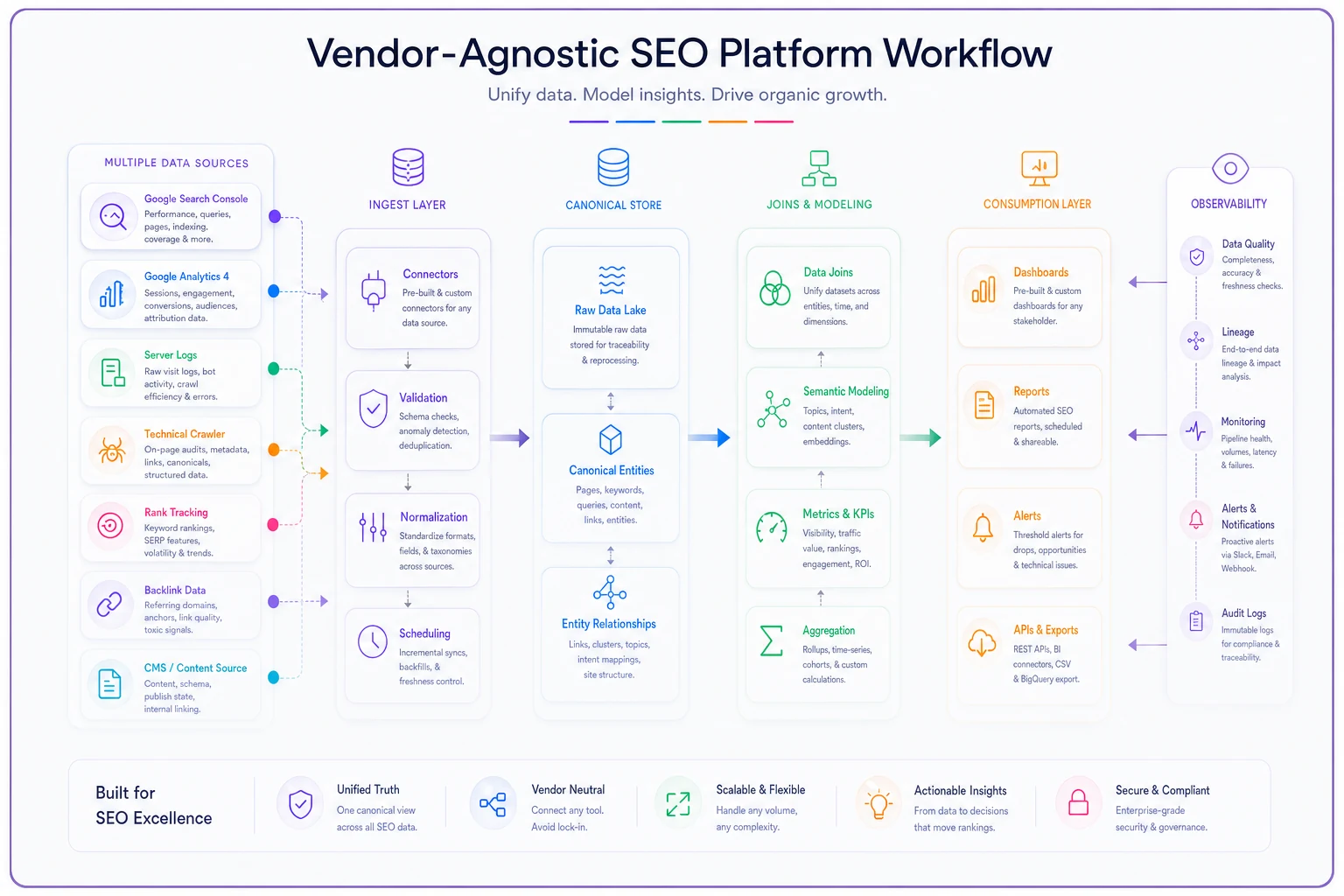
The critical design decision is the immutable raw landing zone. You never transform data on the way in. You land it exactly as the source gave it to you, with an ingestion timestamp, and you transform later in the canonical layer. This one rule saves you constantly — when GSC changes an API field, when a crawler starts reporting differently, when you need to reprocess six months of history because you found a modeling bug. Raw data you can replay is the difference between a two-hour fix and a two-week reconstruction.
Data contracts: the thing nobody wants to write
A data contract is just a written agreement about what a dataset promises: its schema, its freshness, its keys, its owner, and what happens when it violates those promises. It sounds bureaucratic. It's also the single highest-leverage document in the whole architecture.
Here's why it matters in practice. When your rank vendor silently starts returning null for keywords it can't measure instead of dropping the row, your keyword count jumps 8% overnight and your "trending up" dashboard is lying. A contract that specifies "keyword_id is non-null, row count varies less than 15% day-over-day" catches that automatically instead of six weeks later.
A minimal contract for each canonical dataset should cover:
-
Schema — exact columns and types, and what's guaranteed non-null
-
Grain — what one row represents (one URL per day? one keyword per market per day?)
-
Freshness SLA — how stale is acceptable before it's an incident
-
Volume expectations — acceptable row-count ranges
-
Owner — a named human, not a team alias
-
Breakage protocol — who gets paged, and whether downstream consumers fail or degrade
The mistake people make is treating contracts as documentation. They're not — they should be enforced in code as tests that run on every load. A contract nobody checks is just a hopeful comment. This connects directly to how you build trustworthy joins in the first place; if you haven't set up lineage, ownership and alerts to trust your GSC/GA joins, the contracts have nothing to enforce against.
Write the contracts first. Then build the tests. Everything else depends on them being real.
Integration patterns that hold up at scale
There are only a handful of ways to move data between these layers, and choosing the wrong pattern is a quiet, expensive mistake.
| Pattern | Best for | Where it breaks | Rough cost profile |
|---|---|---|---|
| Batch ELT (scheduled loads) | GSC, GA4, crawl exports, backlink feeds | Slow to detect real-time issues; big reprocessing jobs get expensive | Low–moderate; predictable |
| Streaming/event | Log files, real-time index monitoring | Overkill for most SEO data; ops overhead is real | High; needs engineering muscle |
| Reverse ETL | Pushing warehouse data back into ad platforms, CMS, or tools | Fragile if canonical layer isn't clean; garbage-out amplifies | Moderate |
| API polling | Rank data, third-party providers | Rate limits, silent schema changes, pagination bugs | Moderate; hidden maintenance |
| File drops (SFTP/CSV) | Legacy vendors, enterprise data partners | Format drift, no schema enforcement, manual babysitting | Low upfront, high long-term |
For the overwhelming majority of enterprise SEO work, batch ELT into a warehouse is the right default. SEO data is not real-time in any meaningful sense — Google's own data lags days. Teams that build streaming pipelines for rank tracking are usually solving a problem they don't have, and paying for it in engineering time forever.
The pattern that quietly causes the most pain is API polling against rank and backlink vendors. Those APIs change without notice, rate-limit aggressively, and paginate inconsistently. Wrap every third-party API in an ingestion adapter that logs raw responses, so when the vendor breaks something you can prove it and replay it.
Observability: how you find out before the QBR does
The whole architecture is only as trustworthy as your ability to detect when it's wrong. Observability isn't a dashboard — it's the set of automated checks running across every layer that catch drift before it reaches a human decision.
At minimum you want checks in four categories:
-
Freshness — did each source actually update on schedule? A GSC pipeline that silently stopped three days ago is more dangerous than one that's obviously broken.
-
Volume — did row counts stay within expected bounds? Sudden jumps or drops almost always mean a join fanned out or a source changed.
-
Schema — did columns, types, or null-rates change? This catches the vendor-changed-the-API class of failure.
-
Lineage — can you trace any number in a dashboard back through every transformation to its raw source? Without this, debugging a wrong number takes days instead of minutes.
A realistic example of what good observability prevents: a mid-sized retailer joined GSC clicks to sessions on a URL key, but a CMS change started appending tracking parameters to internal URLs. The join quietly fanned out, inflating organic sessions by roughly 20% for about three weeks before anyone questioned it. A volume anomaly check on the join output would have flagged it the first day. Instead it corrupted an entire quarter's attribution model — the exact class of failure a well-built SEO data pipeline for revenue attribution is designed to catch at the modeling stage.
The pattern is consistent: observability failures are almost never loud. Systems rarely crash. They drift, and drift is invisible until someone makes a decision on bad numbers.
Buy vs. build: the decision that defines your TCO
This is where most architecture conversations turn into a religious war. It shouldn't. Buy-vs-build is a layer-by-layer decision, not an all-or-nothing one, and the right answer is almost always a hybrid.
Buy when:
-
The problem is well-solved and undifferentiated (crawlers, rank data collection, backlink discovery)
-
The vendor's core competency is genuinely hard to replicate (large-scale keyword databases, backlink indexes)
-
You lack the engineering headcount to maintain it — and be honest about this
-
Speed to value matters more than long-term cost control
Build when:
-
The logic is specific to your business (your revenue attribution model, your page-type taxonomy, your canonical target rules)
-
The data needs to join with proprietary internal data no vendor can see
-
Vendor lock-in on this layer would be existentially expensive
-
You already own a warehouse and the marginal build cost is modeling time, not new infrastructure
The reliable pattern across companies: buy the ingest, build the canonical store and joins. You almost never want to build your own crawler or backlink index — that's someone else's core product. But you should almost always own your canonical modeling, because that's where your business logic lives and where lock-in hurts most.
The TCO artifacts you actually need
TCO discussions fall apart because people only count the license fee. That's the smallest number. Before any buy-vs-build decision, put these on one page:
-
License/subscription — the obvious one, with the renewal trajectory, not just year one
-
Integration cost — engineering days to connect it, one-time
-
Maintenance load — ongoing hours per month to keep it running (this is the killer everyone forgets)
-
Data egress/compute — warehouse costs to store and process what it produces
-
Switching cost — what it would take to rip it out later, i.e. how locked-in you'll be
-
Opportunity cost of headcount — if you build, what isn't your team building instead?
A concrete illustration: a team compared a $60k/year commercial SEO platform against building equivalent modeling on their existing warehouse. The license looked expensive until they costed the build honestly — roughly 4–5 months of a senior engineer's time upfront, plus ongoing maintenance. The realistic conclusion was to buy the ingest and reporting layer, and build only the revenue-join logic that was unique to them. Neither pure option was correct. The hybrid cut annual cost meaningfully while keeping the proprietary logic in-house.
Maintainability: designing for the person who inherits this
The single best predictor of whether an SEO platform survives isn't its technology. It's whether a new hire can understand it in a week. Architectures die from complexity, not from missing features.
-
One canonical definition per entity. There is exactly one place that defines "an indexed URL." Everything else references it. The moment you have two definitions, you have a future argument.
-
Transformations live in version control, not in tool UIs. Logic buried in a BI tool's calculated field or a vendor's dashboard is invisible and unownable. If it's not in a repo, it doesn't exist.
-
Named owners, not team owners. "The data team owns this" means nobody owns it. Every contract has a human name.
-
Fail loud, not silent. A pipeline that errors and pages someone is safer than one that produces slightly-wrong numbers forever.
-
Document the why, not the what. Code shows what it does. Comments should explain why the weird business rule exists, because that's the knowledge that walks out the door.
The mistake that compounds fastest is letting business logic scatter across tools. When your page-type classification lives partly in the crawler config, partly in a warehouse view, and partly in a spreadsheet an analyst maintains by hand, no single person can reason about the system anymore. Centralizing that logic in the canonical layer is worth more than any tool upgrade.
When this level of architecture actually makes sense
Not every company needs this. If you're managing a few thousand URLs and one person handles SEO reporting, a good all-in-one tool and a clean spreadsheet is genuinely the right architecture. Building a canonical store for that is over-engineering, and over-engineering kills small teams as surely as under-engineering kills big ones.
This reference architecture starts paying off when:
-
You're past roughly 100k URLs, where crawl and index data stops fitting in tools' native limits
-
Multiple teams consume SEO data and disagree about numbers
-
SEO performance needs to join to revenue data that lives in your warehouse
-
You've been burned at least once by a silent data error reaching a decision
-
Vendor renewal costs are climbing faster than the value you get
Who should not build this
If you don't have access to any engineering or analytics resource, don't start here — you'll build something nobody can maintain and it'll rot faster than the mess you have now. If your SEO data never needs to touch proprietary business data, a good commercial platform probably covers you. And if leadership won't fund the boring observability and maintenance layers, don't build the fancy parts — a half-built platform with no monitoring is worse than a spreadsheet, because it looks trustworthy while quietly lying.
A short real scenario
A B2B marketplace with roughly 400k indexable URLs across two brands had the classic accumulated mess: a commercial SEO suite, a separate crawler, GSC feeding one dashboard, and revenue living in a warehouse that never talked to any of it. Every monthly review opened with 15 minutes of arguing about which organic revenue number was right.
They didn't rip anything out. They kept the commercial tools for ingest — crawling and rank data — and built a thin canonical layer in their existing warehouse: one URL dimension, one keyword dimension, one page-type taxonomy, all version-controlled. Then they moved the revenue join into that layer and wrapped it in freshness and volume checks.
The technology barely changed. What changed was that there was now one definition of everything, with automated checks guarding it. The number-arguing in reviews stopped within a couple of months. When a crawler later changed its output format, the schema check caught it the same day instead of corrupting a reporting cycle. And when their SEO suite came up for renewal, they had real leverage to negotiate hard, because the tool was now swappable — the business logic lived in their canonical store, not the vendor's.
The takeaway
A vendor-agnostic enterprise SEO platform architecture isn't about picking the perfect tools. It's about drawing clean lines between layers, putting contracts between them, owning the parts that encode your business logic, and instrumenting the whole thing so drift can't hide.
The tools you use will change — vendors get acquired, prices climb, better options appear. What should stay stable is the canonical store, the contracts, and the observability that guards them. Build those well and the rest becomes a series of reversible decisions instead of a pile you're afraid to touch. That's the entire difference between a platform you own and a mess that owns you.
Ready to elevate your search rankings?
Join 5,000+ businesses using GoSeofy to increase organic traffic, optimize content, and outperform competitors online.