



Most teams don't discover their headless rendering is broken from a dashboard. They find out three weeks later when a category that used to pull steady traffic flatlines, and someone finally checks the cached version Google is serving. It's rendering a loading skeleton. Or a stale price. Or an empty product grid that was fixed in the CMS eight days ago but never made it into the indexed snapshot.
That gap — between what your editors see, what your app serves, and what Google actually caches and ranks — is the core problem with headless at scale. The architecture gives you speed and flexibility, but it multiplies the number of places where "the page is fine" can be true and false at the same time.
Headless SEO governance is really about closing that gap on purpose, with policies and monitoring, instead of hoping the pipeline behaves. Below is how the whole system tends to break, and how more disciplined teams keep it stable.
Why headless breaks differently than monolithic sites
On a traditional CMS, the rendered HTML and the source of truth live close together. When something changes, the page changes, and roughly the same thing gets crawled. Not perfect, but predictable.
Headless splits that into layers that each have their own opinion about what "current" means:
-
The content layer (CMS/PIM) where editors make changes
-
The rendering layer (SSR, SSG, ISR, or client-side) that turns data into HTML
-
The caching layer (CDN, edge cache, object cache) that decides how long to serve a snapshot
-
The crawler's own cache, which stores whatever it last managed to render
Each layer has its own TTL, its own invalidation logic, and its own failure mode. A change can be live in three of them and stale in the fourth. What tends to happen across decoupled builds is that nobody owns the seam between layers — engineering owns rendering, marketing owns content, infra owns caching, and the indexed snapshot belongs to no one until it becomes a revenue problem.
The insight worth sitting with: in headless, staleness isn't a bug, it's a default state you have to actively govern against. The system is designed to serve cached versions. Your job is deciding which cached versions are allowed to reach a crawler, and for how long.
The failure points, mapped
Before fixing anything, it helps to see where regressions actually originate. Most revenue-impacting headless incidents trace back to one of these seams.
Stop losing visibility in search results.
GoSeofy helps you monitor, analyze, and improve your SEO performance with ease.
- Comprehensive keyword tracking
- Backlink quality monitoring
- Real-time SEO performance reports
No credit card required
| Failure point | What it looks like | Who usually catches it (too late) |
|---|---|---|
| Client-side rendering on key templates | Googlebot indexes an empty shell; content loads after JS the crawler didn't wait for | SEO, weeks later, via rank drop |
| ISR revalidation misconfigured | Pages regenerate too slowly; prices/stock go stale in cache | Support tickets about wrong prices |
| Cache not invalidated on publish | Editor updates content, CDN keeps serving old HTML | Editors, confused, refreshing repeatedly |
| Partial deploy skew | Some edge nodes serve new template, some old | Nobody, until CTR quietly dips |
| Fallback/error state cached | A timeout renders a fallback, and the CDN caches the fallback as a 200 | Analytics anomaly, if you're lucky |
Worth noticing: almost none of these throw errors. They return 200s. They look healthy to uptime monitoring. That's exactly why headless needs SEO-specific governance rather than relying on general site reliability tooling.
Start with a page-type rendering policy
The single biggest lever is deciding, per template, how it renders — and writing that decision down so it survives team turnover and framework upgrades.
Not every page should render the same way. A homepage, a product detail page, and a filtered search result have completely different freshness and crawlability needs. Treating them identically is how teams end up client-side rendering their money pages "because that's how the app was set up."
A rendering policy assigns each page type a rendering method and a freshness expectation. A simplified version looks like this:
-
Classify every template into a page type (homepage, category, product, article, faceted result, account/dashboard).
-
Assign a rendering method to each
fully static, incremental static regeneration, server-side rendered, or client-side. Money pages and anything you want indexed should never depend on client-side rendering for primary content.
-
Assign a freshness SLA — how stale is acceptable before it becomes a problem. A blog post can tolerate hours. A product price cannot.
-
Define the crawlable payload — the exact content that must exist in the initial HTML response, no JS required.
-
Document the fallback behavior — what renders on timeout or data-fetch failure, and whether that fallback is allowed to be cached or must return a non-200.
That last point catches teams off guard constantly. A data source times out, the app gracefully renders a "no results" or skeleton state, and the CDN caches that empty page with a 200 status. Now you're serving — and Google is indexing — an empty page as if it were the real thing. The fix isn't in the rendering code, it's in the policy: fallback states must return 5xx so caches and crawlers treat them as temporary.
Cache-invalidation SOPs that actually fire on publish
Caching is where good rendering policy intentions go to die. You can render perfectly and still serve week-old HTML because nobody wired publish events to cache purges.
The core discipline is simple to state and hard to maintain: every content change must map to a specific, verifiable cache invalidation. Not "the cache expires eventually." A deliberate purge tied to the thing that changed.
A workable invalidation SOP covers:
-
Trigger clarity — what event causes a purge (publish, price update, inventory change, template deploy) and which cache keys or URL patterns each event touches.
-
Scope discipline — surgical purges for single-page edits, pattern purges for template changes. Purging the entire CDN on every edit is how you tank Core Web Vitals and origin load simultaneously.
-
Verification, not assumption — after a purge, an automated check that the served HTML actually reflects the change. A purge command returning success does not mean the edge served fresh content.
-
A publish-to-live latency budget — how many seconds/minutes between an editor hitting publish and the change being verifiably live and crawlable.
The mistake that keeps showing up: teams treat the CDN purge API call as the finish line. It's the starting line. The purge fires, returns 200, everyone moves on, and one edge region silently kept the old object because of a race condition in the invalidation. Nobody looks again. Governance means closing the loop — you don't trust the purge, you confirm the outcome.
This connects directly to how you monitor everything downstream. If your logging and analytics joins aren't trustworthy, you can't tell a stale-cache incident from a normal traffic dip. The groundwork in SEO data observability with lineage, ownership and alerts is what makes cache-invalidation monitoring credible rather than just noisy.
Monitoring queries to catch stale indexed snapshots
This is the part most teams skip entirely: actively checking what Google has cached, instead of assuming the live site equals the indexed site.
The gap between live and indexed is where headless revenue leaks. You need monitoring that compares three things — your source content, your served HTML, and your indexed snapshot — and flags divergence.
A practical monitoring layer includes:
-
Rendered-HTML diffing. Fetch key templates the way a crawler would (no JS execution, or with a rendering budget matching Googlebot's) and diff against the CMS source. Flag when primary content, canonical, or title diverges.
-
Cache-age sampling. Pull the cache-age headers on a rotating sample of URLs across page types. Anything exceeding its freshness SLA gets flagged before it's stale enough to matter.
-
Indexed-snapshot spot checks. Compare what appears in search-result snippets and cached versions against current content. Watch for old prices, missing structured data, or content that was edited days ago.
-
Empty-payload detection. Query logs and rendered samples for pages returning suspiciously thin HTML — a sign the crawler got a skeleton, not the real page.
-
Structured-data drift. Confirm schema in the served HTML matches the source, since headless pipelines have a habit of stripping or duplicating JSON-LD during rendering.
Sampling design matters more than the tooling here. You cannot render-diff every URL on a million-page site every hour — the origin load alone would cause the incidents you're trying to prevent. Sample by revenue weight instead: check top-converting templates and highest-traffic URLs frequently, long-tail pages on a periodic rotation. The same logic that drives a proper SEO data pipeline for revenue attribution applies — monitor most aggressively where a regression costs the most.
Stale-snapshot problems are almost always slow problems. Nothing crashes. Rankings drift down over a week or two, CTR softens, and by the time it's obvious in a traffic report, you've lost a month of revenue to a cache setting nobody touched. Monitoring exists to convert a slow, invisible leak into a fast, visible alert.
A simple monitoring workflow for rendered vs indexed snapshots:
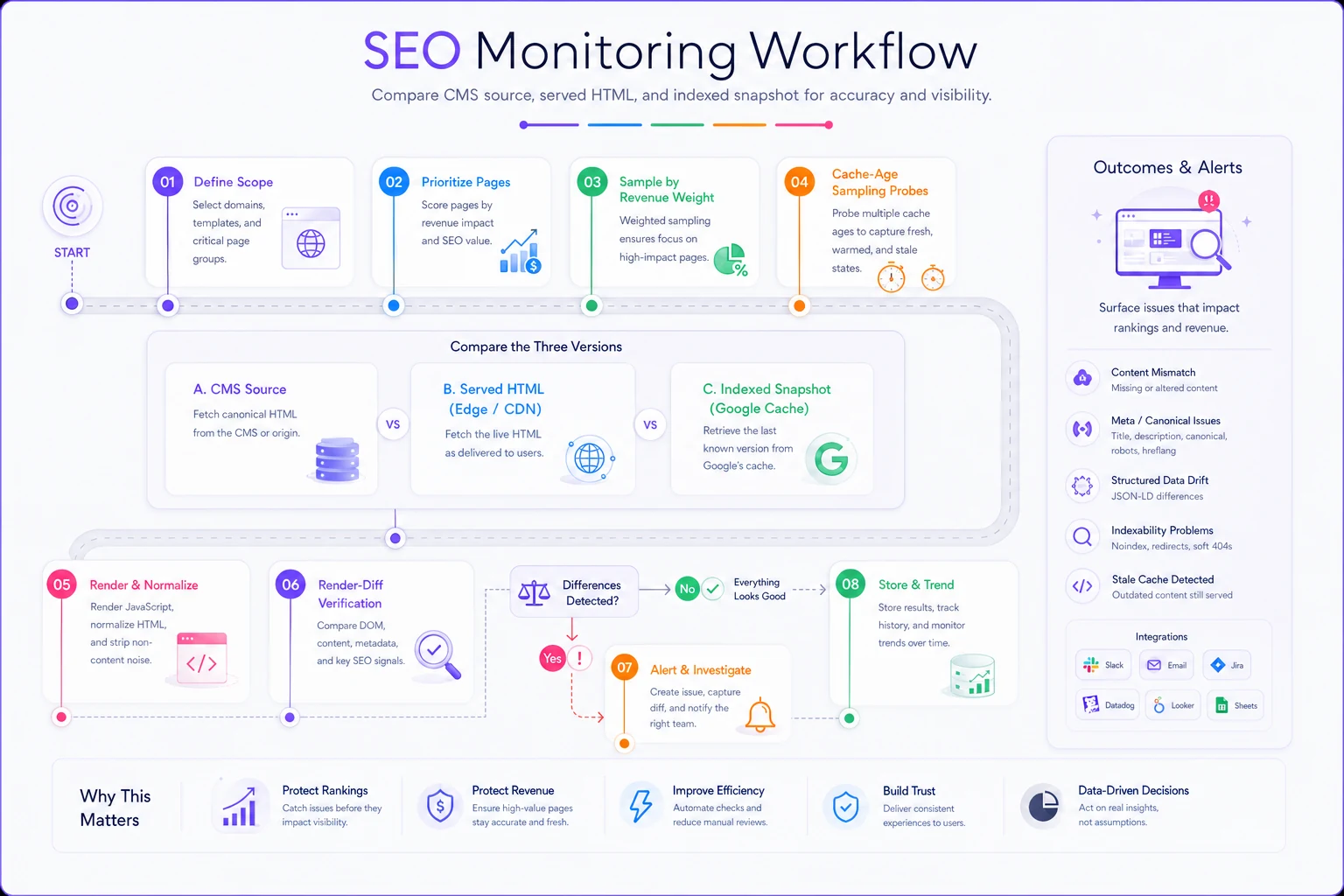
Use revenue-weighted sampling to prioritize checks and escalate to full render diffs only when header-level probes indicate divergence.
Deploy-safe rendering patterns
Deploys are where headless sites take their biggest self-inflicted hits, because a template change touches thousands of pages at once. A bad regex in a canonical tag, a component that stops rendering server-side, a schema field that gets dropped — none of it errors, all of it ships everywhere.
Deploy-safe patterns are about limiting blast radius and catching regressions before full rollout:
-
Render a sample before deploy. Build the new templates against a representative set of real URLs and diff the output HTML against production. Focus on the crawlable payload, canonical, title, meta, and structured data — not visual pixels.
-
Gate on SEO-critical assertions. The deploy fails if primary content disappears from the initial HTML, if canonical or robots directives change unexpectedly, or if structured data validation breaks. These are hard gates, not warnings.
-
Roll out progressively. Ship to a fraction of traffic or a subset of edge nodes first. Watch the monitoring signals — cache age, rendered-HTML diffs, thin-page counts — before going to 100%.
-
Keep rollback fast and rehearsed. You should be able to revert a rendering regression in minutes, not scramble to hotfix. The mechanics of clean rollback and post-launch monitoring overlap heavily with a proper technical SEO migration playbook with rollback criteria.
The failure mode this prevents is partial-rollout skew. Half your edge nodes serve the new template, half serve the old, canonicals disagree, and crawlers get inconsistent signals. It produces confusing, hard-to-reproduce ranking behavior — because the behavior genuinely is inconsistent depending on which node answered.
Sampling rules so monitoring doesn't become the outage
There's a real tension in all of this. Aggressive monitoring — render-diffing, cache probing, snapshot checks — generates load. On a large headless site, careless monitoring can hammer your origin hard enough to degrade the exact pages you're protecting.
Sensible sampling rules:
-
Weight by revenue and traffic, not uniform coverage. Top templates: frequent. Long tail: periodic rotation.
-
Respect origin capacity. Rate-limit render fetches; spread them out; never batch-render thousands of pages during peak hours.
-
Use served HTML where possible. Check the CDN edge before hitting origin, so most probes never touch your app servers.
-
Escalate on divergence. Start with cheap header checks; only trigger expensive full-render diffs when a cheap signal already looks off.
The principle: monitoring should behave like a careful crawler, not a load test. If your observability strategy could plausibly cause an incident, it's not governance, it's a liability.
A real scenario
A mid-sized outdoor-gear retailer moved to a headless stack — React front end, headless CMS, CDN in front. Clean architecture, faster pages, everyone happy for about two months.
Then a category cluster that reliably brought in traffic started sliding. Not a cliff, just a steady drift. The team assumed a seasonal dip. About five weeks in, someone checked the cached version of a top category page and found it rendering an empty product grid — a data-fetch timeout had been silently rendering a fallback "no products" state, and the CDN was caching those fallbacks with 200 status codes.
Roughly 400–500 category and subcategory URLs were affected to varying degrees. The estimated organic revenue drag over that window landed somewhere around $12k–$15k in lost sales before anyone connected the dots.
The fix wasn't glamorous. Fallback states were changed to return 5xx so nothing cacheable got served on a data failure. Cache-age sampling was added on the top ~300 revenue URLs, with an alert when any exceeded its freshness SLA. Render-diffing was wired into deploys for the category and product templates. Within a couple of crawl cycles the empty snapshots aged out and rankings recovered most of the way.
The lasting change was cultural: the team stopped treating "the site is up" as equivalent to "the indexed version is correct." That distinction is what the whole governance model is really trying to install.
When this level of governance makes sense — and when it doesn't
Not every site needs the full apparatus.
This makes sense when:
-
You're on a genuinely decoupled/headless stack with separate rendering and caching layers.
-
Organic search drives meaningful revenue, so stale snapshots cost real money.
-
You deploy template changes frequently enough that regressions are a recurring risk.
-
You have enough page types that a single rendering rule can't cover them all.
This is overkill when:
-
You're a small site on a traditional CMS where content and rendering are tightly coupled.
-
Your traffic and content change slowly and organic isn't a primary channel.
-
You have a handful of pages you can eyeball manually.
Who should not do this yet: teams that haven't nailed the basics — trustworthy analytics joins, clear template ownership, and a working deploy process. Layering render-diffing and sampling on top of a chaotic pipeline just produces alerts nobody trusts. Get the foundation right first, then govern.
A starter checklist
If you're building this out, these are the pieces worth having in place:
-
[ ] Every template classified by page type with an assigned rendering method
-
[ ] Freshness SLA defined per page type (how stale is too stale)
-
[ ] Crawlable payload documented — what must exist in initial HTML with no JS
-
[ ] Fallback/error states return non-200 so they're never cached as valid
-
[ ] Publish events wired to specific, scoped cache invalidations
-
[ ] Post-purge verification that served HTML actually changed
-
[ ] Cache-age sampling on top revenue URLs with SLA-breach alerts
-
[ ] Rendered-HTML diffing against source for key templates
-
[ ] Empty/thin-payload detection in logs and samples
-
[ ] SEO assertions gating deploys (content present, canonical stable, schema valid)
-
[ ] Progressive rollout with monitoring before 100% traffic
-
[ ] Rehearsed, fast rollback for rendering regressions
-
[ ] Sampling rate-limited and revenue-weighted so monitoring never overloads origin
Running through this list periodically is a reasonable substitute for a full governance audit when you don't have the bandwidth for one. It won't catch everything, but it'll surface the gaps that actually hurt.
The uncomfortable truth about headless is that it moves faster than your ability to see what it's serving — unless you build that visibility on purpose. The architecture will happily serve a stale, empty, or skewed version of your most important pages to the exact audience that pays your bills, and it'll return a green 200 the whole time.
Governance is how you take that risk off autopilot. Not by slowing the stack down, but by deciding — deliberately, per page type — how things render, how caches expire, how you verify what's actually indexed, and how you ship changes without betting the quarter on a template diff. Teams that treat rendering and caching as an SEO responsibility, not just an infrastructure detail, are the ones whose traffic doesn't mysteriously erode two months after the shiny replatform.
Ready to elevate your search rankings?
Join 5,000+ businesses using GoSeofy to increase organic traffic, optimize content, and outperform competitors online.