



Most SEO measurement doesn't break because someone picked the wrong attribution model. It breaks quietly, in the gaps between systems — a consent banner change here, a 14‑month retention window expiring there, a URL parameter that means one thing in logs and something else entirely in GA. Six months later someone pulls a revenue‑by‑landing‑page report, the numbers look off, and nobody can explain why the April cohort has a hole in it.
That's a governance problem, not an analytics problem. And it's the part of the stack that almost nobody actually owns.
Privacy constraints made this worse, but they didn't create it. What they did was expose how fragile most measurement setups already were. When you could track everything forever, sloppy identifier handling and undocumented joins were survivable. Now that consent gates, regional data rules, and short retention windows actively delete or withhold rows, the sloppiness shows up as missing data — and missing data in an SEO pipeline looks exactly like a ranking drop or a traffic loss if you're not paying attention.
This piece is about the system that keeps your measurement trustworthy under those constraints: data contracts you can actually enforce, identifier rules that survive privacy stripping, retention and consent trade‑offs you decide on purpose, and a review cadence that catches drift before it poisons a quarter of reporting.
Why measurement quietly rots across most teams
The usual story isn't dramatic. It's a slow accumulation of small, reasonable decisions made by different people who never talked to each other.
Marketing adds UTM parameters for a campaign. Engineering adds a session identifier to server logs for debugging. The analytics team builds a join on URL path to connect GSC query data to GA sessions. Legal shortens the data retention window to comply with a new policy. Each of those is fine on its own. Together, they create a measurement surface where:
-
The URL in GSC is canonicalized, but the URL in your logs still has tracking parameters, so the join silently drops 8–12% of sessions.
-
The GA user identifier disappears for non‑consented traffic, so your "organic conversions" number is actually "organic conversions from consented EU users plus everyone else," and nobody wrote that down.
-
Your log data lives 90 days, GA lives 14 months, and GSC gives you 16 months — so any backward‑looking analysis past 90 days is quietly missing the log layer that let you validate crawl behavior.
None of this gets caught by alerts, because alerts watch for things going to zero. This stuff doesn't go to zero. It goes to slightly wrong, which is far more dangerous because it gets trusted.
Teams with real SEO data observability in place catch some of this through lineage and freshness checks. But observability tells you a pipe broke. Governance tells you what the pipe was supposed to carry, who agreed to that, and what happens when privacy rules force a change. You need both, and most teams only build the first one after they've already been burned.
The core idea: measurement is a contract, not a query
Stop thinking of your GSC/GA/log joins as queries you run. Start thinking of them as contracts between the systems that produce data and the systems that consume it.
Stop losing visibility in search results.
GoSeofy helps you monitor, analyze, and improve your SEO performance with ease.
- Comprehensive keyword tracking
- Backlink quality monitoring
- Real-time SEO performance reports
No credit card required
A data contract, in plain terms, is a written, machine‑checkable agreement about what a dataset contains: the fields, their types, what's allowed to be null, how identifiers are formatted, what privacy class each field falls into, and how long it's kept. If a producer changes something that violates the contract, the pipeline fails loudly before bad data reaches a report — not three weeks later when a VP asks why conversions dropped.
For privacy‑aware SEO measurement specifically, the contract has to carry three things most generic data contracts skip:
-
A privacy class per field — is this field always present, present only with consent, or always pseudonymized?
-
A canonical identifier rule — exactly how a URL or entity is normalized before any join happens.
-
A retention floor and ceiling — the minimum time you need the data for measurement, and the maximum time you're allowed to keep it.
When those three live inside the contract, retention and consent stop being surprises. They become fields you can test.
A minimal contract example
dataset: organiclandingsessions owner: seo-measurement-team description: One row per session landing from organic search identifiers: canonicalurl: type: string rule: canonicalurlv2 # references shared normalization function nullable: false sessionid: type: string privacyclass: pseudonymous nullable: false fields: landingquery: type: string source: gsc privacyclass: aggregateonly # never joined at user level nullable: true consentstate: type: enum[granted, denied, unknown] nullable: false converted: type: boolean privacyclass: consentrequired nullable: true # null when consentstate != granted note: "Null is expected, not an error, for non-consented sessions" retention: floordays: 180 # needed for lagged experiment analysis ceilingdays: 400 # legal max onexpiry: harddelete
The important line is the note on converted. It tells every downstream consumer that a null conversion isn't a data quality failure — it's a privacy outcome. Without that, someone will eventually "fix" the nulls by filling them with zeros, and now your conversion rate is systematically understated and nobody notices for months.
Canonical identifiers: the join problem nobody budgets for
If one thing silently destroys GSC/GA/log joins more than anything else, it's inconsistent URL and entity identifiers. Three systems, three slightly different ways of representing the same page, and your join quietly loses rows.
The fix is boring and absolutely essential: a single canonical normalization function that every system references by name, versioned so you can tell when it changed. Not three implementations that "basically do the same thing." One.
A realistic normalization rule for URLs looks like this:
def canonicalurlv2(rawurl: str) -> str: u = urlparse(rawurl.strip().lower()) # strip tracking + session params, keep meaningful ones keep = {"page", "category", "variant"} query = {k: v for k, v in parse_qs(u.query).items() if k in keep} # normalize: drop trailing slash, force https, drop www host = u.netloc.replace("www.", "") path = u.path.rstrip("/") or "/" return urlunparse(("https", host, path, "", urlencode(query, doseq=True), ""))
The version number in the name (v2) matters more than it looks. When someone eventually decides that variant shouldn't be a canonical dimension, you bump to canonicalurl_v3, and every dataset's contract declares which version it uses. Now a cross‑version join is a visible, catchable mismatch instead of an invisible one.
For entities — products, categories, authors, locations — the same principle applies but the stakes are higher because entity IDs tend to come from multiple source systems. A product might be SKU‑4471 in the catalog, /products/blue-widget in the URL, and bluewidgetv2 in the analytics layer. Without a resolution table mapping all three to one canonical entity ID, your topical and category‑level reporting will never reconcile. If you're building toward entity‑level measurement, this mapping is the foundation everything else sits on.
One pattern worth keeping: store the raw identifier alongside the canonical one. Don't throw away the original. When a join fails, you want to see both the normalized value and what it came from — otherwise debugging a 10% row drop turns into archaeology.
One pattern worth keeping: store the raw identifier alongside the canonical one.
One pattern worth keeping: store the raw identifier alongside the canonical one. Don't throw away the original. When a join fails, you want to see both the normalized value and what it came from — otherwise debugging a 10% row drop turns into archaeology.
Retention and consent: deciding the trade‑offs on purpose
This is where most teams drift, because the decisions get made by whoever touched the system last. Legal shortens retention without telling measurement. Marketing loosens a consent default without telling analytics. Each change ripples into reports nobody re‑validates.
The trade‑off is genuinely real and you can't optimize it away. Longer retention gives you better lagged‑experiment analysis and seasonality baselines. Shorter retention reduces risk and compliance cost. More consented data gives cleaner conversion measurement; aggressive consent gating protects users but widens the gap between what you measure and what actually happened.
The move is to decide these deliberately and write them into the contract, matched to what each analysis actually needs.
| Analysis type | Retention floor needed | Consent sensitivity | Workable approach under constraints |
|---|---|---|---|
| Week‑over‑week ranking/CTR | 90 days | Low (GSC is aggregate) | Full GSC data, no user‑level join needed |
| Landing‑page conversion rate | 120–180 days | High (needs consent) | Model the non‑consented gap; report a consented rate + modeled total |
| Lagged experiment measurement | 180–400 days | Medium | Keep pseudonymous session grain long; drop user grain early |
| Crawl/indexation validation | 60–90 days | None (bot traffic) | Keep logs short; bots aren't privacy‑relevant |
The table makes an uncomfortable point obvious: crawl and indexation data doesn't need long retention or consent handling at all, while conversion data needs the most careful treatment. Treating all your SEO data under one blanket retention policy means you're either over‑keeping bot logs you don't need or under‑keeping conversion grain you do. Splitting retention by analysis purpose is almost always the right call.
Modeling the consent gap instead of ignoring it
When consent gating hides a chunk of conversions, teams either ignore it (and under‑report) or extrapolate blindly (and over‑report). Neither is governance.
-
Observed consented conversions — what you actually saw. Fully defensible, always understated.
-
Modeled total conversions — observed, grossed up by the consent rate for comparable traffic, clearly labeled as modeled.
def modeledconversions(observed, consentrate): # consentrate = share of comparable sessions with consent granted if consentrate < 0.3: return None # too sparse to model honestly return round(observed / consent_rate)
That consent_rate < 0.3 guard is the governance piece. Below some threshold, the modeled number is more fiction than measurement, and the contract should refuse to produce it rather than hand someone a confident wrong answer. The pipeline design work here connects directly to how you structure the underlying tables — the kind of thing covered in building a revenue‑attribution SEO data pipeline with explicit sampling trade‑offs.
An observability cadence built around privacy drift
Standard data observability watches for freshness, volume, and schema changes. Privacy‑aware measurement needs a few extra checks on a deliberate schedule, because the failures here don't trip normal alerts.
A review cadence that catches the specific ways privacy constraints corrupt SEO joins:
-
Daily (automated) Join‑completeness check. For yesterday's data, what percentage of log sessions matched a GSC/GA row after canonicalization? Alert if it drops more than a few points from the trailing 30‑day baseline. A sudden drop usually means a canonicalization or parameter change upstream.
-
Daily (automated) Consent‑mix monitor. Track the share of sessions with
consent_state = granted. A step change here silently shifts every conversion metric even if nothing else moved. -
Weekly (semi‑automated) Null‑pattern review on consent‑required fields. Confirm that nulls still correlate with non‑consent, not with a new pipeline bug masquerading as privacy behavior.
-
Monthly (human) Retention boundary check. Which datasets are approaching their ceiling? Is any backward‑looking report about to lose a data layer it silently depends on?
-
Quarterly (human) Contract review. Walk every contract against current legal/consent reality. This is where you catch the policy change legal made that nobody wired back into measurement.
Sampling rules that don't lie to you
For high‑volume sites, you can't validate every row, so sampling is unavoidable. Naive sampling interacts badly with consent though — if you sample only consented rows because they're complete, you build a validation set that systematically misrepresents your real data.
The rule: sample for validation across the full population including nulls and non‑consented rows. A validation set that's suspiciously clean is a validation set that's lying to you.
def validationsample(rows, target=5000): # stratify by consentstate so the sample mirrors reality strata = groupby(rows, key="consentstate") sample = [] for state, group in strata.items(): share = len(group) / len(rows) sample += random_sample(group, int(target * share)) return sample
Stratifying by consent state keeps the sample honest. If 40% of real traffic is non‑consented, 40% of your validation sample should be too — otherwise your completeness metrics describe a population that doesn't exist.
Here's a visual of the review cadence if it helps to show the team what runs automatically and what needs human touch.
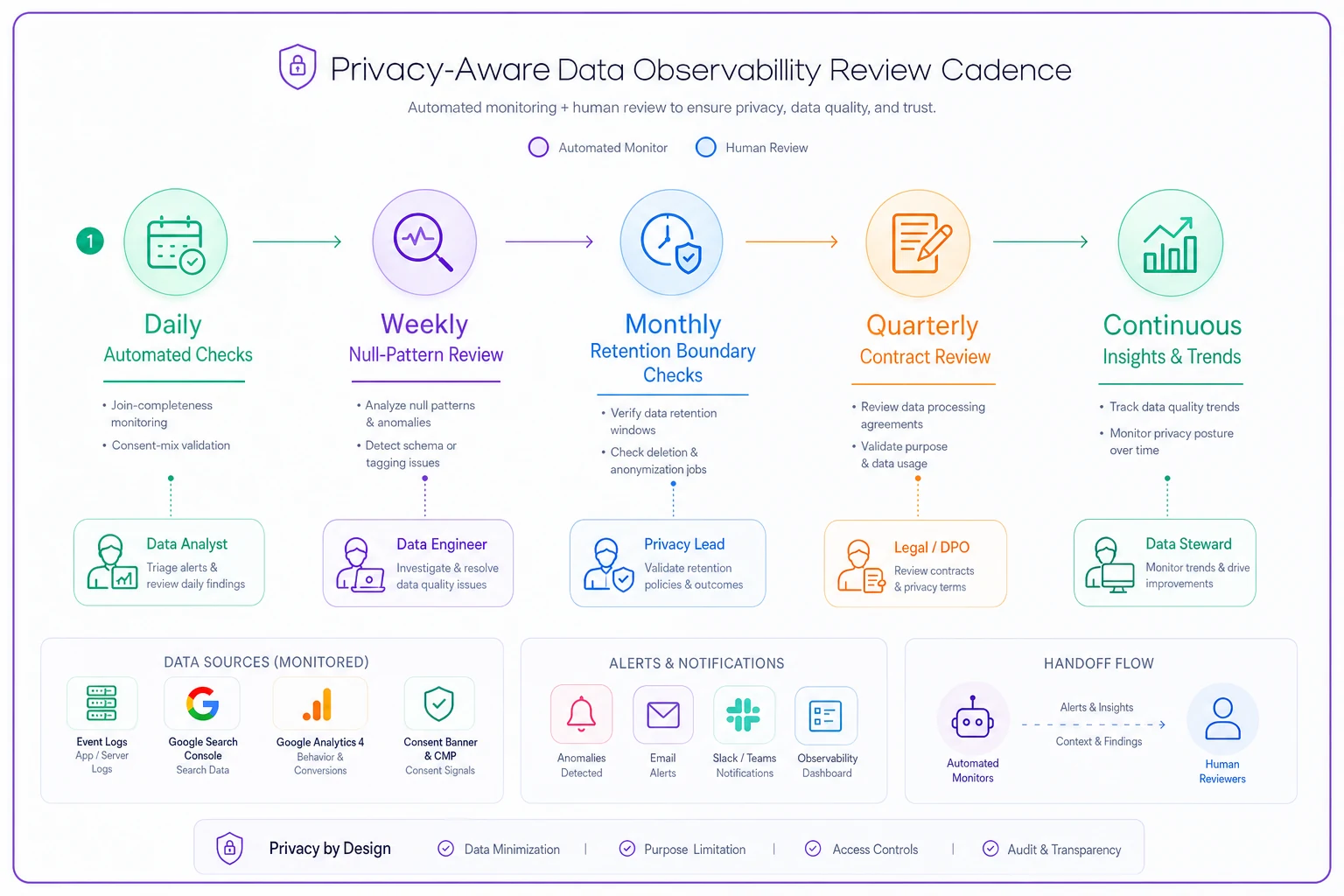
A simple diagram like this makes responsibilities and cadence explicit during onboarding and cross-team reviews.
When this level of governance actually makes sense
Not every site needs formal data contracts and a quarterly contract review. Over‑engineering governance on a small site just burns time you should spend on content and links.
This makes sense when:
-
You join GSC, GA, and server logs for reporting that actual decisions depend on.
-
You operate across regions with different consent regimes.
-
Multiple teams touch the pipeline, so undocumented changes are inevitable.
-
You run lagged experiments where retention length directly limits what you can measure.
This is overkill when:
-
You're a single‑site business reading GSC and GA dashboards directly.
-
Nobody joins these sources programmatically.
-
Your traffic is low enough that a wrong number costs you a bad afternoon, not a bad quarter.
Who should NOT start here: teams that don't yet have basic ownership defined for their datasets. If nobody owns the GA export, writing a data contract for it is building a roof with no walls. Sort ownership first. The platform‑level thinking in a vendor‑agnostic enterprise SEO architecture is the right foundation before layering contracts on top — contracts enforce agreements, but someone has to be accountable for keeping them.
A real scenario: the April hole
A mid‑sized ecommerce operation — a few hundred thousand organic sessions a month across the US and EU — ran a landing‑page conversion report every month to decide where to invest content budget. In the spring, their legal team tightened the EU consent default so that consent was now denied unless explicitly granted. Reasonable change. Nobody told measurement.
The next conversion report showed EU landing pages cratering — conversion rate down roughly 35–40% month over month on key categories. The content team nearly killed two product category expansions based on it. What actually happened: the consent change meant converted was now null for most EU sessions, and the pipeline was treating null as zero. The pages were converting fine. The measurement had changed, not the performance.
Once they moved the consent class into a data contract — null expected for non‑consent, modeled total reported separately, consent‑mix monitored daily — the apparent drop disappeared and a real, smaller seasonal dip (around 6–8%) showed up underneath it, which was the thing actually worth acting on. The cost of not having governance wasn't just a confusing report. It was nearly a six‑figure content decision made on a privacy artifact.
Pulling it together
The teams that measure reliably under privacy constraints aren't the ones with the most data. They're the ones who decided, on purpose, what each dataset contains, how identifiers are normalized, how long data lives, and what a null is supposed to mean — and then wrote those decisions somewhere a pipeline can enforce them.
Privacy rules will keep changing. Consent defaults will keep shifting. Retention windows will keep getting shorter. None of that has to corrupt your measurement if the rules live in contracts you test, identifiers you version, and a review cadence that watches for drift instead of only watching for zeros. The alternative is finding out about every change three weeks late, in a report someone already made a decision from.
Start with one contract for your most‑used join, add the consent class and retention bounds, and wire a daily completeness check against it. That single step catches most of the damage — and it's a far better use of a week than rebuilding attribution after the fact because nobody knew the data quietly changed underneath them.
Ready to elevate your search rankings?
Join 5,000+ businesses using GoSeofy to increase organic traffic, optimize content, and outperform competitors online.